

NYU finance professor Aswath Damodaran has put a number on Anthropic ahead of its IPO, and it lands just under the price range he cites for the offering. In a blog post published October 28, he values Anthropic's equity at $1.475 trillion, which he places "at the lower end of the offer pricing range ($1.5 to $2 trillion)." He also calls the company's share structure "so deviously self-serving that it would put Kim Jong Un to shame." The S-1 does not yet carry a price range. CNBC TV18 describes $1.5 trillion to $2 trillion as the range being discussed for the IPO.
Damodaran wrote the post after Anthropic filed its S-1 prospectus on October 26, a filing he puts at 416 pages. Our earlier walkthrough of the S-1 covers the filing itself. This post covers how Damodaran, who teaches valuation at NYU's Stern School of Business, turns that filing into a price, and where he thinks the risks sit.
What he takes from the prospectus
Damodaran sorts the S-1 into good and bad news for each input to his model.
- Revenue: first-half 2026 revenue was about fourteen times the same period a year earlier ($16.3 billion versus $1.2 billion in Anthropic's S-1 filing). But he notes growth slowed in the third quarter, as OpenAI gained share, compute capacity became a constraint and some enterprises moved to cheaper open-source models.
- Customers: the S-1 counts more than 1,900 customers with $1 million or more of revenue over the trailing twelve months as of September 30, which Damodaran compares with fewer than a hundred a year earlier. The top five customers accounted for about 25% of revenue in the first nine months of 2026.
- Losses: the reported first-half net loss was $80.7 billion, and $72.4 billion of that was a non-cash change in the fair value of convertible notes, derivative liabilities and SAFEs, which the S-1 ties mainly to the rise in its valuation. Damodaran describes it as expensing the conversion option on a convertible bond. He puts the operating loss, corrected for non-cash and one-time charges, at over $8 billion for the six months. The S-1's own figures for the period are an operating loss of $693 million and Adjusted Operating Income of $1.6 billion.
- Costs: compute and infrastructure costs, the biggest expense, fell from 251% of quarterly revenue to 48%, per the S-1. He notes the company claims an operating profit in its most recent quarter. The filing reports $1.0 billion of operating income for the three months ended June 30, 2026.
- Commitments and cash: compute commitments run to hundreds of billions of dollars, which he later puts at "in excess of $600 billion." He puts the cash balance at $114 billion. The S-1 reports $112.4 billion in cash and cash equivalents plus $19.3 billion of short-term investments as of June 30, 2026. He expects about $100 billion more from the offering. He also cites a BB+ bond rating, which the S-1 does not state.
His summary is blunt: the filing is "a snapshot of a young company that is evolving," and reading it for answers about all of AI is like "reviewing a report card for a kindergartner." He also warns readers against conspiracy theories about AI company cabals or accounting fraud.
How he gets to $1.475 trillion
Damodaran builds the value from four story choices, and he invites readers to swap in their own through a downloadable spreadsheet and a shared Google sheet.
- Scale. He assumes AI will displace highly paid white-collar work in some industries, for an end market of $5 trillion or more. With Anthropic aiming at the premium end, plus its stated push into drug development, he thinks revenue could approach $1 trillion by 2036. For context, he writes that Amazon and Walmart sit at around $700 to $750 billion in revenue today.
- Margins. He splits the future market into a price-driven mass segment with margins near 10%, like business services, and a premium segment near 40%, like top enterprise software. A 75/25 premium-to-mass mix gives 32.5%. He then cuts 5 points for regulation, for a target operating margin of 27.5%.
- Reinvestment. He assumes Anthropic must invest about $1 for every $3 of added revenue, because chips age fast and need replacing.
- Risk. He uses a 9.74% cost of capital, against a median of 9.16% for US firms in September 2026. He also assigns a 10% chance of failure, with a loss of half the company's value if that happens.
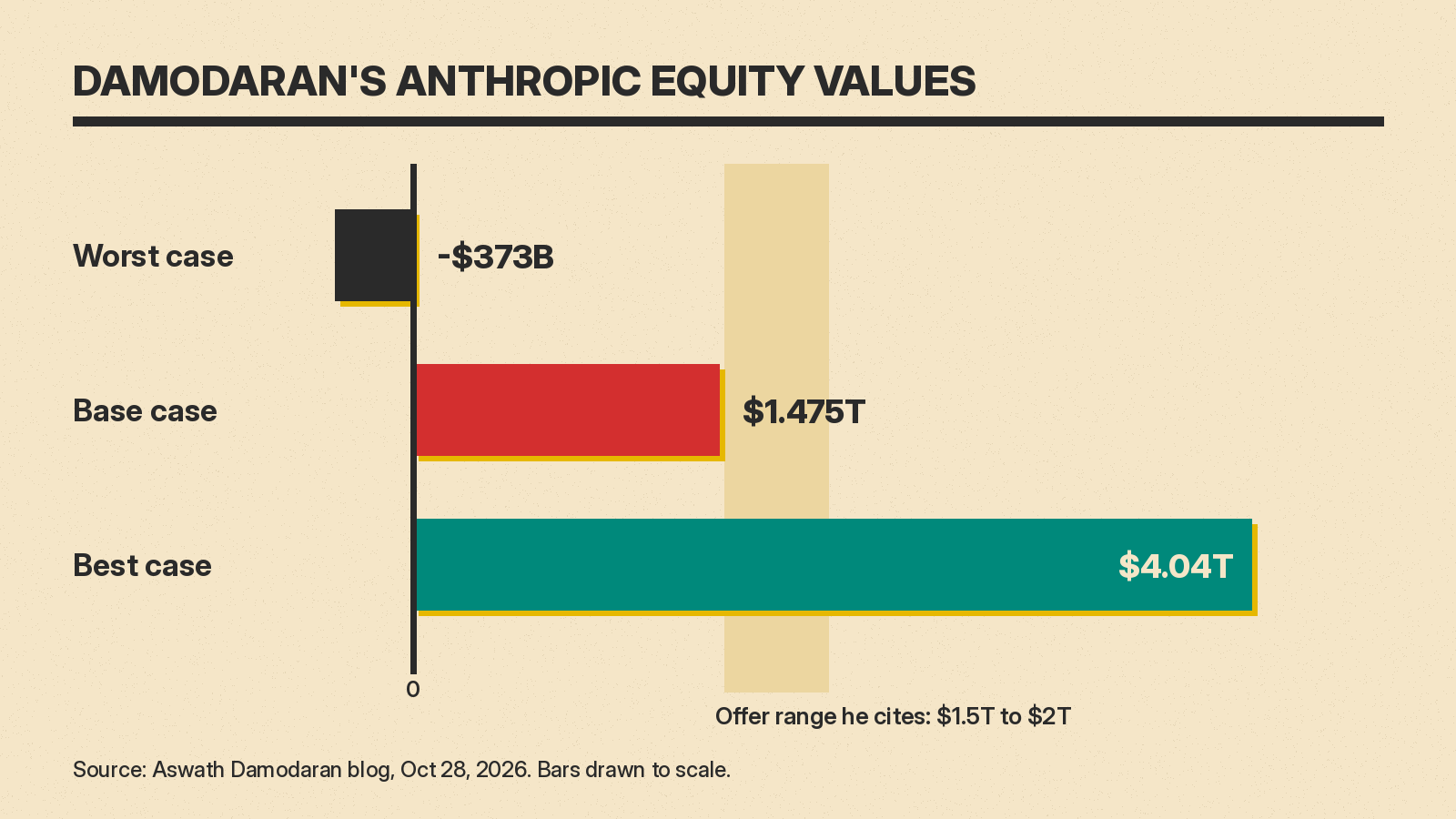
The spread between his scenarios is wide. In his worst case, revenue reaches only $200 billion in 2036, margins settle at 10% and compute stays scarce, and the equity is worth minus $373 billion, meaning the company "will not survive as a going concern." In his best case, revenue hits $1.5 trillion, margins reach 40%, compute gets cheap and the cost of capital falls to 7.79%, for an equity value of $4.04 trillion. He calls both extremes "possible, but unlikely."
The governance problem
The sharper part of the post is about control. Damodaran counts five classes of shares with different voting rights. He writes that with a benefit trust picking the board and the founders controlling 50.1% of the vote no matter how many shares are issued later, the structure "effectively emasculates public investors." CNBC reported the 50.1% founder voting entity when the S-1 was filed. Our explainer on the Long-Term Benefit Trust covers the trust's powers.
He also flags Anthropic's status as a public benefit corporation. He quotes the prospectus saying the company may make decisions that "negatively impact" its performance or share price. His view is that the structure does not protect society from AI risk but "puts power in the hands of the few." He holds shares in Alphabet and Meta, which also have dual-class shares, and says he will not rule out investing on that basis alone.
On lock-ups, he describes the S-1 terms: insiders other than founders and certain major figures may sell up to 10% of their shares on the first trading day, more shares unlock in tranches over 180 days, and founders and named key figures can trade after 365 days. He thinks the market effect of these unlocks will be muted.
What he plans to do
Damodaran repeats his view that almost everyone trading the stock right after the offering will be pricing it, not valuing it. If it prices well above his estimate, he will "sit out the frenzy," and he will not short it, because the market may not agree with him within his time horizon. He points to Facebook: he found it overvalued at $36 at its 2012 IPO and bought three months later at $18. For Anthropic, he says the governance structure "will require a much larger discount on my value estimate."
Why it matters
Damodaran published his full model, so anyone can test his inputs against their own. He calls the cost of capital "among the least critical" of his inputs, and his story leans most on two bets: whether Anthropic's revenue gets near $1 trillion in a decade, and whether its margins end up looking like enterprise software or business services. His worst and best cases, which also change reinvestment, risk and regulation, sit more than $4 trillion apart. He also frames the governance terms as a test of large investors, writing that Anthropic seems to be "daring institutional investors" to either object by skipping the IPO or stay passive, and that it has "already calculated that they will do the latter." For another read on the S-1 numbers, see our opinion piece on why the 85% margin is the wrong number to watch.
Sources
- Aswath Damodaran, "The Anthropic Prospectus Arrives: My (but not the) IPO valuation" (October 28, 2026)
- CNBC TV18: Anthropic could be worth $4 trillion or nothing at all, says Damodaran
- Benzinga: Anthropic's voting structure "would put Kim Jong Un to shame," says Aswath Damodaran
- CNBC: Anthropic IPO filing gives 7 founders 50.1% voting control
- Anthropic, PBC: Form S-1 registration statement (SEC EDGAR, October 26, 2026)
