
Anthropic is preparing for a public listing, and one part of its governance is something Anthropic itself calls "an experiment": a small trust whose members own no Anthropic stock but have appointed a majority of its board. On October 18, the Wall Street Journal's Theo Francis published a look at that body, the Long-Term Benefit Trust, which the paper describes as a "five-person trust empowered to shape its board and block major moves" and about whose dynamics the company "has shared few details."
This explainer covers what the trust is, what powers Anthropic says it has, who sits on it today, and which parts of the WSJ account can be checked against public sources.
What the Long-Term Benefit Trust is
Anthropic first laid out the Long-Term Benefit Trust (LTBT) in a September 2023 post. It describes the trust as "an independent body of five financially disinterested members with an authority to select and remove a portion of our Board that will grow over time (ultimately, a majority of our Board)."
The trust sits on top of Anthropic's status as a Delaware public benefit corporation. Under that status, the stated public benefit purpose in Anthropic's charter is "the responsible development and maintenance of advanced AI for the long-term benefit of humanity," and directors are legally allowed to weigh that purpose alongside stockholder returns.
Anthropic's argument in 2023 was that this was not enough. A public benefit corporation lets directors balance the public interest against profit, but, in the company's words, "it does not make the directors of the corporation directly accountable to other stakeholders." Ordinary stockholders still elect, remove, and can sue directors. The LTBT was designed to add a second constituency that directors answer to.
Some background from the same post:
- An earlier version, called the "Long-Term Benefit Committee," was written into Anthropic's Series A investment documents in 2021.
- The current trust is organized as a "purpose trust" under Delaware common law, with the same purpose as Anthropic.
- The trust "must use its powers to ensure that Anthropic responsibly balances the financial interests of stockholders with the interests of those affected by Anthropic's conduct and our public benefit purpose."
- Anthropic called the structure "an experiment" and said it was "not yet ready to hold this out as an example to emulate."
What powers the trust has
Class T stock and board seats
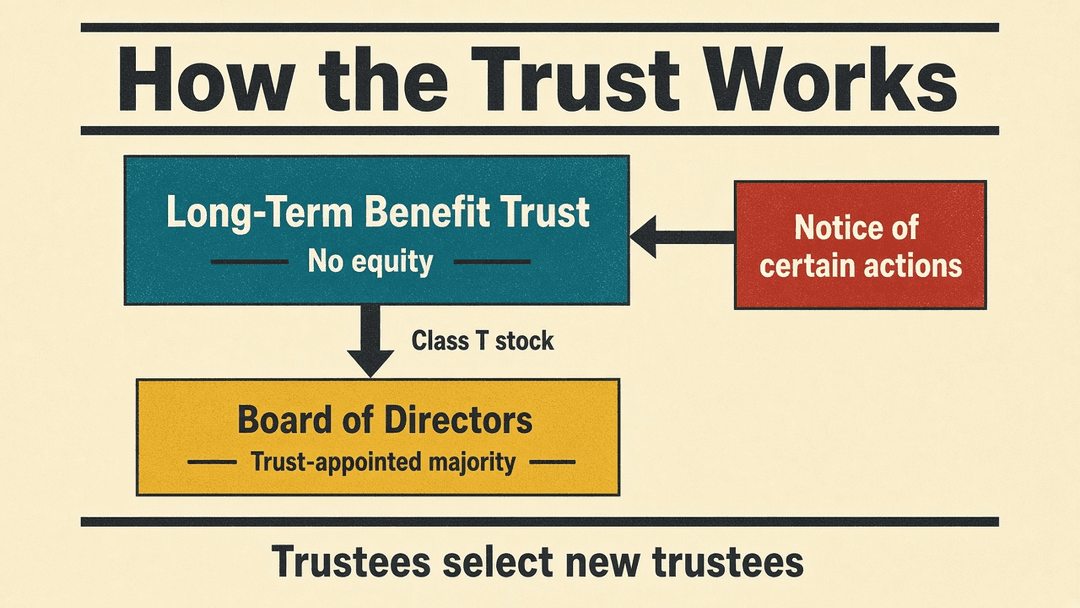
The trust's power runs through a special share class. At the close of its Series C, Anthropic amended its charter "to create a new class of stock (Class T) held exclusively by the Trust." According to the 2023 post, Class T stock "grants the Trust the authority to elect and remove a number of Anthropic's board members that will phase in according to time- and funding-based milestones," and "in any event, the Trust will elect a majority of the board within 4 years."
That milestone has now been reached. When the trust appointed Novartis CEO Vas Narasimhan to the board in April 2026, Anthropic said that "with Narasimhan's appointment, Trust-appointed directors now make up a majority of the Board."
Anthropic has named trust appointments in several board announcements:
- Jay Kreps, co-founder and CEO of Confluent, was appointed by the trust in May 2024.
- Reed Hastings, chairman and co-founder of Netflix, was appointed by the trust in May 2025.
- Vas Narasimhan was appointed by the trust in April 2026.
Protective provisions
The 2023 post also says Class T stock includes "protective provisions" that "require the Trust to receive notice of certain actions that could significantly alter the corporation or its business." Anthropic's description is about notice. The WSJ's framing goes further, describing a trust "empowered to shape its board and block major moves." Anthropic has not published the provisions themselves, so the exact scope of any veto cannot be confirmed from public documents.
What the trust is not supposed to do
Anthropic was explicit that the trust is not meant to run the company. "We do not expect the LTBT to intervene in these day-to-day decisions or in our ordinary commercial strategy," it wrote. Instead, it expects the trust to "primarily concern itself with these long-range issues," such as making sure leadership is incentivized to evaluate future models for catastrophic risks or to have nation-state level security "rather than prioritizing being the first to market above all other objectives."
In its July 2026 announcement of Ben Bernanke's appointment, Anthropic described the role more concretely: the LTBT "has the authority to appoint members to Anthropic's board," and the trustees "advise the board and Anthropic's leadership on critical decisions, particularly those involving the potential risks and societal impacts of AI."
Independence, terms, and how trustees are chosen
From Anthropic's own pages:
- Trustees "hold no equity in Anthropic, don't share in its profits, and are compensated only for their time and service."
- They are "independent of the company's management and investors."
- In 2023, Anthropic said trustees "serve one-year terms" and future trustees "will be elected by a vote of the Trustees."
- In 2026, it said "New Trustees are selected by the existing ones, in consultation with the company."
How the trust can be changed
The trust is not permanent by design. Anthropic's 2023 post says most adjustments would be made "by agreement of the Trustees and Anthropic's Board, or the Trustees and the other stockholders." It also built in "failsafe" provisions that "allow changes to the Trust and its powers without the consent of the Trustees if sufficiently large supermajorities of the stockholders agree." Those required supermajorities "increase as the Trust's power phases in."
Anthropic has not published the supermajority thresholds.
Who sits on the trust now
The WSJ describes a five-member trust, which matches the size Anthropic set out in 2023. Anthropic's current company governance page lists three trustees. Their roles below are as Anthropic's trust announcements describe them:
- Neil Buddy Shah, CEO of the Clinton Health Access Initiative and Chair of the LTBT
- Richard Fontaine, CEO of the Center for a New American Security
- Dr. Ben Bernanke, Distinguished Fellow at the Brookings Institution and former Chair of the Federal Reserve
The trust has turned over almost entirely since 2023. Anthropic's own footnotes on the original LTBT post record the changes:
| Trustee | Joined | Status |
|---|---|---|
| Neil Buddy Shah | Initial trustee (2023) | Current, Chair |
| Jason Matheny | Initial trustee (2023) | Stepped down December 2023 |
| Paul Christiano | Initial trustee (2023) | Stepped down April 2024 |
| Kanika Bahl | Initial trustee (2023) | Stepped down January 2026 |
| Zach Robinson | Initial trustee (2023) | Stepped down January 2026 |
| Richard Fontaine | May 2025 | Current |
| Mariano-Florentino (Tino) Cuéllar | January 2026 | Stepped down August 2026 |
| Ben Bernanke | July 2026 | Current |
The reasons given for departures vary. Matheny stepped down "to preempt any potential conflicts of interest" with RAND Corporation's policy work. Christiano left to become Head of AI Safety at the U.S. AI Safety Institute. Bahl left to start a nonprofit, the AI Access Initiative, and Robinson to focus on nonprofit and philanthropic work.
The most recent change moved a trustee into the company's management. Cuéllar, then President of the Carnegie Endowment for International Peace, joined the trust in January 2026. In August, Anthropic named him its first Chief Global Affairs Officer. The company said he "has stepped down from the Trust to join the company" and that "the Trust will select a successor under its normal process." No successor appears on Anthropic's governance page.
The current board listed on the same page is Dario Amodei, Daniela Amodei, Yasmin Razavi, Reed Hastings, Chris Liddell, and Vas Narasimhan. Jay Kreps, who was listed in the April 2026 Narasimhan announcement, is not on the current list.
What the WSJ adds, and what can be checked
The full WSJ article is paywalled. From the publicly visible headline, summary, and opening of the article, and Techmeme's summary of it, the main points are:
- The trustees own no equity. This matches Anthropic's own statement that trustees hold no equity and do not share in profits.
- The trust is "five-person." This matches the trust's designed size. Anthropic's own pages currently list three trustees.
- The trust can "shape its board." This matches Anthropic's statements about Class T stock and the trust-appointed board majority.
- The trust can "block major moves." This is the WSJ's characterization. Anthropic's public description of the protective provisions covers notice of certain actions, and the provisions have not been published.
- The documents governing the trust have not been disclosed. This is the WSJ's reporting. Anthropic's public pages describe the structure but do not include the trust agreement.
The WSJ also ties the piece to the IPO and to Anthropic's October 18 announcement committing 5% of its shares to a Public Benefit Fund. Anthropic confirms the fund announcement on its own site.
How the trust fits the IPO structure
The trust is one of two layers of control Anthropic plans to keep after listing. As reported by Reuters via CNBC, based on a copy of the IPO filing Reuters reviewed:
- A majority vote of Anthropic's seven co-founders, acting through a Founder LLC, will direct a single share of Class F stock carrying 50.1% of total voting power over key corporate matters.
- Class F and Class A stockholders will elect Dario Amodei, Daniela Amodei, and one director yet to be named.
- The remaining four directors will be elected by the Long-Term Benefit Trust.
- Anthropic will remain a Delaware public benefit corporation.
Anthropic has not published the prospectus, and these details come from Reuters' reporting.
Why it matters
For investors, the trust is a real limit on ordinary shareholder control. Under the plan Reuters describes, public Class A holders vote on three seats alongside the founders' Class F share, which carries 50.1% of total voting power on key matters, and the trust picks the other four.
For the trust itself, the numbers matter. A body designed for five members, with powers that have grown to cover a board majority, currently has three trustees on Anthropic's own list, and those trustees choose their own successors. How it fills its open seats, and whether Anthropic publishes the trust agreement before listing, will say a lot about whether the structure works as a check or mainly as a description.
Sources
- Anthropic: The Long-Term Benefit Trust
- Anthropic: Company (governance, board and trustees)
- Anthropic: Ben Bernanke appointed to Anthropic's Long-Term Benefit Trust
- Anthropic: Tino Cuéllar to join Anthropic as Chief Global Affairs Officer
- Anthropic: Long-Term Benefit Trust appoints Vas Narasimhan to Board of Directors
- Anthropic: Reed Hastings appointed to Anthropic's board of directors
- Anthropic: Jay Kreps appointed to Anthropic's Board of Directors
- Anthropic: Investing in the public benefit
- Wall Street Journal (Theo Francis): What to Know About the Obscure Trust Looming Over Anthropic's IPO
- Techmeme summary of the WSJ article
- CNBC (Reuters): Anthropic leaders to control AI lab to promote public good over market forces
