
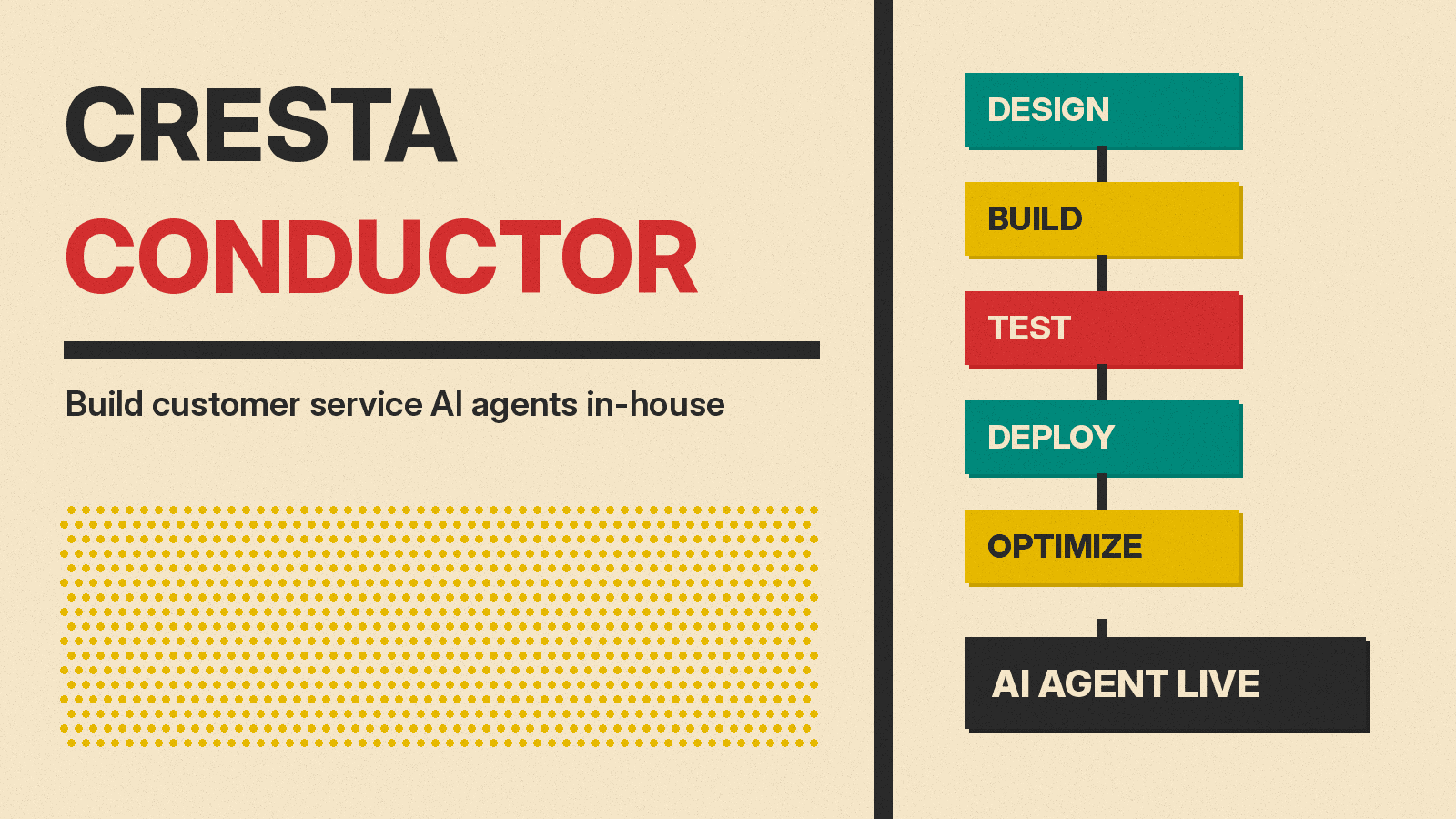
Cresta, which sells AI for customer service, announced on October 29, 2026 that outside developers can now build, test, ship and tune customer-facing AI agents on its platform without Cresta staff doing the work. The press release calls it "end-to-end self-service." The center of it is Cresta Conductor, the tool Cresta's own engineers used to build agents for clients, now handed to customers and partners.
For support leaders, the news is less about a new feature and more about who does the building. Until now, Cresta's forward-deployed teams built agents for large companies. Now a company's own engineers, or an outsourcing partner, can do it with the same tools.
What Cresta announced
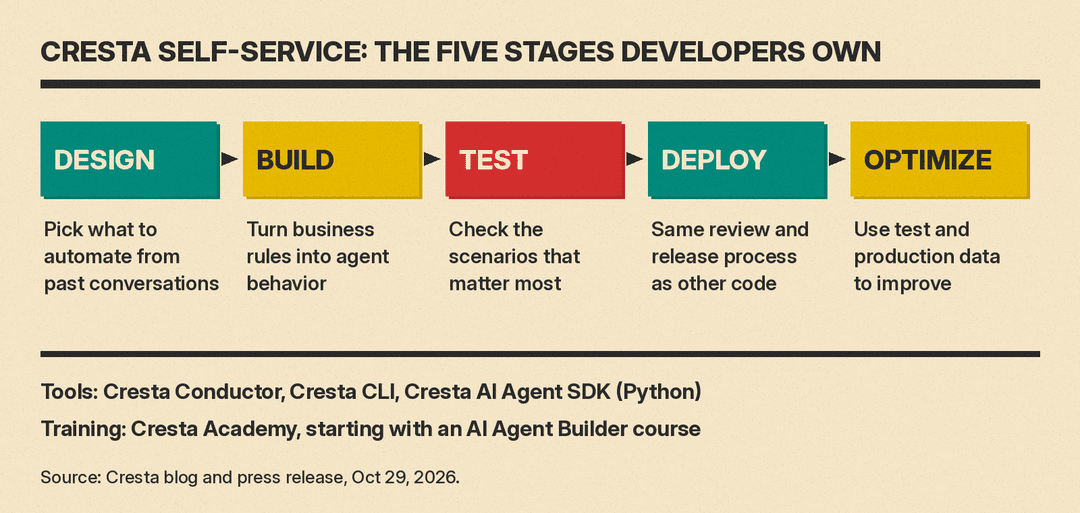
- Self-service for developers. Teams can take an agent from discovery to build, testing, launch and later tuning on their own. Cresta says enterprise developers have gone from first requirements to production "in as little as one week."
- Cresta Conductor and the Cresta CLI. These are the internal tools Cresta's own product managers and engineers use. Cresta says those teams spend "up to 5x less time on custom tools, code, and deployments" with them.
- Cresta AI Agent SDK. Developers write custom code in standard Python to connect agents to their own systems.
- Cresta Academy. A training and certification program for customer and partner engineers, starting with an AI Agent Builder course, available through the Cresta help center.
Conductor is built on Anthropic's Claude Agent SDK, developed with Anthropic. It also supports the open Agent Skills standard, so skills a team already wrote for coding assistants such as Claude Code carry over.
How it fits into normal software work
The pitch is that a customer-facing agent should go through the same process as any other production code. In Cresta's launch blog post, CEO Ping Wu says engineers work from their own IDE, Git and CI/CD pipeline. Agent changes are versioned in Git and reviewed as pull requests.
The release says agent builders often keep agents "in a visual interface outside that process," and that building directly on AI models means creating guardrails, testing and release tooling from scratch. Cresta is betting that engineering teams would rather keep agents in their normal review flow.
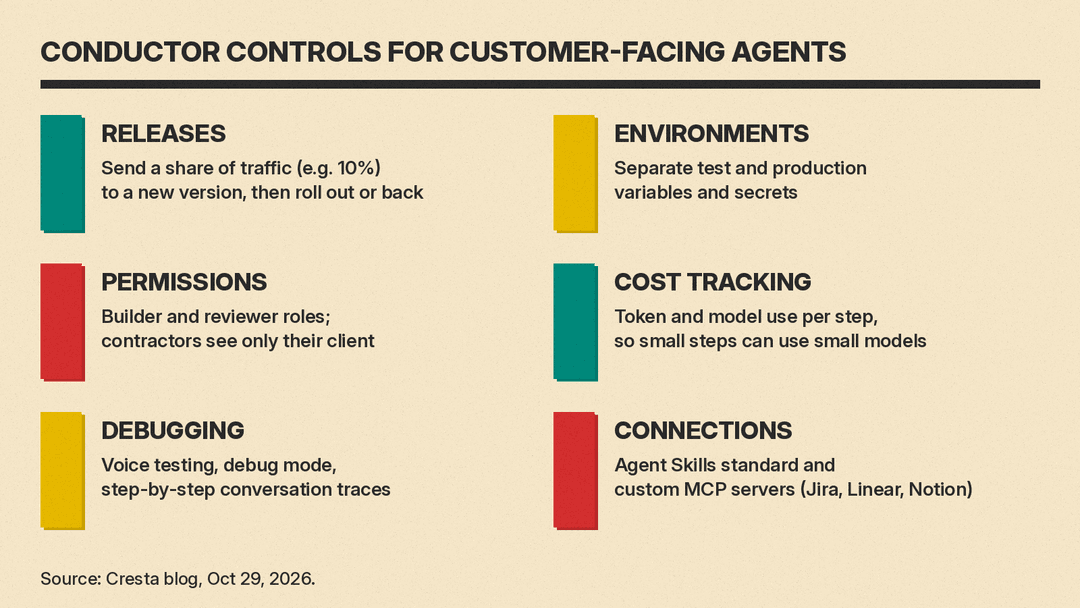
The controls Cresta lists:
- Controlled releases. Send a share of conversations to a new version, A/B test versions, and roll back. Cresta's example: change how a claims agent handles disputed claims, send 10% of calls to the new version, then roll out or roll back based on results.
- Separate environments. Test and production each hold their own variables and secrets, such as API endpoints and keys. Several agents can share one environment.
- Builder and reviewer permissions. These set who can build, review, test and inspect each agent. A contractor working for one client sees only that client's agents.
- Token and model cost tracking per step. Cresta's example is an airline rebooking agent where a simple routing step runs on the same costly reasoning model as the main agent. The developer moves the router to a smaller model and runs evals to check quality.
- Testing and debugging. Turn-by-turn voice testing during the build (latency, interruptions, conversation flow), a debug mode for chat and voice that shows why an agent said something, and step-by-step conversation traces.
- Custom MCP servers. These connect Conductor to tools such as Jira, Linear and Notion.
On compliance, Cresta says it holds SOC 2 Type II, ISO 27001 and ISO 27701 certifications, is PCI DSS and HIPAA compliant, and was the first customer experience AI provider to achieve ISO 42001, the international standard for AI management systems.
Who is already using it
Two outsourcing firms are quoted. Paul Ignasinski, Chief Digital Transformation Officer at Atento, said Conductor "gives our teams a self-serve platform" as Atento builds "an AI agent workforce for our clients." Jamie Timm, Global SVP of Service Delivery and Operations at TELUS Digital, said its engineers started building on Conductor in June.
The release also says a developer at an Australian telecom provider rebuilt a production chat agent, with more than 10 subagents and custom code, from another platform onto Cresta in under a week. In an earlier October post, Cresta said Conductor cuts initial deployment time "roughly in half." All of these figures come from Cresta and its customers, not independent tests.
Why it matters for support teams
For a support team, the hard part of a customer-facing agent is often not the model. Cresta's own list of pain points is about testing, tracing failures, releasing changes safely and knowing what each step costs. Cresta's move packages those parts and lets the company's own engineers own them.
That shifts the build-or-buy question. A support team can still pay for done-for-you work, and Cresta says its forward-deployed engineers remain available at any stage. But teams that already use coding agents can now treat a support agent like other software they ship. Zendesk is moving in a similar direction for internal requests with its employee service AI agents.
What to check before you try it
This is a developer product. If your support team has no engineers, it is not a fit on its own; a partner such as an outsourcing firm or Cresta's own staff would do the build. Questions worth asking:
- Who on your team will own agent code, reviews and releases after launch?
- What share of traffic will you send to a new version first, and what result triggers a rollback?
- Which steps really need a large reasoning model, and which can run on a smaller one?
- Do your existing skills or internal tools connect through Agent Skills or MCP?
Cresta did not publish pricing in the announcement. The release and blog do not say whether self-service changes how Cresta charges.
Sources
- Cresta press release: Cresta Opens Its AI Agent Platform With End-to-End Self-Service for Developers (PR Newswire, Oct 29, 2026)
- Cresta blog: Introducing Our End-to-End Self-Serve Model
- Cresta blog: Bringing AI Agent Development to More Teams with Cresta and Anthropic
- Cresta Academy trainings (Cresta docs)
