
China's AI model makers used the Double 11 shopping festival to sell AI usage quotas. On November 11, Zhipu, MiniMax, Alibaba Cloud and two Alibaba apps put token and subscription packages on sale on Tmall, Alibaba's online mall, at half price or less.
The deals are small in money terms. They matter because they show Chinese labs selling AI access to ordinary shoppers in the same promotion as physical goods, not only to developers through an API console.
What went on sale
Business outlet Yicai reported on November 11 that the discounts sat in the Token top-up center of the Tmall AI Space Station. Per Yicai:
- MiniMax: all three monthly cards at 50% off.
- Alibaba Cloud Token Plan: two monthly cards, from 50% off.
- Zhipu: weekly cards, from 50% off.
- Qwen Office (千问办公) basic membership: monthly card, first month from 30% of the regular price.
- Qoder: monthly card at 33% of the regular price.
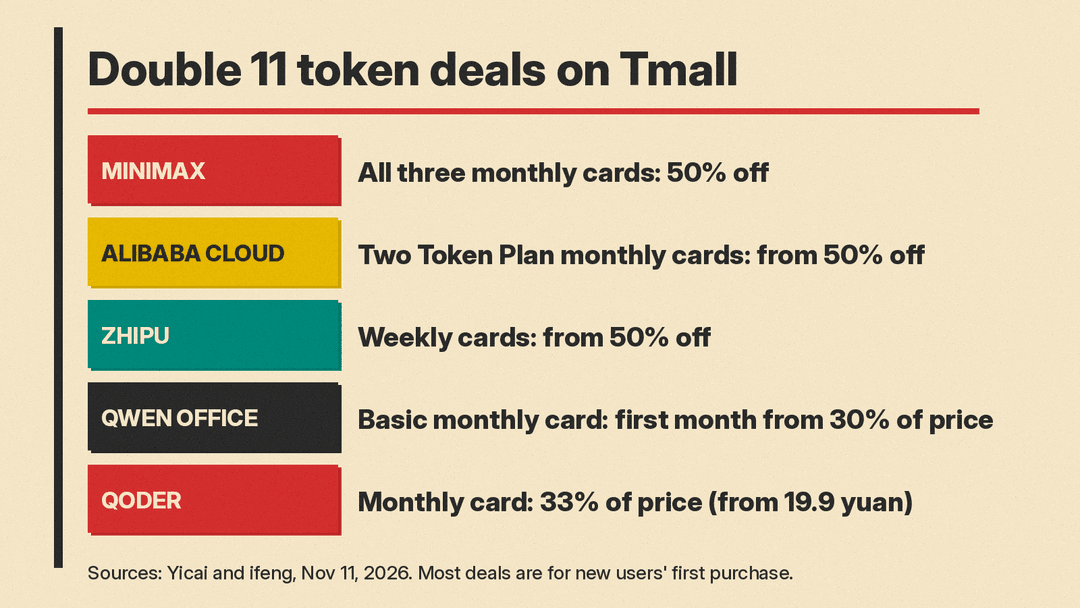
That is five offers. Phoenix New Media (ifeng) reported the same list the same day and said, citing the event page, that the lowest event price was 19.9 yuan, for the Qoder card. Ifeng also said the deals mainly apply to a first purchase by a new user and to specific packages. So most of these are trial offers, not a cut to the price that existing customers pay.
The products cover different uses, per ifeng: model calls through an API, AI office work, and AI coding. Alibaba Cloud's Token Plan is the subscription that, per Alibaba Cloud, is the only way to try Alibaba's Qwen4-Max preview, which runs until November 25 (UTC+8). Qoder is Alibaba's AI coding tool (see also our post on Qwen Code 1.0 Preview).
The store behind it
Tmall opened the AI Space Station, also called the Token top-up center, in September, according to ifeng. The first companies on it were Alibaba Cloud, Zhipu, Kimi maker Moonshot AI and MiniMax. Buyers get either a card code or a direct top-up to their account, ifeng said.
During Double 11, ifeng said, tokens joined the platform's promotion categories alongside physical goods. Tmall is part of Alibaba, so the store also puts Alibaba's own Qwen products next to rival labs such as Zhipu and MiniMax. For background on who these companies are, see our guide to Zhipu's GLM models.
Credits are hard to compare
Five days before the sale, the newspaper IT Times looked at what shoppers actually get for their money. Its report, republished on Jiemian on November 6, said the Tmall station gathers Qwen AI, Zhipu, MiniMax, Qoder and Qwen Office. IT Times said a promotion listed the Qwen AI Lite plan at 39 yuan a month with 11,500 credits, below its 60 yuan official-site price, with Standard at 139 yuan and Pro at 499 yuan a month.
IT Times compared monthly plans on the promotion pages it checked:
- Qwen Office personal standard: 78 yuan a month, 2,000 credits, plus daily login rewards.
- Qoder Pro: about 70 yuan a month, 2,000 credits.
- Tencent WorkBuddy standard: 70 yuan a month, 2,000 base credits plus 2,000 bonus credits.
- ByteDance Coze personal advanced: 89 yuan for the next month's renewal, 99,000 credits a month.
- TeleAgent personal standard: about 69 yuan a month, 3,500 base credits plus 2,500 bonus credits.
The paper's point was that these numbers do not compare. Each platform defines a credit in its own way, and the same platform can charge different amounts for different models and features. It said Coze's 99,000 credits look far larger than the others, but that a cost per credit tells a buyer little about how much work a plan will do.
Expiry rules also differ, per IT Times. Coze subscription credits last one month and separately bought credits last one year. WorkBuddy's paid add-on packs for domestic personal users last one month. Qwen Office's daily bonus credits expire the same day.
IT Times also found complaints. A search on the Black Cat complaints platform for "Qwen credits" and "Coze credits" returned 253 and 238 results, it said, with some about credit use, unfinished tasks, fee details and customer service. One Coze user, named by the paper only by a pseudonym, said three or four video clips of a dozen-plus seconds each used almost 60,000 credits.
Why it matters
The Double 11 deals put AI access in front of consumers, and they use the same tools as any other retail product: a shopping festival, a first-month discount, and a monthly card.
That raises a buyer question the IT Times report makes clear. A token or credit is not a fixed unit of work. Agent apps can split one request into many model calls and retries, so the same task can cost different amounts on different days. A cheap first month helps a lab win a new subscriber. It does not tell that subscriber what a month of real use will cost.
For the labs, the sale tests whether ordinary people will pay for AI usage as a monthly habit. MiniMax, which also released its H3-Image open-weight model this week, sells access to its models through the same store as Alibaba.
We found no published sales figures for the Double 11 token offers as of November 12, 2026.
