
GLM is a family of AI language models. Zhipu AI makes it, and the company uses the name Z.ai outside China. The name also stands for a chatbot, a developer service and model files that anyone can download. This guide explains each one in plain English: who is behind it, what the main models are, what open weights means, how people use it and what to know about privacy. Facts about current models are as of November 2026 and will change as Z.ai releases new versions.
The short answer
- The company. The South China Morning Post (SCMP) described Zhipu AI as a Beijing-based start-up "marketed internationally as Z.ai".
- The models. As of November 2026, the Z.ai documentation lists GLM-5.3, GLM-5.3-Flash and GLM-5.3-FlashX as its featured models.
- The chatbot. The page title of chat.z.ai reads "Z.ai - Advanced AI Chatbot & Agent powered by GLM-5.3-Flash" as of November 2026.
- The weights. Z.ai publishes model files on Hugging Face. The licenses differ by model. The GLM-5.3-Flash card lists the MIT License. The GLM-5.3 card lists its own license, named glm-5.3.
Who is behind GLM and Z.ai
SCMP reported on January 8, 2026 that Zhipu AI was one of three technology companies listing in Hong Kong that day. It called Zhipu a "Beijing-based company". The listing followed an initial public offering (IPO), a first sale of shares to the public. SCMP's report on the listing is the source for the Hong Kong and Beijing details here.
The research papers give a second clue. The GLM-130B paper lists Tsinghua University and Zhipu.AI as affiliations. The ChatGLM report, the GLM-4.5 paper and the GLM-5 paper list Zhipu AI and Tsinghua University.
The Z.ai website and API name a Singapore company as their operator. The Z.ai Terms of Use, last updated April 14, 2026, say Z.ai is "the platform operated by JINGSHENG HENGXING TECHNOLOGY PTE.LTD". The privacy policy gives that company a registered address in Singapore. It does not mention Zhipu AI by name, so this guide does not describe how the two companies are related.
What the name GLM means
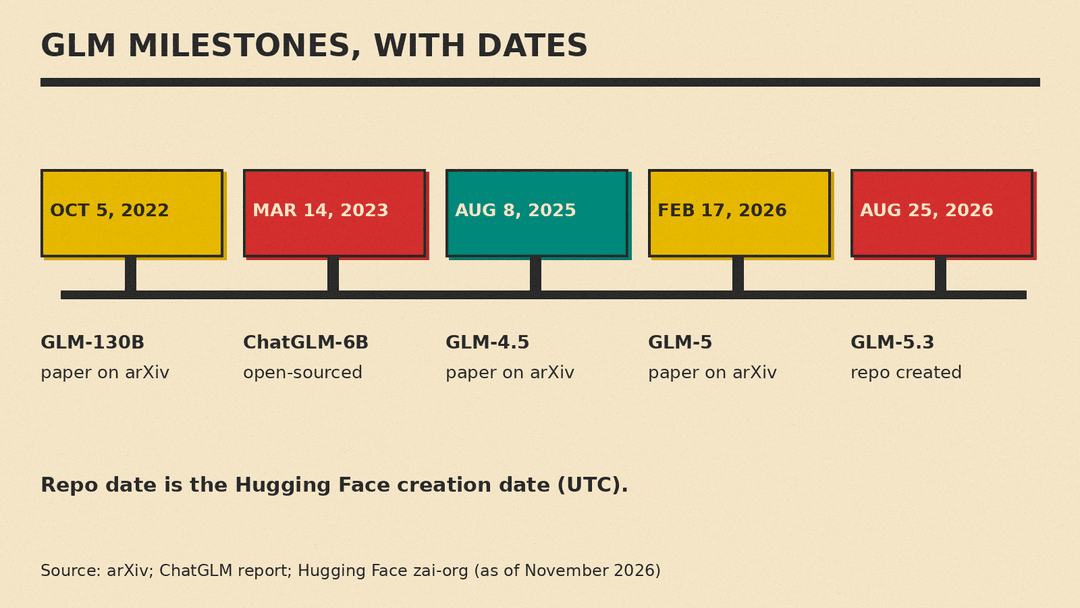
The GLM-130B paper describes the "General Language Model (GLM)" algorithm, which trains a model to fill in blanks in text. The sections below list the main steps, with dates taken from the papers and model pages.
From GLM-130B to GLM-4.5
The GLM-130B paper was submitted to arXiv on October 5, 2022. Its abstract calls GLM-130B "a bilingual (English and Chinese) pre-trained language model with 130 billion parameters". A parameter is one of the learned numbers inside a model. The abstract also says the weights are "publicly accessible".
The ChatGLM report was submitted on June 18, 2024. It says the chat model ChatGLM-130B "went live" on chatglm.cn on March 14, 2023. It says a smaller model, ChatGLM-6B, with 6.2 billion parameters, was open-sourced the same day. The report also says Zhipu's open models drew "over 10 million downloads on Hugging face in the year 2023 alone", which is Zhipu's own figure.
The GLM-4.5 paper was submitted on August 8, 2025. It describes GLM-4.5 as "an open-source Mixture-of-Experts (MoE) large language model with 355B total parameters and 32B activated parameters". A mixture-of-experts model has many specialist parts and uses only some of them for each token, which is a word or a piece of a word. So it can have hundreds of billions of parameters in total and use far fewer at a time. The paper also names a smaller model, GLM-4.5-Air, with 106B parameters.
GLM-5, GLM-5.2 and GLM-5.3
The GLM-5 model card says that, compared with GLM-4.5, GLM-5 scales from 355B parameters (32B active) to 744B parameters (40B active). The card also says GLM-5 "integrates DeepSeek Sparse Attention (DSA)", a technique named for DeepSeek. The GLM-5 paper was submitted on February 17, 2026.
The GLM-5.2 card lists the MIT License. It also describes a "solid 1M-token context". A context window is the amount of text a model can read at once, counted in tokens. One million tokens is the window the card describes.
The GLM-5.3 card says GLM-5.3 "uses the same base model as GLM-5.2" and that "every gain comes from post-training". Post-training is the extra training a model gets after its main training run. Z.ai claims a 50% improvement over GLM-5.2 on its own "Z.ai Code Bench". That is a vendor claim. The repository's metadata on Hugging Face lists 753,329,940,480 parameters in total. The GLM-5.3 documentation says it takes text-only input, has a 1M-token context window and a maximum output length of 128K tokens.
GLM-5.3-Flash
The GLM-5.3-Flash card calls it "the first natively multimodal model in the GLM-5 series", with "320B total parameters and just 18B active parameters". Multimodal means the model accepts more than one kind of input. In the Z.ai docs table, GLM-5.3-Flash and GLM-5.3-FlashX both list English and Chinese and a 1M context. The table describes FlashX as "Delivering inference speeds of 200 tokens/s".
The repository date in the timeline is a Hugging Face creation date in UTC. The cards do not state release dates, so it is not necessarily a launch date.
What GLM is used for
Z.ai's own pages stress coding and agent work. An agent is software that uses an AI model to carry out a multi-step task. GLM-5.3 takes text only, while the GLM-5.3-Flash card calls GLM-5.3-Flash natively multimodal. The docs overview calls GLM-5.3 a "Flagship Model" with "Open-source SOTA coding capabilities". That is Z.ai's description, not an independent ranking.
The same overview lists other products: an image model named GLM-Image, a Slide/Poster Agent in beta, a general-purpose translation agent that supports "40+ languages", and a web search tool.
What open weights means here
A model's weights are the learned numbers that make up the model. When a company publishes them, people can download the model and run it themselves. "Open weights" describes that. It is not the same as open source, because the license decides what you may do with the files.
Z.ai's licenses differ by model. As of November 2026:
- The GLM-5.3-Flash card lists
license: mit, and its LICENSE file is the MIT License. - The GLM-5.2 card lists
license: mit. - The GLM-5.3 card lists
license: otherwith the license name glm-5.3. Its LICENSE file is titled "GLM-5.3 License".
The GLM-5.3 License grants broad rights to use, copy, modify and distribute the files. It adds conditions. Here are the exact words of three passages, from the LICENSE file:
The Licensee's use of the Software must comply with applicable laws and regulations.
"Model as a Service" means giving a third party access to language model inference or fine-tuning (e.g., via API) in a manner that allows such third party to exercise meaningful control over the inputs, parameters, or training data. This does not include (a) end-user products with model capabilities solely embedded within specific features or harnesses, or (b) mere relaying of requests to models hosted by others.
If the Licensee or any of its affiliates operates a Model as a Service business, and the aggregate revenue of the Licensee and its affiliates exceeds 10 billion US dollars (or the equivalent in other currencies) in total over any consecutive 12 months, the Licensee must pass Z.AI's security review before using the Software or its derivative works for any commercial purpose. The scope and method of the security review shall be reasonably determined by Z.AI.
This guide is not legal advice. Read the full file for the model you plan to use, and do not assume one GLM license covers every GLM model.
Three ways people use GLM
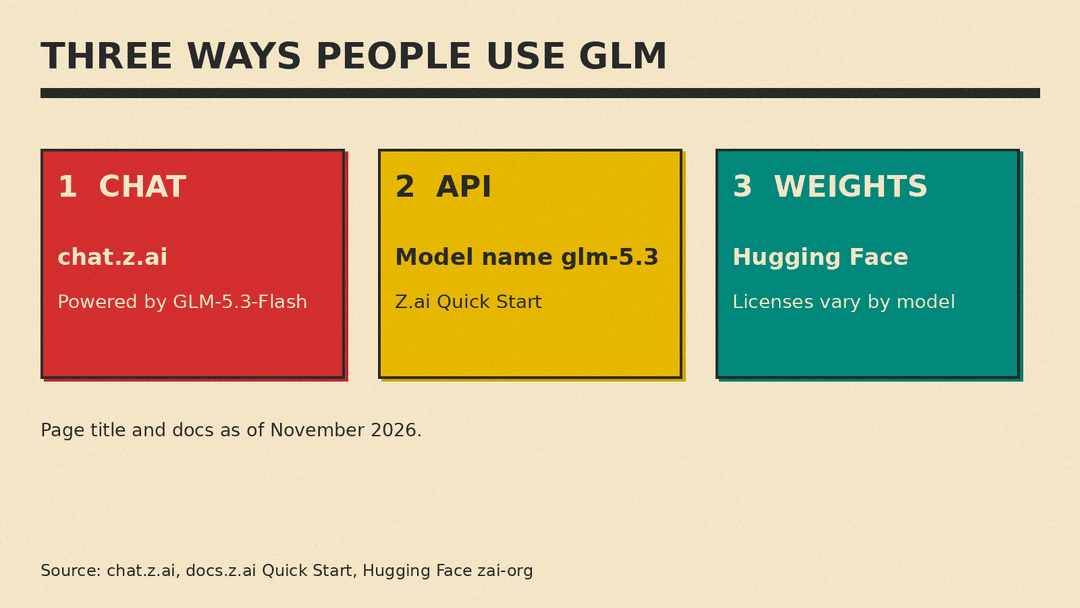
- Chat. Open chat.z.ai. Its page title says GLM-5.3-Flash powers it as of November 2026. See the privacy section below.
- API. An API lets software send requests to a model. The Quick Start says to register on the Z.AI Open Platform, create a Standard API Key and call the chat completions endpoint. Its example uses the model name
glm-5.3. The docs also include a guide for the OpenAI Python SDK. The Quick Start warns that the GLM Coding Plan uses a separate, dedicated endpoint. Prices change, so check the pricing page rather than a blog post. - Weights. Download the files from the zai-org page on Hugging Face. As of November 2026, the zai-org listing includes repositories for GLM-5.3, GLM-5.3-Flash, GLM-5.2, GLM-5.1, GLM-5 and GLM-4.7, along with others named GLM-OCR, GLM-Image and GLM-TTS. The GLM-5.3 card lists serving tools including SGLang, vLLM and Transformers. Check each repository's license and size before you download.
Safety and privacy basics
This section covers Z.ai's own chat and API services. It quotes the privacy policy (last updated September 29, 2025) and the Terms of Use (last updated April 14, 2026). Both can change, so read the current text before you share sensitive information.
- Where data is processed. The policy says: "We generally provide the Services from Singapore, and our group companies and their designated service providers are typically located in Singapore. As a result, your personal data is generally processed in Singapore." It also says personal data "may be transferred and processed outside the jurisdiction in which you reside, including to an affiliated company within the Z.ai Group or a third party".
- Model training. The policy's table lists "To improve and develop our Services and conduct research" as a purpose and gives, as its legal basis, cases "such as when we train and improve our models". The Terms say that for individual users, "we reserve the right to process any User Content to improve our existing Services and/or to develop new products and services".
- API customers. A separate Data Processing Addendum for API Services says: "The Company do not store any of the content the Customer or its End Users provide or generate while using our Services." The same addendum says other customer data is stored temporarily.
- Deleting chats. The policy says you can delete individual conversations, which "will be removed immediately from your conversation history and automatically deleted from our back-end".
- Age. The policy says: "Our Services are not directed to, or intended for, the individual under 18."
- Accuracy. The policy says: "we cannot guarantee the factual accuracy of Outputs". The Terms also bar using Z.ai "as a substitute for professional services", including medical care.
The policy describes Z.ai's own websites, applications and services. If you run downloaded weights yourself, or use another company's hosting, that host's terms apply instead.
How GLM compares with DeepSeek and Qwen
Only sourced facts are listed here, each from a model card as of November 2026. Benchmark scores are left out because they go stale and each lab runs its own tests. The GLM-5.3 card has a table comparing GLM-5.3 with DeepSeek-V4 Pro-0813 and Qwen3.8-Max, among others. Those scores are Z.ai's own.
- License. GLM-5.3-Flash: MIT. GLM-5.3: the glm-5.3 license. DeepSeek-V4.1-Flash: the card says the weights are "licensed under the MIT License". Qwen3.8-27B:
license: apache-2.0. - Size. GLM-5.3-Flash: 320B total and 18B active parameters. DeepSeek-V4.1-Flash: a "multimodal Mixture-of-Experts (MoE) model with 552B backbone parameters". Qwen3.8-27B: 27B parameters in what the card calls a "dense model". A dense model uses all of its parameters for every token.
- Context. GLM-5.3 and GLM-5.3-Flash: 1M in the Z.ai docs. DeepSeek-V4.1-Flash: "contexts of up to one million tokens". Qwen3.8-27B: "262,144 natively and extensible up to 1,000,000 tokens".
The GLM-5 card says GLM-5 uses DeepSeek Sparse Attention, so ideas move between labs. The licenses differ, which makes the license a practical point of comparison. For a wider view of who makes what, read our guide China's AI Labs Explained. For side-by-side comparisons that include other models, see Kimi K3.1 Pro vs DeepSeek V4.1 Flash vs MiniMax M3.1 Flash and Mistral Large 4 vs DeepSeek V4.1 Flash vs Qwen3.8-2.4T-A95B.
Common questions
Is Zhipu AI the same as Z.ai? SCMP describes Zhipu AI as "marketed internationally as Z.ai". The Z.ai terms and privacy policy name a Singapore company as the operator of the Z.ai platform.
Is GLM one model? No. It is a family of models. GLM-130B and ChatGLM are older. As of November 2026, the docs list GLM-5.3 and GLM-5.3-Flash as the latest models.
Can I use GLM for a business? It depends on the model and its license. GLM-5.3-Flash lists the MIT License. GLM-5.3 has the glm-5.3 license, with the extra conditions quoted above.
What does it cost? The licenses cover the weights. Z.ai's hosted chat and API are separate services, and the docs have their own pricing page. Check it for current terms.
Where do I find the latest version? Check the Hugging Face page and the Z.ai docs overview.
Sources
- SCMP: Zhipu AI sees tenfold surge in overseas users as Chinese AI gains traction (Nov 4, 2025)
- SCMP: 3 Chinese tech stocks gain in Hong Kong debuts as investors jump on AI, robotics (Jan 8, 2026)
- Z.ai chat
- Z.ai docs: Models and agents overview
- Z.ai docs: GLM-5.3
- Z.ai docs: Quick Start
- Z.ai docs: Pricing
- Z.ai docs: Privacy Policy and Data Processing Addendum for API Services
- Z.ai docs: Terms of Use
- arXiv: GLM-130B: An Open Bilingual Pre-trained Model (Oct 5, 2022)
- arXiv: ChatGLM: A Family of Large Language Models from GLM-130B to GLM-4 All Tools (Jun 18, 2024)
- arXiv: GLM-4.5: Agentic, Reasoning, and Coding (ARC) Foundation Models (Aug 8, 2025)
- arXiv: GLM-5: from Vibe Coding to Agentic Engineering (Feb 17, 2026)
- Hugging Face: zai-org organization
- Hugging Face: zai-org/GLM-5.3 and its LICENSE file
- Hugging Face: zai-org/GLM-5.3-Flash
- Hugging Face: zai-org/GLM-5.2
- Hugging Face: zai-org/GLM-5
- Hugging Face: deepseek-ai/DeepSeek-V4.1-Flash
- Hugging Face: Qwen/Qwen3.8-27B
