
Alibaba has opened a preview of Qwen Code 1.0, a new version of its open-source terminal coding agent. The release folds the agent harness that Alibaba built for its Qoder coding tool into Qwen Code, so outside developers can run it or build on it. The code is under the Apache 2.0 license. The team says parts of it may still change.
The v1.0.0-preview release appeared on GitHub at 03:55 UTC on Nov 11, 2026 (7:55 PM PT on Nov 10). GitHub marks it as a pre-release. IT之家 (ITHome) reported the same day that Alibaba "officially announced" Qwen Code 1.0 and the merged open-sourcing of Qoder and Qwen Code.
What is Qwen Code 1.0 Preview?
The preview README calls Qwen Code "an open-source coding agent for your terminal." You ask it in plain language to explain code, add features, find problems and run tests. Per the README, you can inspect its changes with /diff, and it shows permission prompts before tool actions.
According to the GitHub release notes, the preview:
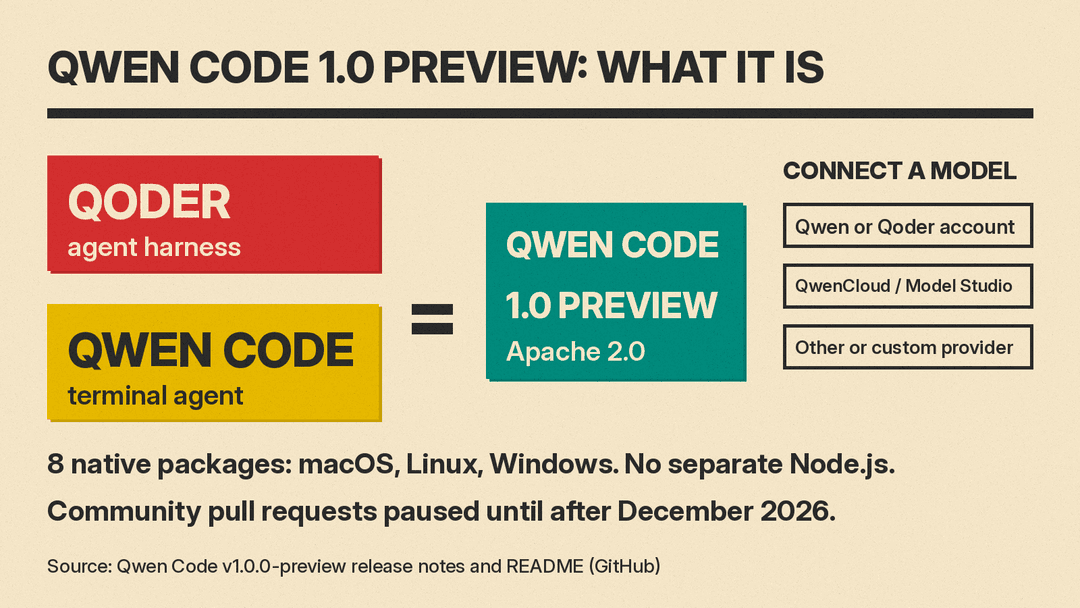
- brings together the agent capabilities of Qoder and Qwen Code for code understanding, implementation, debugging and testing
- supports Qwen and Qoder accounts, multiple model providers, and custom compatible endpoints
- ships native packages for macOS, Linux and Windows that do not need a separate Node.js installation
- supports session resumption and non-interactive runs for scripts and automation
The release page lists 8 download packages: macOS on Apple silicon and Intel, Linux on arm64 and x64 (each also in a musl build), and Windows on arm64 and x64.
What is an agent harness, and what came from Qoder?
ITHome describes a harness as the layer that connects a model, its tools and the execution process. In a coding agent, that covers the tool actions around the model, such as running tests or changing files. Qwen Code shows a permission prompt before such actions.
Per ITHome, Alibaba took the harness it had refined inside Qoder and merged it into Qwen Code, to give developers an agent runtime base they can embed in their own products. ITHome describes the design this way:
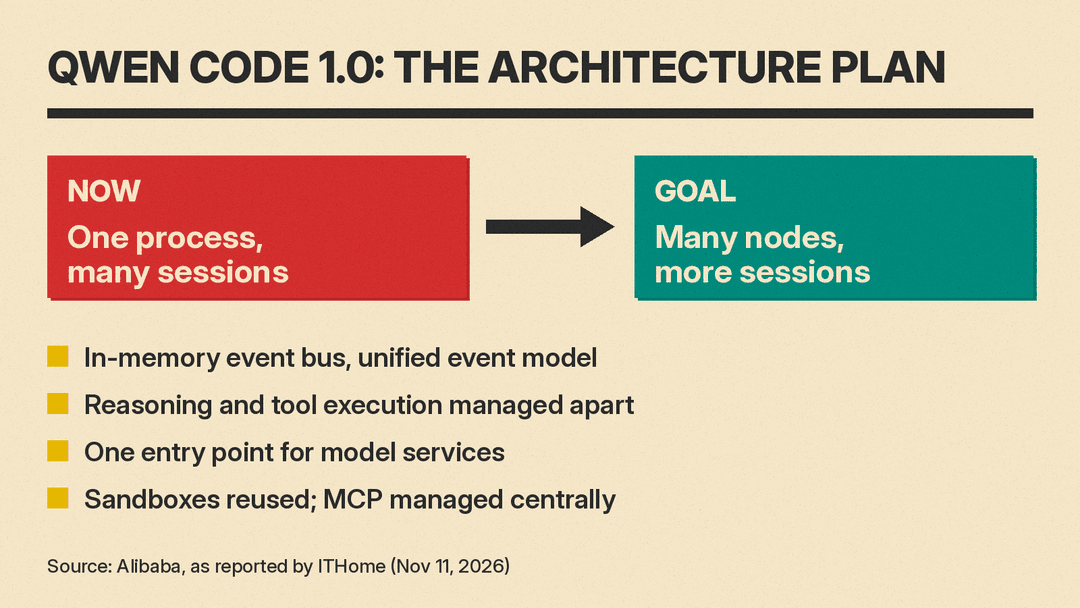
- It starts from an in-process, in-memory event bus and moves along a unified event model toward distributed operation.
- Access, scheduling and execution scale in separate layers.
- A "hand-brain separation" (a literal translation of 手脑分离) manages reasoning orchestration and tool execution apart from each other.
- The goal is to go from "one process, many sessions" to "many nodes, more sessions."
Alibaba said, according to ITHome, that model services connect through one entry point with central configuration, authorization and call records. Sandboxes are allocated and reused inside the same configuration and permission boundary, which Alibaba says cuts repeated setup and idle use. MCP (Model Context Protocol) configuration, authorization and connections are also managed in one place.
How to install and try it
The preview README gives a one-line install script for Linux and macOS (curl) and for Windows (PowerShell). After you install it, open a new terminal, go to your project folder and type qwen.
To connect a model, follow the dialog at startup or type /auth. The README lists three routes:
- a Qwen account or a Qoder account
- QwenCloud or Alibaba Cloud Model Studio, with a plan or an API key
- another provider, or a custom endpoint that uses a compatible API
Then use /model to pick a model and /diff to review changes. qwen --continue reopens your last session, qwen --resume picks an older one, and qwen -p "..." runs a single request without the interactive screen. The README tells users to review permission prompts before they approve tool actions.
The preview is a separate branch. ITHome reported that the existing stable branch stays in place, and the main README still gives install steps for the main version.
What does it cost?
The software is free to download under Apache 2.0. Running it is not always free. The preview README says "model access and service charges depend on the selected provider and account." The main README says users can sign in with a Qwen "Plus or Pro subscription" or set up a provider with an API key. Neither page gives a price for the agent itself.
Alibaba's newest model, the Qwen4-Max preview, launched the same day. It is sold through Alibaba's Token Plan and is also live in Qoder.
Caveats
- It is a preview. The release notes say "Some interfaces, configuration options, and behaviors may change during Preview."
- No outside code for now. The README says the team is "temporarily not accepting community pull requests" and expects to open them "after December 2026." Issues and suggestions are still welcome.
- It has a history. The README says Qwen Code was first based on Google Gemini CLI v0.8.2 and has been developed on its own since v0.1. Per the README, some vendored and upstream-derived parts carry other open-source licenses, listed in its NOTICE file.
Why it matters
Chinese AI labs now ship their own agent software next to their models. DeepSeek runs DeepSeek Harness, and Alibaba has pushed agents into team chat with Qwen Office 2.0. With Qwen Code 1.0, Alibaba puts the harness from a product it sells, Qoder, under an open license that lets other companies embed it.
The project is not new. The repository showed 29,466 stars and 3,366 forks on GitHub as of Nov 11, 2026, 6:50 PM PT. For background on the models behind it, see our explainer on what Qwen is.
