
ElevenLabs has opened Professional Voice Clone fine-tuning for its newest speech models to every workspace. According to the ElevenLabs changelog for November 2, 2026, fine-tuning a Professional Voice Clone (PVC) on Eleven v4 and Eleven v4 Turbo "is now available to every workspace." The same update makes v4 requests use the Clone Strength value saved in a voice's settings, so developers no longer have to pass it on every call.
If you narrate audiobooks, voice ads or run a voice agent on your own cloned voice, this is the point where Eleven v4 becomes a practical option for that voice. Here is what changed, what Clone Strength does, and how to move an existing clone over.
What Eleven v4 is
ElevenLabs released Eleven v4 and Eleven v4 Turbo on September 28, 2026. The company calls Eleven v4 its "latest and most advanced Text to Speech model" and says it improves output quality, voice accuracy, consistency, emotion, delivery, audio tags and language coverage compared with Eleven v3. The model family supports more than 90 languages.
There are two variants:
- Eleven v4 (
eleven_v4) is the highest-quality model, for content creation, audiobooks and character voiceovers. - Eleven v4 Turbo (
eleven_v4_turbo) is built for real-time use such as conversational agents. The September 28 changelog gives it a median inference latency of approximately 100 ms.
Both variants use two voice settings, Stability and Similarity. The Style and Speed sliders are not available in Eleven v4, and SSML is not supported. Delivery is directed with audio tags such as [whispering] or [laughing], which ElevenLabs says are "not perfect yet."
For background on how cloning works in general, see our explainer What Is AI Voice Cloning and How Does It Work?.
Instant clones vs Professional clones
ElevenLabs offers two kinds of clone, and Eleven v4 works with both.
- Instant Voice Clone (IVC): no separate training step. The Eleven v4 docs say you upload a short sample, "generally one to two minutes," and have a usable voice within seconds. ElevenLabs says IVCs received "a significant upgrade" in Eleven v4.
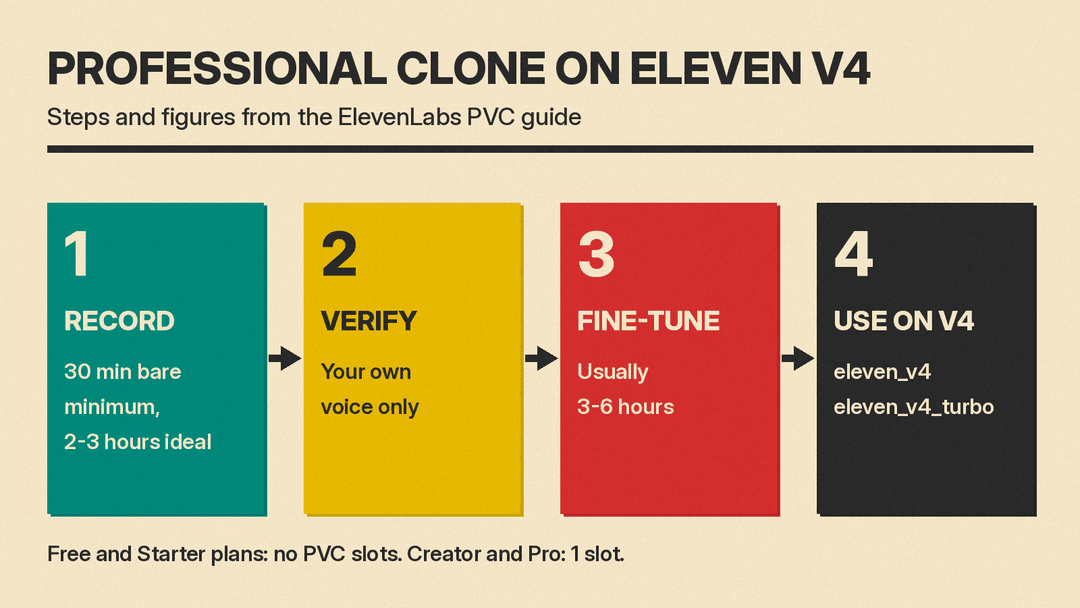
- Professional Voice Clone (PVC): trains a dedicated model on a longer set of recordings. The Professional Voice Cloning guide says fine-tuning usually takes 3 to 6 hours, depending on the queue and other factors, and can sometimes take longer.
PVCs come with rules. You can only create a PVC of your own voice, and ElevenLabs states that "even with their consent, you cannot clone someone else's voice." Every PVC goes through a voice verification step. PVCs do not currently support singing.
They are also tied to your plan. The guide lists no PVC slots on the Free and Starter plans, 1 slot on Creator, Pro and legacy Scale, 3 on Scale and legacy Business, 10 on Business, and a custom number on Enterprise.
What Clone Strength does
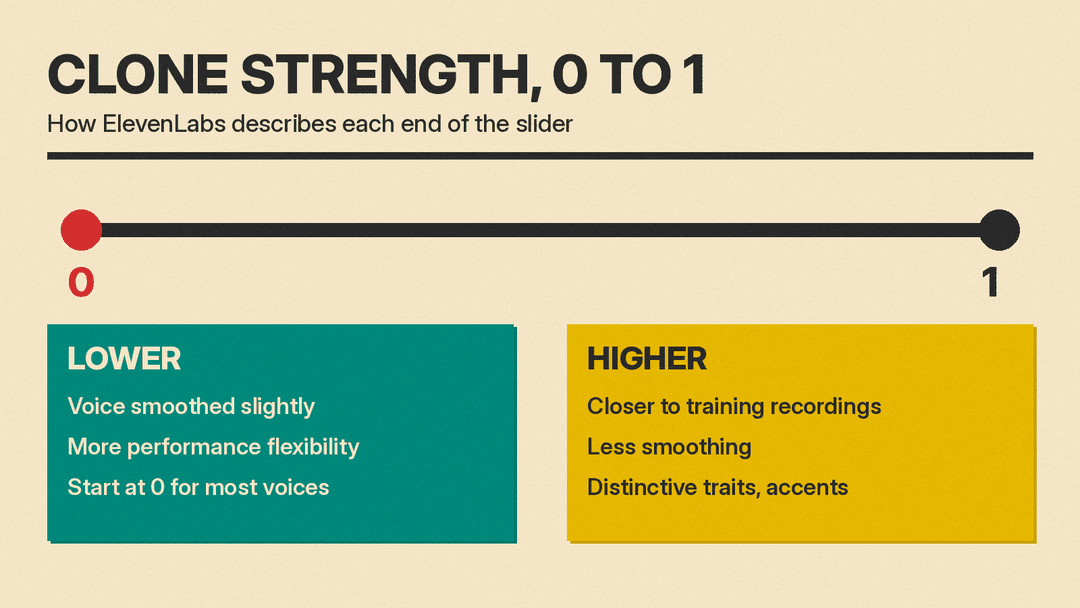
When you pick a PVC and Eleven v4, the voice settings show an extra Clone Strength slider. It controls how closely the output follows the clone's training recordings.
ElevenLabs describes the two ends this way:
- Lower values: "the voice is smoothed slightly and the delivery gains more performance flexibility, which often sounds better overall while still sounding like the original voice."
- Higher values: the output "stays closer to the training recordings with less smoothing," which the docs say "can be especially useful for voices with distinctive traits or unique accents."
The advice for most voices is to start at 0%. For unique accents or traits, the PVC guide suggests raising Clone Strength to 50%. In the API, the October 26 changelog added clone_strength as a value from 0 to 1, set in voice_settings on Create speech or in settings on Create dialogue, and says "the recommended value for most use cases is 0." On the Text to Dialogue endpoints, clone_strength now decides whether a v4 PVC runs as a PVC or an IVC, and the older use_pvc_as_ivc flag is deprecated.
The November 2 update adds one convenience: when a request sets neither clone_strength nor use_pvc_as_ivc, a v4 PVC request uses the Clone Strength saved in the voice's settings.
How to move an existing clone to Eleven v4
The PVC guide says "most Professional Voice Clones will fine tune on Eleven v4 automatically." If yours has not:
- Open My Voices and hover over the voice.
- Models the voice is already fine-tuned on show a tick. Models you can add show a plus.
- Click the plus next to Eleven v4 to start fine-tuning.
- ElevenLabs notifies you in the app and by email when it finishes.
Then test before you switch production audio. ElevenLabs warns that because v4 is more accurate, a clone "may sound substantially different from Eleven v3," and that "accuracy and personal preference are not always the same." It recommends comparing both versions on your own content.
Your recording quality matters more now
Eleven v4 copies the source closely, flaws included. The Eleven v4 page says it reproduces "accent, delivery, loudness, and other distinctive qualities," and the PVC guide adds that it captures "background noise, distortion, and other flaws." ElevenLabs recommends clean audio with a single speaker, and for now a single speaking style in the training audio.
On length, the PVC guide gives two figures. One section recommends "at least an hour of training audio, and ideally as close to three hours as possible." Another calls 30 minutes "the bare minimum" and recommends "closer to 2-3 hours" for the most accurate clone.
One behavior change to know: accents across languages
Eleven v4 handles accents differently from older models. When you generate speech in the same language as the training audio, the accent is kept. When you generate in a different language, Eleven v4 aims for fluent speech in the target language instead of carrying the original accent over. The docs give the example of a Korean speaker's clone producing "natural, fluent English rather than English spoken with a Korean accent."
ElevenLabs calls this "a deliberate change," not a bug, and says it is exploring a toggle but has no timeline. If your project depends on a voice keeping its native accent in another language, test that first. You can try audio tags to guide an accent, but the company says "results may vary."
Why it matters
With this rollout, any workspace with PVC access can fine-tune a clone on both v4 models, and Clone Strength gives a single dial between a smoother, more flexible read and a closer copy of the recordings. For a comparison with other text-to-speech tools, see our guide to the best AI voice generators. For an open-weight alternative, see Audio8-TTS Realistic Air.
ElevenLabs also notes that Eleven v4 "is under active, continuous development" and that its behavior "may shift over time," so it recommends re-testing your use case periodically.
