
OpenAI on November 10 launched Businesses in ChatGPT in beta, a way for companies to claim their business in ChatGPT, manage the details ChatGPT shows about them, and see how people engage with them there, according to the company's announcement. The launch also adds Business Agents, which let a customer chat with a business inside ChatGPT, starting with eligible ecommerce and online service businesses in the U.S.
The move confirms the tool we covered as a test earlier this week in our report on the ChatGPT Business Hub. OpenAI says the products give businesses "a new way to connect with the 1.2 billion people who use ChatGPT each week." An a16z essay dated the same day, which says agents now make up the majority of web traffic, also cites the launch.
What launched
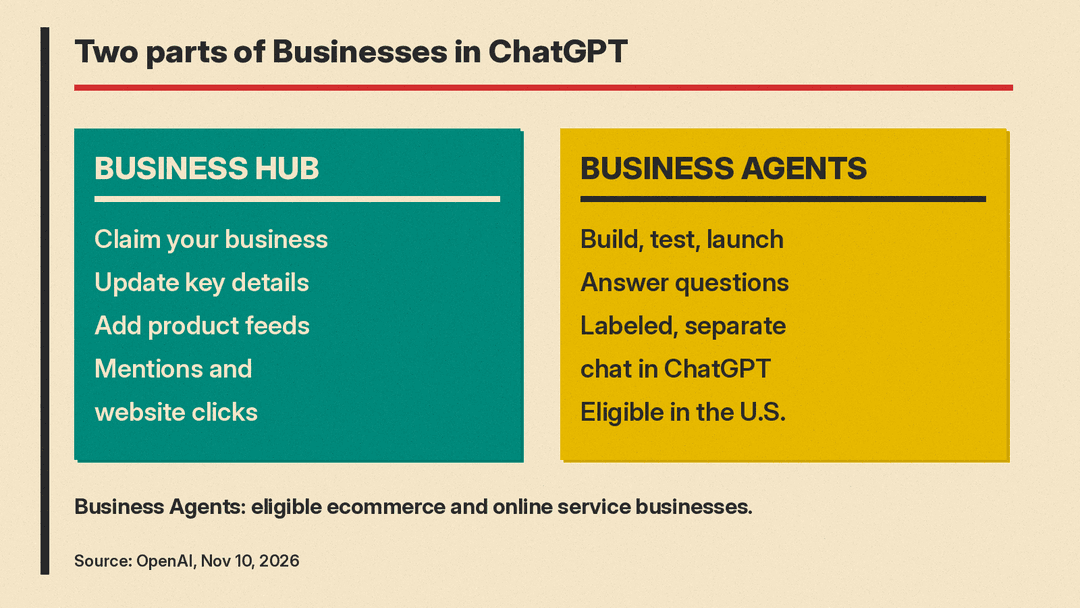
There are two parts.
- Business Hub. Companies can claim their organization in ChatGPT and, once verified, update key details and add self-service product feeds with pricing and availability. Business Hub also shows aggregated insights, including the number of mentions and website clicks a business receives.
- Business Agents. After claiming their business, eligible organizations can build, test, and launch a Business Agent, which OpenAI describes as "a new way to answer questions and help people explore their offerings."
OpenAI calls this "an early step in bringing businesses more deeply into ChatGPT" and says it plans to expand Businesses in ChatGPT and Business Agents to more markets and business categories over time.
Who can claim a business
According to OpenAI's help article, you can claim a business if you own it or are authorized to represent it. You don't need an Ads account or a ChatGPT Enterprise agreement. Availability depends on the business's location and type, and OpenAI's business page says claiming "is initially available to eligible businesses with a website."
Existing OpenAI Enterprise customers and advertisers can work with their OpenAI representative instead. Shopify merchants can connect their store from Business Hub or the Shopify admin to streamline verification.
How claiming works
The help article lays out these steps:
- Sign in to ChatGPT, open Business Hub from the sidebar, and search for your business by name.
- Select the listing that matches your business and confirm the ChatGPT account you'll use to manage it.
- Choose one of the verification methods offered for your business, such as business phone, business email, website domain (a DNS TXT record), or Shopify store.
- Wait for OpenAI to review the claim. It emails you its decision or a request for more information.
- Complete identity verification with Persona. You may need a government-issued ID, business registration information, and proof that you're authorized to represent the business.
Persona approval is required before you can publish changes to your business information, view insights, or create an eligible business agent. The help article says the verified badge, shown as a blue check, appears after Persona verification is approved. Local stores and restaurants can currently claim only an existing U.S. listing.
What the insights show
Insights cover aggregate activity over the past 28 days. The help article defines the metrics:
- Mentions. For an online business, a mention counts when ChatGPT references the business's website. The brand name alone doesn't count. For a local business, it counts when ChatGPT shows a result for that location.
- Website clicks. How often people click through to your website.
- Discovery topics. Common themes in ChatGPT answers that mentioned or cited your business. OpenAI says they don't reveal individual prompts or directly measure customer intent.
OpenAI says, "We don't share users' conversations or Business Agent chats with businesses." Insights only appear when there are enough conversations or interactions to meet certain thresholds, and a blank metric "doesn't necessarily mean zero activity."
How Business Agents work for customers
When a business appears in a ChatGPT answer, people can click to see its ChatGPT profile. If a Business Agent is available, they can choose to start a conversation with it, for example to ask about the differences between two products. OpenAI says the Business Agent conversation is "clearly labeled, separate from the customer's original ChatGPT conversation, and distinct from ChatGPT's independent answers."
There are limits. The help article says agents can't complete purchases, make bookings, or check a customer's order. They explain products and policies and link to the business's website, where customers complete those actions. Under the Business Agents Policy, an agent must be clear that it is AI representing the business, and "business verification alone does not guarantee agent eligibility."
Ads and rankings
Businesses can also sponsor their Business Agent and use it as the destination for ChatGPT Ads. OpenAI says sponsored placements are clearly labeled and separate from ChatGPT responses.
Claiming does not buy visibility. OpenAI's business page says, "Claiming does not guarantee higher placement or sales," and the help article says advertising "doesn't influence ChatGPT's independent answers." ChatGPT may show information about a business whether or not it has an agent, and may also draw on other sources.
Why it matters
ChatGPT already sends people to websites through its answers, as our guide to how ChatGPT search picks sources explains. Business Hub gives companies OpenAI's own counts of their mentions and website clicks, and a way to update the details ChatGPT shows about them. For shoppers, the main change is a labeled chat with a business inside ChatGPT, kept apart from ChatGPT's own answers. It also extends OpenAI's push to sell to companies, after it began selling ChatGPT Enterprise through AWS Marketplace this week.
