
Olivia Moore and Justine Moore published "Welcome to the B2A Economy" on the Andreessen Horowitz website on November 10, 2026. They write, "The primary users of the Internet are no longer human. They're AI agents." The next sentence says agents "now make up the majority of web traffic, write more than half of new articles published online, and generate most of the code pushed to production." The essay cites no data for the claim that agents now make up the majority of web traffic, and it names no source for those three claims. A chart next to them, titled "Bot vs. Human Web Traffic Share," cites NP Digital, Security Magazine, Imperva and Soax. It counts bots in general, not only AI agents, and shows them at 51% of web traffic in 2024 and 2025 and 54% in 2026. The chart labels the 2026 figure a forecast. A second chart, which cites a Graphite study, is titled "AI Now Writes as Many Online Articles as Humans," a weaker claim than "more than half." The essay names no source for the claim about code pushed to production. It is the first in a series the authors plan on the agent economy.
What the named sources measured
Later in the same essay, the authors write that Shopify "reported that AI-driven traffic to its stores grew eightfold year over year in Q1 '26, while orders from AI-powered searches grew nearly thirteenfold."
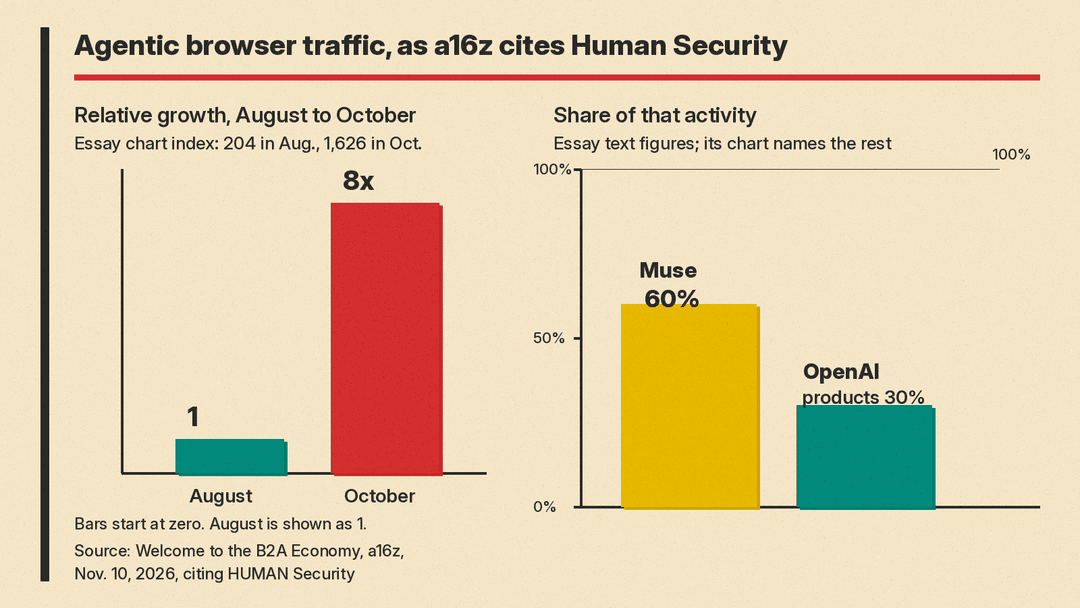
They then write that Human Security "saw agentic browser traffic grow 8x between August and October, with Muse driving the largest share of activity (60%) and OpenAI products reaching a combined 30%." A chart in the essay cites HUMAN Security's State of Agentic Traffic report for October 2026, published November 9, and says the data are observed requests on HUMAN customer sites, including allowed and blocked activity. It gives an index, not absolute counts: 204 in August and 1,626 in October, with February set to 100. The chart puts Meta Muse at 59% of agent requests, and ChatGPT Agent (16%), Codex Browser (8.8%) and the Codex Chrome extension (5.2%) at 30% together. It also names the rest, led by Perplexity Comet at 3.6% and the Claude Chrome extension at 3.5%. These are shares of agent requests on HUMAN customer sites, not shares of all web traffic.
The essay also says "AI-referred consumer traffic is higher engagement and converts better to revenue than non-AI traffic, with a lower bounce rate." A chart in the essay credits that data to Adobe and J.P. Morgan. For July 2026 it shows AI-referred traffic with a 60% higher conversion rate, 53% more revenue per visit and a 34% lower bounce rate than non-AI traffic. The essay separately says, "Even pre-agents, an estimated 11% of shopper journeys in the U.S. visited AI before a transactional site." A chart next to it cites Similarweb and shows 11.4% of U.S. desktop shopper journeys in June 2026.
How the authors say agents browse and shop
"Right now, most of this traffic is happening via browser use," the essay says. The authors describe that as an agent either taking over the user's browser or starting its own virtual machine and browser instance, then completing the task by clicking around the way a person would.
They also describe a second path: connectors, plug-ins, and MCPs (the Model Context Protocol), which they say let agents reach third-party tools and sites more directly. Meta, in an October 26, 2026 post, added six app-setup tools to its Social Technologies MCP server so an agent can create and configure an app, as we covered in our post on Meta's developer MCP. The a16z essay does not discuss Meta's server.
They asked ChatGPT to create and edit a video ad using the Krea, Descript, and Eleven Labs plug-ins. The essay says it "coordinated across the products, and upsold us on a Descript paid plan to get the video done."
They write that signing up or paying will get easier as platforms let a user "lend" their identity or tokens to other products, and they give "Sign in with ChatGPT" as an example. They say agents will eventually be able to select and install tools without human intervention, and that "Claude already allows enterprise admins to connect plugins for their entire organization."
The November 10 essay says "Just yesterday, OpenAI launched Businesses in ChatGPT" and that companies can claim their business, add product feeds, and see insights on how users interact with them on ChatGPT. Our post on Businesses in ChatGPT, citing OpenAI, dates that launch to November 10, not November 9. The two dates do not agree. The essay also refers to "ChatGPT (with 1.2 billion weekly active users)" without naming a source. The same post reports that OpenAI used a similar weekly figure, saying the products give businesses "a new way to connect with the 1.2 billion people who use ChatGPT each week."
The coding agents case study
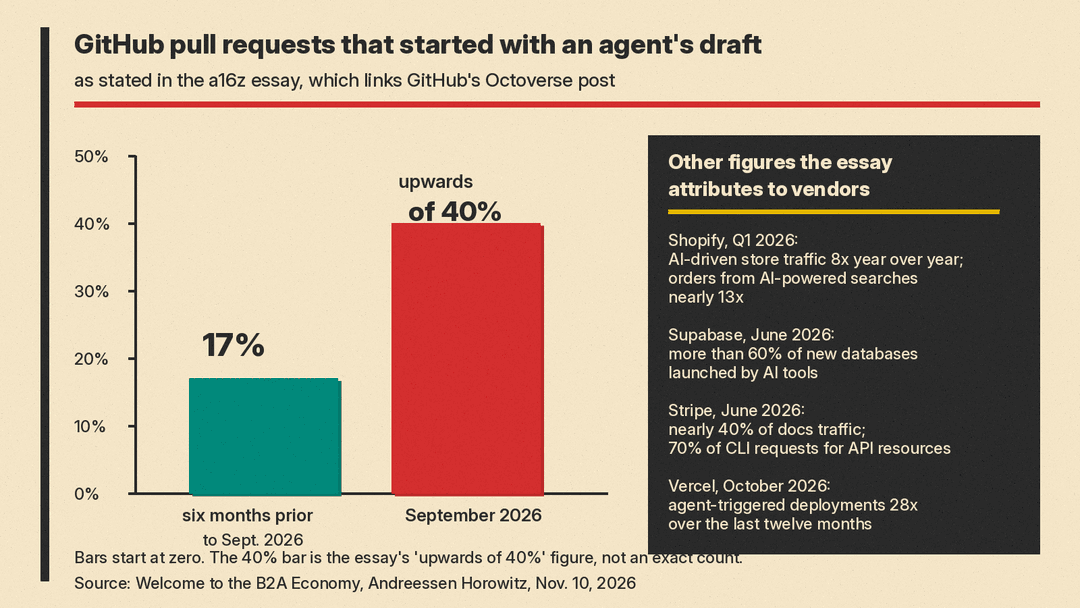
The essay says that as of September 2026, "upwards of 40% of GitHub PRs started with an agent's draft" versus "just 17% six months prior." The essay links that figure to GitHub's Octoverse post, which says more than 40% of pull requests on GitHub started with an agent's first draft by September 2026, up from 17% in March.
They list Cursor, Codex, Claude Code, and Cognition, as well as vibe coding platforms like Replit, Lovable, and Base44. In a separate Nov. 10 blog post, Cursor said Projects "is now multiplayer" and is "rolling out in beta to all users in Cursor starting today," as we covered in our post on Cursor Projects multiplayer. The a16z essay does not discuss that Cursor update.
The essay also attributes these vendor figures and links each one to a company post, without describing how they were measured:
- Supabase reported in June '26 that more than 60% of new databases are launched by AI tools.
- Neon reported in May '25 that automated agents deploy 80% of its new databases.
- Stripe reported in June '26 that agents accounted for nearly 40% of documentation traffic and 70% of CLI requests for API resources.
- Vercel reported in October '26 that agent-triggered deployments had increased 28x over the last twelve months.
"Fewer than 1% of the global workforce is developers" is the essay's wording. It names no source for that share.
What the authors say comes next
They write in the essay that as agents move from answering questions to completing tasks, the agents will increasingly decide which products to use, which services to subscribe to, and where to spend money on a person's behalf. They also write, "Most enterprises are still blocking agent traffic due to concerns about fraud and chargebacks, but we believe they'll have to embrace an increasingly valuable wave." The "we believe" is their forecast, not a measured result.
For a different measure, spend rather than traffic, SemiAnalysis CEO Dylan Patel said on November 11 that persistent agents made up 45% of his firm's AI spend in the week to November 8.
For a view on how far the traffic claim goes, see our opinion piece on why a16z's agent traffic claim needs a source.
Sources
- Welcome to the B2A Economy (Andreessen Horowitz)
- Octoverse: Commits, pushes, reach new highs in 2026 as developers build with agents (GitHub)
- Businesses in ChatGPT: Business Hub and Agents Launch (llms.blog)
- Cursor Projects Goes Multiplayer: Teams Share Agents (llms.blog)
- Meta's Developer MCP Adds Six App Setup Tools for Agents (llms.blog)
