
According to several reports, OpenAI appears to be testing an unannounced analytics feature in ChatGPT that would let businesses see how often the chatbot mentions them and how many clicks reach their websites. The feature has not launched. OpenAI has not announced it, and the company declined to comment when contacted by Digiday.
What OpenAI is reportedly testing
On November 6, Juozas Kaziukėnas, founder of e-commerce research firm Marketplace Pulse, posted a screenshot of a banner for the unreleased feature on LinkedIn after spotting it, according to Digiday. The same day, Barry Schwartz of Search Engine Roundtable reported on the banner and described the tool as one like Google Search Console or Webmaster Tools. The screenshot labels the page "unreleased/beta" and tells businesses: "You'll need to verify that you're authorized to represent your business."
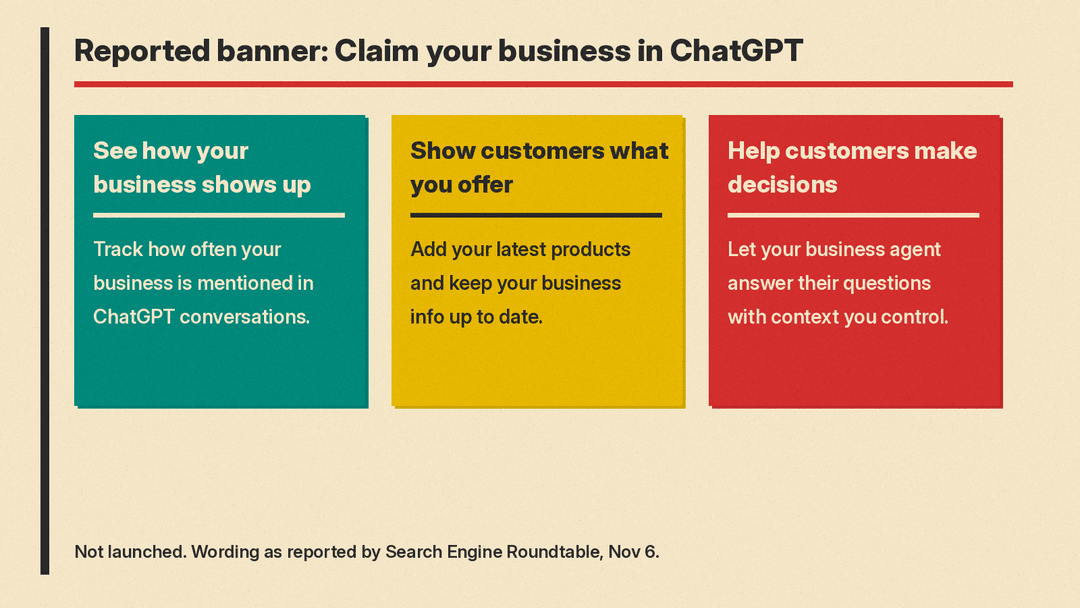
According to Schwartz's report, and as shown in the screenshot, the banner lists three items:
- "See how your business shows up: Track how often your business is mentioned in ChatGPT conversations."
- "Show customers what you offer: Add your latest products and keep your business info up to date."
- "Help customers make decisions: Let your business agent answer their questions with context you control."
In his LinkedIn post, Kaziukėnas said the tool "measures both impressions and clicks: number of times a business appeared in ChatGPT responses and number of clicks on links to their website. It tracks those events daily and shows them as a chart." He wrote that "the feature is a work in progress" and that he saw "its first steps as early as August." He described it as part of a larger Business Hub feature, available only to businesses that have verified their ownership, for example by connecting a Shopify store.
What the dashboard would show, and what it leaves out
Based on Kaziukėnas's account, the chart would track two things daily: the number of times a business appeared in ChatGPT responses, and clicks on links to that business's website. The banner also references a business agent. According to Digiday, claiming a business unlocks what OpenAI calls a business agent that answers customer questions. Digiday's two sources describe the same daily log of impressions and clicks on a chart.
Kaziukėnas said the tool does not show prompts, user data, or any kind of competition benchmark or ranking. "So it won't help understanding why mentions/clicks are increasing or decreasing," he wrote. In his assessment, combined with external tools that track prompts, it "will show accurate first-party data if GEO/AEO strategies are working," meaning generative engine optimization and answer engine optimization. For background, see our guides to how ChatGPT search picks its sources and citations and using AI for SEO.
Kaziukėnas also wrote that the feature "seems to be getting close to launch" because of the banner. That is his inference, not a statement from OpenAI.
Who could claim a business
Digiday reported on November 9, in an article by Krystal Scanlon, that, according to two separate sources with knowledge of its workings, the banner asks businesses to "Claim your business in ChatGPT." According to that report, getting in requires proof of authority to represent the business.
Kaziukėnas gave connecting a Shopify store as one example of how a business verifies ownership. That leaves questions open. PPC Land noted it is unclear whether a publisher or a service business without an online store could verify at all. It also listed as unknown how an appearance in a response is defined and how clicks are attributed.
Why it matters for ChatGPT ads
Schwartz wrote that the tool seems separate from ChatGPT ads and aimed at organic answers. Digiday made the case that OpenAI's ads business could still gain the most from it, because marketers who see a daily visibility number will want that number to rise. Digiday compared it to two Google products, Business Profile listings and Search Console, which in its view made it easier for Google's sales teams to sell ads to those businesses. That is Digiday's analysis, not a statement from OpenAI.
The advertising context is already moving. According to Digiday, OpenAI has a self-serve ads manager and a measurement pixel. ChatGPT ads started as a U.S. test in February. OpenAI has since said ads passed a $1 billion annualized revenue run rate less than 200 days after launch, and on October 21 it said more than 100,000 advertisers had run campaigns as ads expanded to 89 countries. Those are OpenAI's own figures, reported by Digiday and in our coverage of the 89-country expansion.
A claimed listing plus a mention and click dashboard would also touch the GEO vendor market. Per Digiday, GEO vendors such as Profound and Adthena estimate a brand's ChatGPT visibility, mostly by sending large numbers of prompts to the chatbot. Digiday noted that none of them has OpenAI's own counts. Kaziukėnas sees the two as complementary: outside tools for the prompts, and OpenAI's first-party numbers for whether GEO work is paying off.
What we still don't know
OpenAI has not confirmed a name, launch date or markets for the feature, according to PPC Land. The reported details rest on a screenshot, one LinkedIn post, and anonymous sources cited by Digiday. The product could change before any release. OpenAI declined to comment to Digiday.
