
AWS has released AWS Emulator, a local stand-in for Amazon Web Services that runs on a developer's own machine. AWS says the code was written entirely by autonomous AI agents.
"The emulator was written entirely by autonomous agents. Our team hasn't written or reviewed any of the code," Matthew Goldberg, a senior principal engineer at AWS, wrote in a post on About Amazon on November 11.
What AWS Emulator does
According to the AWS News Blog launch post, AWS Emulator is a local emulator that the AWS CLI, the AWS SDKs and coding agents talk to over a local HTTPS endpoint, "using the same AWS APIs they would use in the cloud, from your laptop."
The workflow, as AWS describes it:
- You start the emulator and set environment variables so your tools point at it instead of AWS. Your application code stays unchanged.
- It creates its own credentials on start. Its access key IDs start with
EMULATOR, and it rejects requests signed with any other keys. - It serves HTTPS on
127.0.0.1:9297, so by default only your own computer can reach it.
AWS says the emulator is written in Rust "so that it stays light on CPU and memory on a laptop," and is built from the same API models the AWS SDKs use, so requests and errors have the same shape as on AWS. An operation that is not implemented yet returns HTTP 501. An embedded test mode is available for the AWS SDK for Rust.
On Linux it installs from RPM or Debian packages. On macOS and Windows you build a Docker image from a short Dockerfile in the documentation; AWS says it does not publish a ready-made image. The source is on GitHub.
The New Stack reports that the current version supports 438 public AWS API models covering more than 200 services. It quotes Tom "Spot" Callaway, a principal open source software strategist at AWS: "There's no AI inside of AWS Emulator."
Price
The AWS News Blog says AWS Emulator "has no additional service fee. You pay only for AWS resources when you deploy on AWS." AWS calls the emulator generally available.
How the agents built it
Goldberg writes that the project began as a weekend experiment, after Anthropic researchers showed AI agents could build a C compiler. He gave Kiro, AWS's agentic coding tool, a three-step prompt: write tests based on the AWS CLI, iterate until they pass against real AWS, then build an in-memory implementation that passes the same tests. He says Kiro returned "a passable first version" of Amazon SQS after 15 minutes, and that he had it build the rest of AWS over the weekend. "It obviously had gaps," he writes, but his team started using it the next Monday.
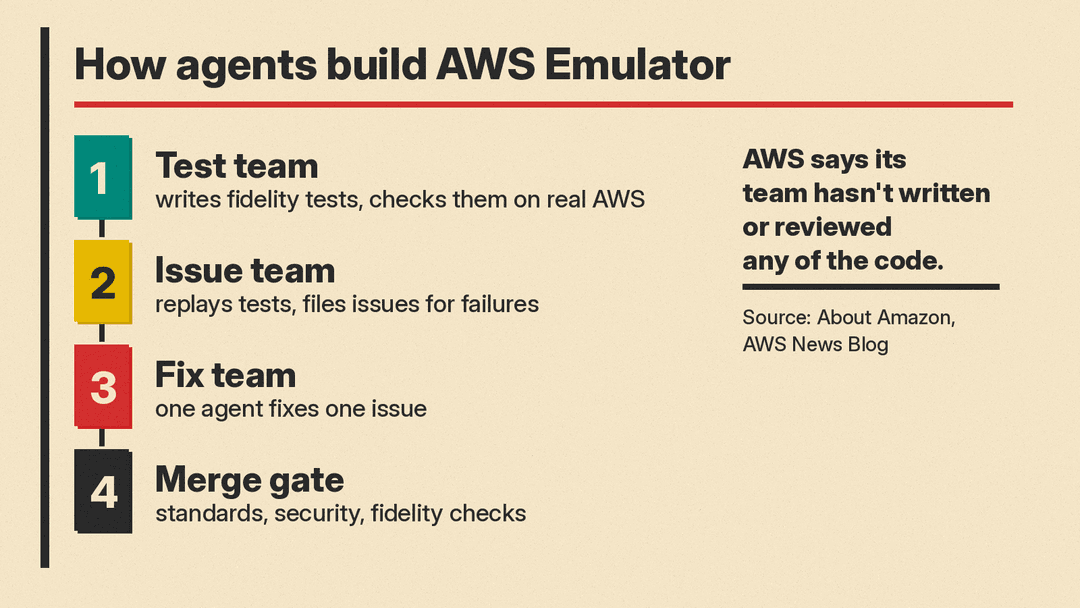
The product version, per Goldberg's post, is built by three teams of agents:
- Test team. Writes fidelity tests (real AWS scenarios) from public API models and checks each against real AWS. Goldberg says there are "tens of thousands of fidelity tests across all of AWS."
- Issue team. Replays those tests against the emulator, files issues for failures and groups failures that may share a root cause.
- Fix team. One agent takes one issue, finds the cause and changes the code.
Every change then goes through a merge gate that blocks code that does not compile and includes agents that review coding standards, security and fidelity regressions. He writes: "We've seen thousands of issues fixed every day as hundreds of agents concurrently work on the codebase."
The AWS News Blog adds that the agents run on Amazon Bedrock AgentCore Runtime instances with AWS CodePipeline and AWS CodeCommit, and that "an independent security agent reviews changes adversarially" during the fix and again in the release pipeline.
For background, see our explainers on what a coding agent is and on AI agent permissions and approvals.
For what developers said about the launch on Hacker News and X, see our roundup of AWS Emulator reactions.
Fidelity scores and the public backlog
AWS publishes how many fidelity tests pass for each service, as "k of n," with each release. The tests, including failing ones, are public in the aws-emulator-evaluation-suite repository. The fidelity page in the docs explains how to read the scores.
Goldberg writes that every issue the agents file is in the repository: fixed ones under "issues/things-that-now-work" and open ones under "issues/things-that-do-not-work." He recalls an earlier version of the agents that "decided to build their own Python interpreter" for AWS Lambda functions.
The code is released under the Creative Commons CC0 public domain dedication, except code in the repository's vendor/ directory, which is under the Apache License 2.0, according to the GitHub README. The New Stack reports that AWS was not sure it could copyright the agents' work, and quotes Callaway: "We're not going to take pull requests on the project at all." AWS will take issues instead.
Limits AWS lists
AWS lists these limits at launch:
- It does not evaluate IAM policies and resource-based policies the way AWS does, so "a request that AWS denies might succeed in the emulator." AWS says not to use it to test whether an application is secure.
- Each emulator acts as a single account, with no cross-account or cross-Region behavior.
- How closely it matches AWS varies by service and feature.
- By default it sends anonymous usage and error data, which you can turn off.
Goldberg says more posts on the workflow, fidelity and security will follow.
Sources
- Test your applications against AWS locally with AWS Emulator (AWS News Blog)
- How we built the agents that built AWS Emulator (About Amazon)
- AWS Emulator documentation
- Fidelity in AWS Emulator (docs)
- aws/aws-emulator on GitHub
- aws/aws-emulator-evaluation-suite on GitHub
- The New Stack: AWS had its agents build a free and open emulator for AWS
