
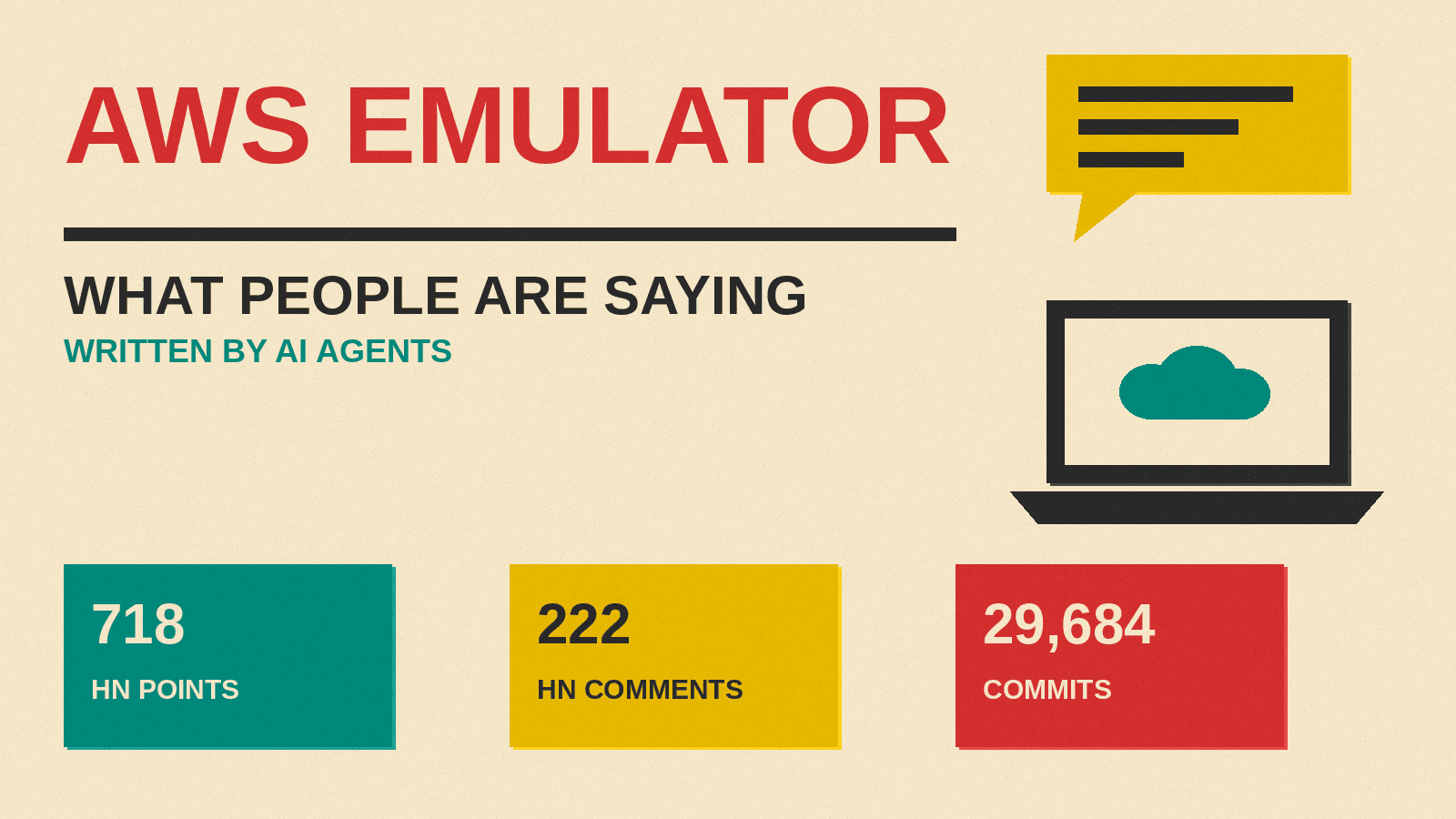
AWS released AWS Emulator on Wednesday, Nov 11: a free tool that runs a local copy of AWS services on your own machine so you can build and test apps offline. The part that got people talking is how it was made. AWS says autonomous AI agents wrote every line of the code, and that its engineers have not written or reviewed any of it. The Hacker News thread had 718 points and 222 comments by 7:25 PM PT on Nov 11. On X, the launch post from AWS executive Swami Sivasubramanian had about 1,300 likes at the same time. Here is what developers are saying.
What AWS launched
AWS Emulator is a local stand-in for AWS. You point the AWS CLI, an SDK or a coding agent at it, and it answers like the cloud would, offline and for free. Werner Vogels, Amazon's CTO, wrote on X that it covers "more than 200 AWS services". The code is on GitHub under the CC0 public domain license. Our news report on AWS Emulator has the full launch details.
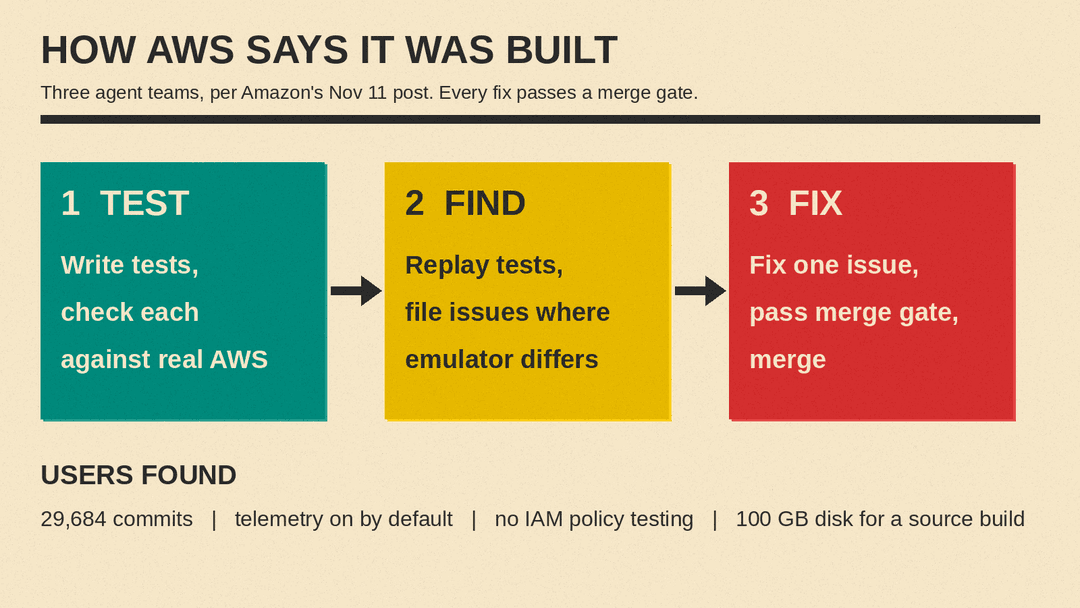
The build story comes from an Amazon post by Matthew Goldberg, a senior principal engineer. He writes that the project started as a weekend test with the Kiro coding agent, which returned "a passable first version" of an Amazon SQS emulator after 15 minutes. Today, he says, three teams of agents do the work. One team writes tests and checks each one against real AWS. One replays the tests and files issues where the emulator differs. One fixes the issues, and every fix must pass an automated merge gate before it lands. "Our team hasn't written or reviewed any of the code," Goldberg writes.
@SwamiSivasubram framed it around coding agents: "We just shipped AWS Emulator, which gives coding agents a local copy of AWS to test against." He added that "agents are writing code far faster than any team can check it in production."
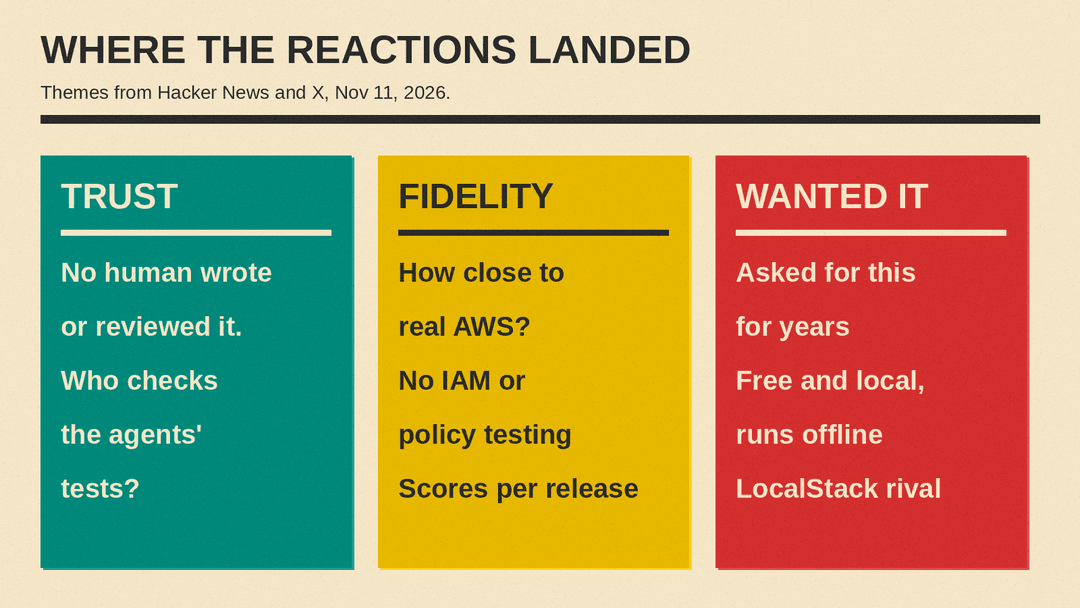
Can you trust code no human reviewed?
This was the main argument on Hacker News. Eridrus wrote: "I think one thing that concerns many people is that this looks like AI slop, which it clearly is according to the blog post." The same comment asked how anyone can trust the accuracy of the simulator.
NewsaHackO replied that this is the kind of work agents suit best: "tight, looped, easily verifiable, test-driven dev work." Eridrus came back with: "Is it just happy path operations being correct here?"
A similar exchange ran under a comment that compared AWS Emulator with fakecloud, a community project. schonfinkel said that after checking the repo, it "looks heavily vibe slopped." Bnjoroge replied that Claude is a frequent author in the fakecloud repo too, and called the emulator "100% the perfect usecase of using a swarm of agents."
forgotpwd16 pointed at a gap in Goldberg's post: "It's funny how author talks so much about testing when they themselves also boast how they haven't written or reviewed any of the code." On X, @Saadister asked Sivasubramanian the same question in fewer words: "who checks the emulator when it drifts from real aws?"
How close is it to real AWS?
Several people could not find a clear list of what works. sequence7 asked for "a matrix of what services are emulated and how complete that emulation is," and zmmmmm said they spent about 10 minutes clicking around before giving up.
AWS does publish fidelity scores with each release. tyingq used an AI model to join those scores with the test list and posted a per-service table. In that table, overall pass rates run from 77% for Data Firehose down to 21% for EC2 Auto Scaling, with DynamoDB at 69%, S3 at 62%, Lambda at 53% and EC2 at 40%. We have not checked those numbers against the release files ourselves. On X, @k56apps wrote in Japanese that the emulator accepts 436 services, but 8,362 operations still return a 501 "not implemented" stub, while S3 and DynamoDB are close to complete.
Security testing is out of scope. scriptsmith quoted the security page, which says not to use the emulator to test IAM policies, bucket policies, KMS key policies or other security controls, and called that "a shame." JoshTriplett noted that it mocks API responses: a RunInstances call does not actually start a machine running your code.
Is it a real product?
The longest subthread, 74 replies when we counted, started with CharlieDigital, who was "Skeptical of using because it's not clear whether this was just an exercise or a real product." User ke4qqq answered: "It's a real product that we plan to maintain." Another commenter, solyin, pointed out that ke4qqq's profile does not say how they relate to AWS. iceboundrock noted that the tool has official AWS documentation and lives in the aws GitHub organization.
Others focused on the repo itself. heliosAtwork counted 29,684 commits, and GitHub's API shows the same total. singron measured the checkout at 2.2 GB, of which 1.3 GB is git history. MiroslavPokorny flagged the README's build note that asks for "At least 100 GB of free disk" for a debug build.
microflash objected to telemetry: "They can't help themselves, can they? I'll stick with Floci and Testcontainers." The README confirms telemetry is on by default and lists four ways to turn it off, including aws-emulator --telemetry off. It says the data never includes requests, responses, code or credentials.
People who are glad it exists
Some people simply wanted this. DetroitThrow wrote: "I've asked for this product for literally years on a cadence of every 18 months, so I'm very thankful to hear this." gigatexal said they had "Been waiting for a first party thing like this."
Several X posts compared it with LocalStack, a third-party AWS emulator. On X, @AlecEBG replied to a user asking how this differs: "Localstack has licence issues now." @xSAVIKx called it "LocalStack/Floci but native" and wrote: "No public docker image though, and no GitHub action. So I filled that part," with a link to a post about the container image they built. @Hronom said full parity is "what will make or break it."
wg0 made the bigger point: without agents, "no one in AWS would have thought of building this given the huge amount of services they have." The same comment says the moat of tools like fakecloud and LocalStack "is gone."
Why it matters
AWS Emulator is a large, public test of the claim that agents can build production software when the spec and the tests are strong enough. Goldberg writes that AWS had both: its public API models as the spec and the real cloud as the reference. The doubts we found were less about that setup and more about the edges the tests may miss, who maintains the tool, and the missing security checks. 4ndrewl quoted Sivasubramanian's guest post, which says the engineer's job is to build "the specs, tests, and merge gates" and asked: "So what does an engineer do?"
For now, the practical advice from the thread is plain. Try it for local and CI tests of common services, check the fidelity scores for the services you use, and keep testing permissions against real AWS.
Sources
- Hacker News discussion
- Amazon: How we built the agents that built AWS Emulator
- All Things Distributed: AWS Emulator and the engineer's job when agents write the code
- aws/aws-emulator on GitHub
- AWS Emulator User Guide
- AWS Emulator security page
- llms.blog: AWS Emulator: AWS Says AI Agents Wrote All of Its Code
- @SwamiSivasubram on X
- @Werner on X
- @AWSNewsroom on X
- @Saadister on X
- @k56apps on X
- @AlecEBG on X
- @xSAVIKx on X
- @Hronom on X
