
Google has released A2UI 1.0, which it calls "the first stable version of our open protocol for generative UI." The idea is simple: instead of answering with a wall of text, an AI agent can answer with an interactive screen, such as a form to confirm or a chart, and the app that shows it draws that screen with its own native components.
The announcement came on the Google Developers Blog on November 11, 2026, from Vishal Motwani, A2UI PM, and the Google A2UI Team. The code lives in the open at github.com/a2ui-project/a2ui under the Apache 2.0 license.
What A2UI does
Google says user interactions with agents today are where computers were in "the terminal era": capable, but answering almost everything in text. Text is a poor way to compare three products or to edit and approve a detailed plan, the post says.
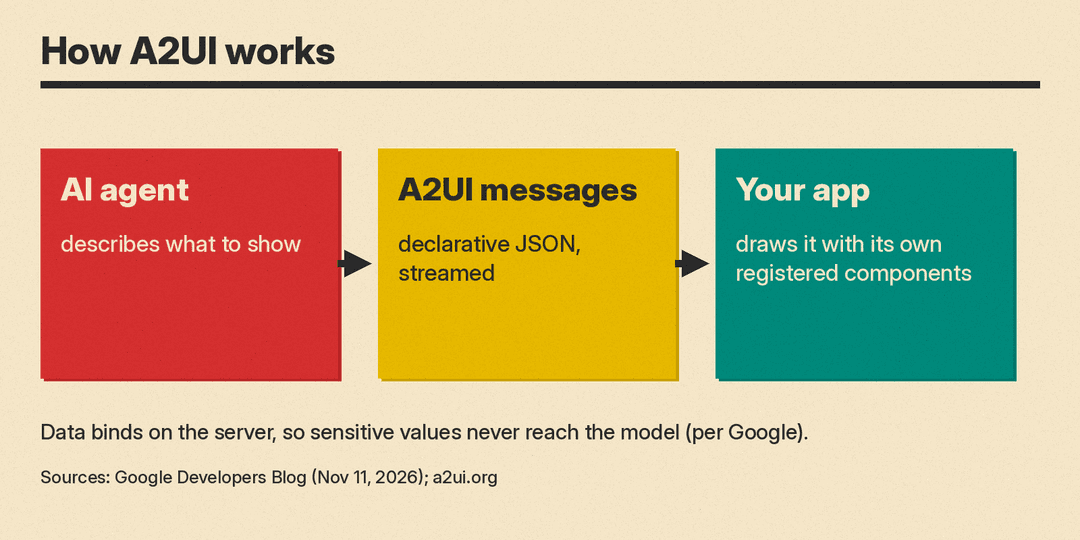
With A2UI, the agent describes what to show, and each app renders it. Google lists three selling points:
- Personalized in the moment. The agent builds a UI that adapts to each user's needs.
- Native to your brand. Agents "use your design system and nothing else." They place and configure only the components a developer registers.
- Fast, reliable, and secure in production. Models compose UI with A2UI Express or with "system one" decision models that pick components instead of writing text. A2UI binds data and child components on the server, so, per Google, "sensitive values never reach the model," and the app streams in the UI as the agent works.
The A2UI site adds one more point that matters for security reviews: in its composition mode, A2UI streams declarative JSON data with two-way bindings and "never executable code." The same page describes a code generation option, in which the model writes HTML and JS that runs in a sandbox. With A2UI, that code can run as an MCP App inside an A2UI surface.
Google's example is a sick day. Getting through the morning takes six apps: a video visit, meetings, a team message, an out-of-office reply, a school pickup request and a soup order. Google is careful here: "A2UI won't handle your sick day, but it gives developers the framework to build an agent that can." Such an agent could answer with one view of all six apps, and nothing is sent until you confirm.
What is new in 1.0
The blog post lists three changes:
- A stable protocol. Version 1.0 adds bidirectional function calls, so a flight or reservation picker can check availability on the spot. It also adds accessibility support and extensions for extra metadata.
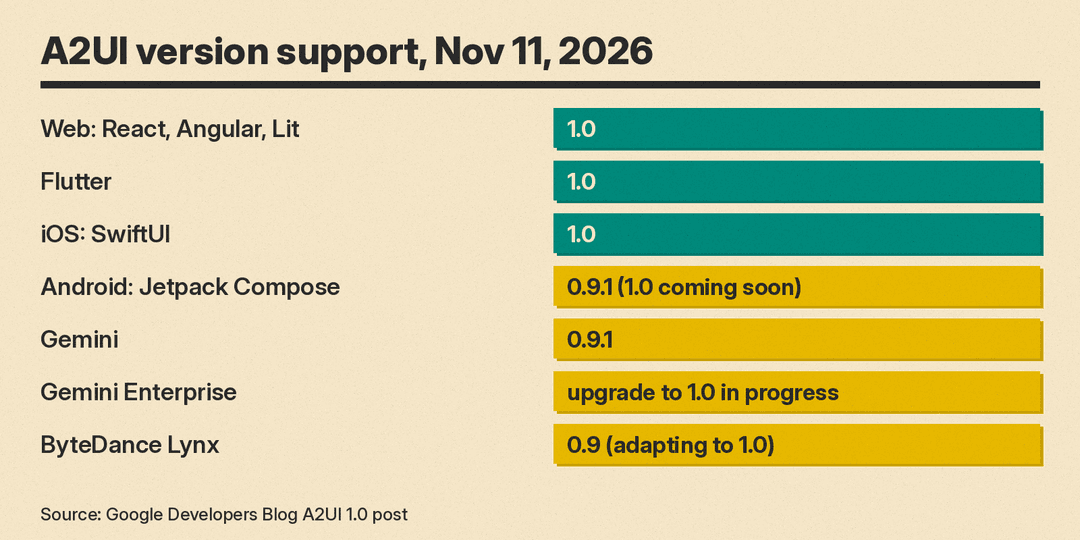
- Renderer libraries. Open-source renderers draw A2UI screens with React, Angular and Lit on the web, Flutter on mobile, web and desktop, and SwiftUI on iOS. The web and Flutter renderers also work inside MCP Apps, so A2UI screens can appear in AI assistants that support MCP Apps, such as Claude and Gemini.
- Agent SDKs. New SDKs for TypeScript and Dart join Python. Google says they generate skills, translate messages and correct errors. Swappable inference formats reduce latency, and in Python, A2UI Macros add programmatic component expansion and data binding.
Limits to know first
Not every piece is on 1.0 yet. Builders should check these before they plan a launch:
- Android lags. The Jetpack Compose renderer supports version 0.9.1 today, with 1.0 "coming soon," per the post.
- Gemini is on 0.9.1. Organizations can register their own agents that respond with A2UI, and Gemini renders them with components from its A2UI component gallery. Google says Gemini "supports A2UI 0.9.1 today."
- Gemini Enterprise upgrade is in progress. Agents in Gemini Enterprise can already use A2UI, and Google says it is "working on upgrading Gemini Enterprise to A2UI 1.0."
- ByteDance Lynx is on 0.9. Lynx supports A2UI 0.9 today and is adapting to 1.0 with the A2UI team.
- Version jump. Teams on 0.9 have an evolution guide that covers every change.
The package versions also differ from the protocol number. On GitHub, the November 10 releases include a2ui-agent-sdk 0.11.0 and a2ui-core 0.6.0 for Python, and the A2UI CLI is at v0.3.0.
Who is using it
Google names Atlassian, Alation, Bloomberg and ByteDance as companies already building with A2UI. The post gives details for three of them:
- Atlassian is bringing A2UI to Jira. When an AI agent assigned to a work item needs a missing detail or a decision, it asks with an interactive card in the work item.
- Alation builds the feeds in its Alation Intelligence Operating System (AIOS) with A2UI: metric cards, charts and more. The same feed renders in Claude and in Alation's own app with a nearly identical layout.
- ByteDance released an A2UI renderer for Lynx, its cross-platform framework, in June 2026.
Inside Google, Gemini Notebook uses A2UI cards. Ask it for a slide deck and it replies with a card that asks for presenter slides or a detailed deck and which topics to focus on, then a review card you can edit before it generates the deck. Google says several other teams are building features with A2UI that have not launched yet.
Why it matters
Agents now run in many places at once: a company's own app, a chat assistant, a work tool. A2UI's pitch is that a developer builds a view once and it renders natively on each screen, while the host app keeps control of which components appear. That control is the part enterprise teams will weigh most, since the agent can only place components the developer registered.
It also arrives alongside other recent Google tools for agents. We covered Antigravity's /swarm preview for teams of coding agents, and the Gemini Decisions API, which scores a fixed set of choices instead of writing text.
To try it, Google points to the docs and quickstart at a2ui.org and the A2UI Playground by CopilotKit.
Sources
- A2UI 1.0: Build delightful, fast, reliable, agentic experiences (Google Developers Blog, Nov 11, 2026)
- A2UI official site
- a2ui-project/a2ui on GitHub (releases as read Nov 12, 2026)
