
iFLYTEK is a Chinese speech technology company founded in 1999, and Spark (Xinghuo in Chinese) is its family of large language models. It has shipped Spark models since 2023, says it trained recent ones on Chinese-made chips, and publishes small open-weight versions that anyone can download, most recently Spark X2.6 in October 2026. This guide explains who iFLYTEK is, what the Spark models are, and how they fit into China's AI field.
For the wider map of Chinese labs, see our guide China's AI labs explained.
Who is iFLYTEK?
iFLYTEK Co., Ltd. was founded in 1999 by university classmates, according to the company's own history page. The same page describes it as "a listed company in the Asia-Pacific Region focusing on intelligent speech and technology." It went public on the Shenzhen Stock Exchange in 2008 under the ticker 002230.
Until 2023, the company's timeline is mostly about speech. It lists these steps:
- 2000: research labs built with the University of Science and Technology of China (USTC) and the Chinese Academy of Social Sciences
- 2010: the iFLYTEK Open Platform, which the company calls the first open voice platform with voice recognition
- 2011: a Chinese speech recognition system based on deep neural networks
- 2016: the Xiao Yi Translator and the iFLYREC conferencing system
- 2019: selected as the transcription and translation provider for the Beijing 2022 Winter Olympics and Paralympics
Speech, translation and many languages also show up in the Spark releases below.
What is iFLYTEK Spark?
Spark is iFLYTEK's general large language model. The company says it officially released Spark on May 6, 2023, built by a team from its State Key Laboratory of Cognitive Intelligence. At launch iFLYTEK listed seven core capabilities: text generation, language understanding, knowledge question-answering, logical reasoning, mathematical abilities, coding abilities and multimodal capabilities.
In Chinese the brand is 星火, Xinghuo, which literally means "spark" or "spark of fire." English material from iFLYTEK uses both "Spark" and "SPARK."
How Spark developed
The Spark line has moved through several generations. The dates and claims below come from iFLYTEK's own pages unless another outlet is named.
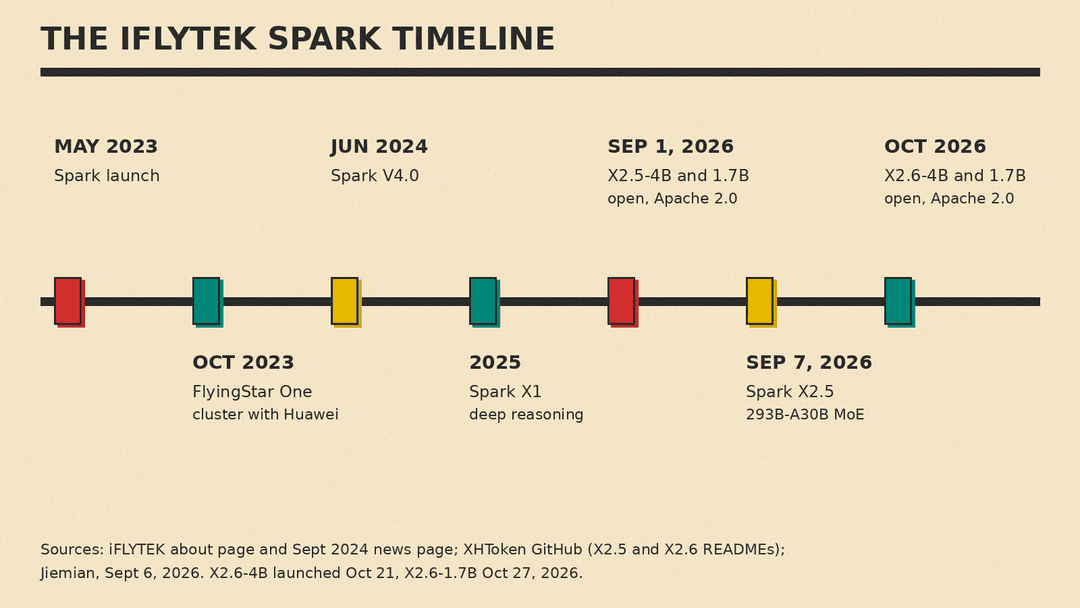
- May 6, 2023: first Spark release (iFLYTEK).
- October 24, 2023: iFLYTEK and Huawei jointly launched a computing platform the company calls "FlyingStar One," which it describes as "the first fully domestic computing platform in China" (iFLYTEK). The company history page calls it "Feixing No.1" and a 10,000-card platform (iFLYTEK).
- June 27, 2024: Spark V4.0, trained on that cluster. iFLYTEK said in September 2024 that V4.0 "surpassed eight out of 12 mainstream Chinese and English benchmarks." The page does not name the 12 benchmarks.
- By September 2024: a Spark Large Speech Model that, per iFLYTEK's September 2024 page, "supports 74 languages and dialects without switching."
- 2025: Spark X1, which iFLYTEK's history page calls "China's first deep reasoning LLM built on fully domestic computing." That is the company's own claim.
- September 1, 2026: two small open-weight models, Spark X2.5-4B and Spark X2.5-1.7B (GitHub).
- September 7, 2026: Spark X2.5, a mixture-of-experts model with 293B total and 30B active parameters, focused on code and agent tasks, as reported by Jiemian.
- October 2026: Spark X2.6-4B (October 21) and Spark X2.6-1.7B (October 27), new small open-weight models with the same architecture as X2.5 and improved post-training (GitHub).
Spark X2.5: the large model
According to Jiemian, a Chinese business news site, iFLYTEK officially released Spark X2.5 on September 7, 2026 (Jiemian's news flash is time-stamped September 6). It uses a mixture-of-experts (MoE) design, where only part of the model runs for each token. Jiemian gives the size as 293B-A30B, which means 293 billion parameters in total and 30 billion active per token. Jiemian reports that iFLYTEK focused this version on coding and agent abilities, and that the model was trained and served entirely on domestic Chinese computing. Jiemian says it is live on the iFLYTEK Open Platform.
The public download pages from iFLYTEK's model unit, XHToken, list only small 4B and 1.7B models from the X2.5 and X2.6 series. As of November 9, 2026, the Spark-X2.5 collection on Hugging Face does not include the 293B model, and neither does XHToken's Hugging Face model list.
Spark X2.6 and X2.5: the small open models
The small Spark models are the ones anyone can download and run. IT之家 (ITHome) reported that 词元星火, a subsidiary of iFLYTEK, released the first two, Spark X2.5-4B and X2.5-1.7B, on September 1, 2026. The official Spark-X2.5 README on GitHub publishes them under the account name XHToken.
What the X2.5 README says about the two X2.5 models:
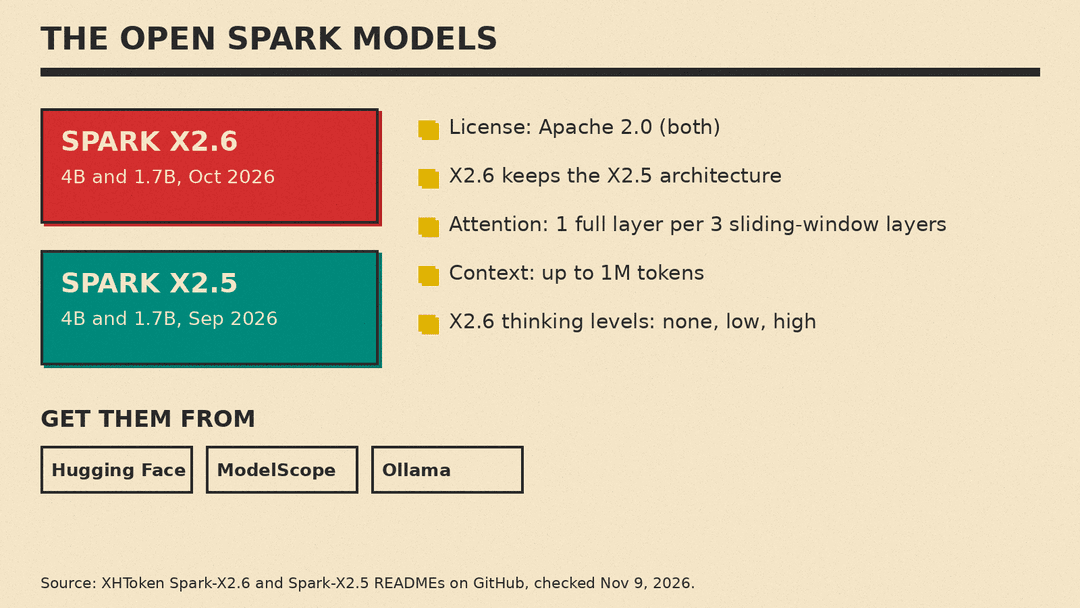
- License: "The Spark-X2.5 model series is licensed under the Apache 2.0 License."
- Context: native context windows of up to 1M tokens.
- Languages: support for more than 200 languages.
- Design: a hybrid attention architecture "that combines one full-attention layer with three sliding-window attention layers," which the README says reduces the compute cost of long inputs.
- Training: "The models were trained on Huawei Ascend clusters."
- Hardware: support for NVIDIA, Huawei, Hygon and HOUMO.AI hardware.
- Software: compatible with vLLM, SGLang, llama.cpp and MLX, with deployment through Ollama and LM Studio.
- Downloads: Hugging Face, ModelScope, Modelers, Ollama, SCNet and AtomGit.
ITHome adds that the models were pretrained on about 20 trillion tokens. It also reports an iFLYTEK test result: on the Domux smart home test set, Spark X2.5-1.7B carried out control commands correctly 90.3% of the time, with an average response time of 0.85 seconds. That is a vendor figure from the September 2026 launch, not an independent test.
On October 21, 2026, XHToken released Spark X2.6-4B, followed by Spark X2.6-1.7B on October 27, according to the Spark-X2.6 README on GitHub. The README says X2.6 "retains exactly the same architecture as Spark-X2.5" and gets its gains "through improved post-training." It adds three thinking levels (none, low and high), which the README says let apps balance reasoning quality, latency and inference cost. X2.6 is also released under the Apache 2.0 License and is on Hugging Face, ModelScope and Ollama. Its benchmark claims, like those for X2.5, are iFLYTEK's own.
iFLYTEK calls these on-device models, and the X2.5 README notes support in the PocketPal AI phone app. ITHome lists long-document question answering, office reports, smart home control and robot control as example uses.
Spark and Chinese chips
A theme across iFLYTEK's releases is training on Chinese hardware. The company says Spark V4.0 was trained on the FlyingStar One cluster built with Huawei, and the X2.5 README says the small X2.5 models were trained on Huawei Ascend clusters. Jiemian reports the same for the 293B model.
iFLYTEK also has a US export-control history. On October 9, 2019, the US Commerce Department's Bureau of Industry and Security added IFLYTEK to the Entity List, along with 27 other Chinese entities. The Federal Register notice says "eight additional entities are enabling activities contrary to the foreign policy interests of the United States," and that these entities "have been implicated in human rights violations and abuses" in Xinjiang. Under the rule, exports to the listed entities of any item subject to US export rules need a license. A short list of item types gets case-by-case review; for all other items the policy is a "presumption of denial."
For more on how US chip rules work, see our explainer on US AI chip export controls on China.
How Spark compares with other Chinese models
Spark comes from a company whose history is in speech technology. Like Baidu with ERNIE, iFLYTEK offers its large model through its own platform. Its 2024 page says it also built the SPARK Enterprise Intelligent Agent Platform for businesses.
Some practical differences for a reader choosing a model:
- Open weights: DeepSeek and Qwen publish weights for large models. iFLYTEK's open releases so far are small 4B and 1.7B models from the X2.5 and X2.6 series.
- Focus: iFLYTEK's releases stress speech, many languages and on-device use. Its September 2026 big model stresses code and agents.
- Hardware: iFLYTEK states that its recent models were trained on Chinese hardware.
For background on another lab that publishes open weights, see What Is DeepSeek?
Should you use Spark?
If you want a small open model with a very long context window, the Spark X2.6-4B and 1.7B models, or the earlier X2.5 versions, are worth a test. They are released under Apache 2.0, and you can run them on your own hardware. Check the claims yourself: the benchmark and test figures in the release material come from iFLYTEK.
If you want iFLYTEK's large 293B model, Jiemian reports it is available on the iFLYTEK Open Platform.
Sources
- iFLYTEK: company history and about page
- iFLYTEK: iFLYTEK Makes Fortune China's Top 50 Tech Companies List in 2024 (Spark history) (September 11, 2024)
- GitHub: XHToken Spark-X2.5 README (X2.5 branch)
- GitHub: XHToken/Spark-X2.6 README
- Hugging Face: Spark-X2.5 collection
- Hugging Face: Spark-X2.6 collection
- IT之家 (ITHome): Spark X2.5-4B and 1.7B release (September 1, 2026)
- Jiemian: Spark X2.5 released (news flash dated September 6, 2026)
- Federal Register: Addition of Certain Entities to the Entity List (October 9, 2019)
