
What changed on November 9
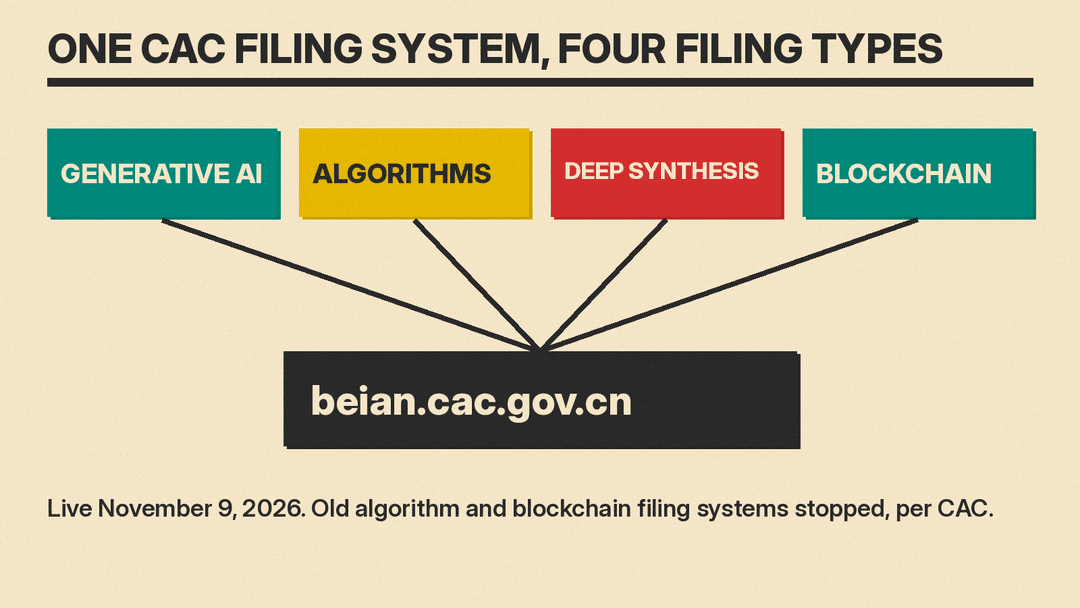
On November 9, 2026, at 15:00 Beijing time, the Cyberspace Administration of China (CAC, 国家互联网信息办公室) published a notice about a new online filing system. The system is named the Internet New Technology and New Application Information Service Filing System (互联网新技术新应用信息服务备案系统). It went live the same day at beian.cac.gov.cn.
The notice says the CAC built the system to make filing work more standardized and to make it easier for companies and the public to submit and look up filing information online. It handles filings for generative AI, algorithms, deep synthesis, blockchain and other new technologies and applications in one place.
Two older systems, the Internet Information Service Algorithm Filing System and the Blockchain Information Service Filing Management System, stopped being used at the same time. The algorithm filing system had been operating since March 1, 2022, per a CAC notice dated February 28, 2022.
The notice gives a phone number for questions, 010-82990521, on workdays from 9:00 to 17:00. It says nothing about changes to filing rules, deadlines or requirements. What the notice covers is the website where filings are made and searched.
The new system's homepage says it handles four filing types: generative AI, algorithms, deep synthesis and blockchain. Of the two older systems, it mentions only the algorithm filing system as stopped.
What is AI filing in China
Filing, or bei'an (备案) in Chinese, is a record a company submits to a government agency about a service it operates. Under the CAC rules below, covered providers send details of their service to the regulator within ten working days, update the record when the service changes, and deregister when the service ends. The CAC says the new system lets the public look up filing information online. For the wider rulebook, see our explainer on how China regulates generative AI.
Who has to file
Four sets of CAC rules define who must file. Three of them use the same trigger: whether a service has public opinion attributes or social mobilization capabilities.
The Algorithm Recommendation Provisions (互联网信息服务算法推荐管理规定), in force since March 1, 2022, require algorithm recommendation providers with public opinion attributes or social mobilization capabilities to file within ten working days of starting the service, under Article 24.
The Deep Synthesis Provisions (互联网信息服务深度合成管理规定), in force since January 10, 2023, say in Article 19 that deep synthesis providers with those attributes file under the algorithm rules, and technical supporters file the same way. Filed providers and technical supporters must show their filing number and a link to public information in a prominent place on their website or app.
The Interim Measures for Generative AI Services (生成式人工智能服务管理暂行办法), in force since August 15, 2023, require providers of generative AI services with public opinion attributes or social mobilization capabilities to do a security assessment under national rules and to complete algorithm filing, changes and deregistration under the algorithm rules, under Article 17.
The Interim Measures for AI Anthropomorphic Interactive Services (人工智能拟人化互动服务管理暂行办法), in force since July 15, 2026, cover AI services that imitate a person's personality and offer ongoing emotional interaction, such as companionship. Under Article 26, these providers must complete algorithm filing, changes and deregistration under the algorithm rules, with no public opinion trigger, and cyberspace authorities verify the filing materials every year.
What filers must submit and show
Article 24 of the algorithm rules lists what a filing contains: the provider name, service form, application field, algorithm type, algorithm self-assessment report and content to be made public. Changes must be filed within ten working days. Ending a service requires deregistration within twenty working days.
Display duties also reach apps built on filed models. A CAC notice dated September 14, 2026 says live generative AI apps or features must show, in a prominent place or on the product detail page, which filed or registered generative AI service they use, with the model name and the filing number or launch number.
How many AI services are filed
The CAC reports two cumulative numbers: generative AI services filed nationally, and apps or features registered by local CAC offices because they call a filed model through an API or other means.
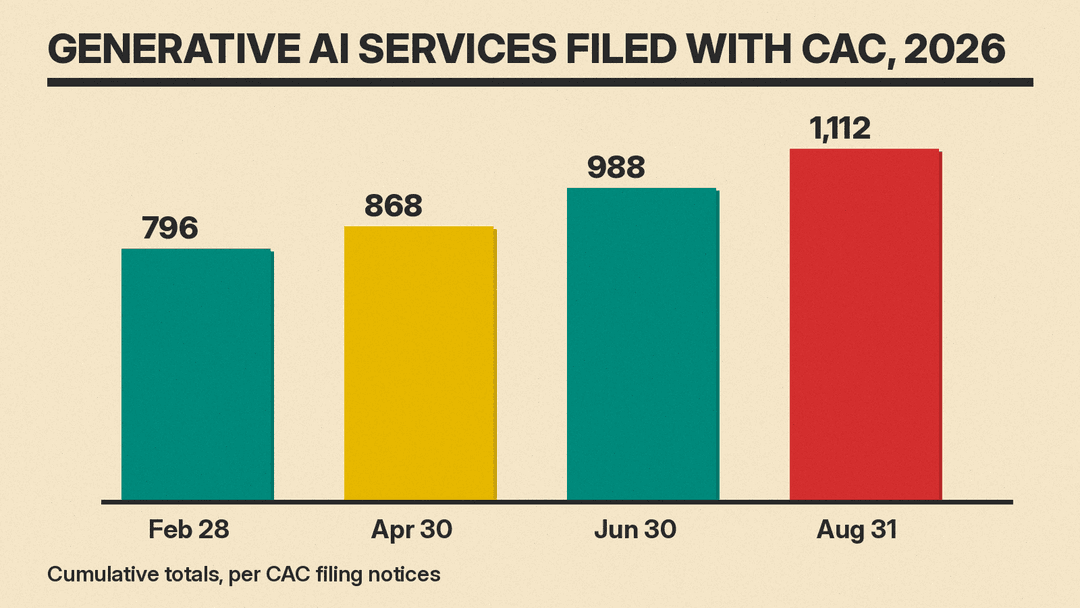
- As of February 28, 2026: 796 services filed, 481 apps or features registered
- As of April 30, 2026: 868 filed, 530 registered
- As of June 30, 2026: 988 filed, 598 registered
- As of August 31, 2026: 1,112 filed, 731 registered
In six months, from the end of February to the end of August 2026, the filed total rose by 316 and the registered total by 250, per these CAC figures. The CAC had not posted a national total for September and October when we checked on November 9, 2026.
July to August added 124 filed services, including 7 that provide on-device generative AI on phones, and 133 registered apps or features, per the September 14 notice. A separate notice dated September 23, 2026 listed 3 more on-device phone generative AI services, including one named "YOYO Claw".
For related coverage, see our piece on the Apple Intelligence China beta with Qwen. For background on the organizations behind DeepSeek, Qwen, Kimi and other Chinese models, see China's AI labs explained and What is DeepSeek.
What it means for AI companies and users
For companies shipping AI in China, submissions and searches for four filing types now go through one website. The November 9 notice does not mention any change to deadlines or submission requirements. It covers where filings are made and searched.
For users, filing information can be looked up online at beian.cac.gov.cn. Filed algorithm and deep synthesis providers must show their filing number, and live generative AI apps must show which filed or registered service they use, with the model name and the filing number or launch number.
Sources
- https://www.cac.gov.cn/2026-11/09/c_1795978604463007.htm
- https://beian.cac.gov.cn/
- https://www.cac.gov.cn/2022-02/25/c_1647395666889023.htm
- https://www.cac.gov.cn/2022-01/04/c_1642894606364259.htm
- https://www.cac.gov.cn/2022-12/11/c_1672221949354811.htm
- https://www.cac.gov.cn/2023-07/13/c_1690898327029107.htm
- https://www.cac.gov.cn/2026-03/17/c_1775482074695536.htm
- https://www.cac.gov.cn/2026-05/13/c_1780413225190669.htm
- https://www.cac.gov.cn/2026-07/10/c_1785427810632554.htm
- https://www.cac.gov.cn/2026-09/14/c_1791136833136332.htm
- https://www.cac.gov.cn/2026-09/23/c_1791913977404975.htm
- https://www.cac.gov.cn/2026-04/10/c_1777558395078289.htm
