
When people say the United States "banned AI chips to China," they are compressing several years of rules into one phrase. There is no single ban. There is a set of export controls, run by the Commerce Department's Bureau of Industry and Security (BIS), that decides which chips, which chipmaking tools and which buyers need a US government license. Those rules have been rewritten several times since 2022, and the direction has not always been tighter.
This guide explains how the controls work, in plain English: what is covered, how a chip gets classified, who needs a license, how the rules changed over time, and what they mean for Chinese AI labs such as DeepSeek, Alibaba's Qwen team and Moonshot. Status details are as of October 2026. Export rules change often, so check the BIS website for the current text before relying on any detail here.
This is a general explainer, not legal advice. Check with an export-control lawyer or BIS for your situation.
The short version
- The controls are written by BIS under the Export Administration Regulations (EAR), the US rulebook for exports of "dual-use" items that have both civilian and military uses.
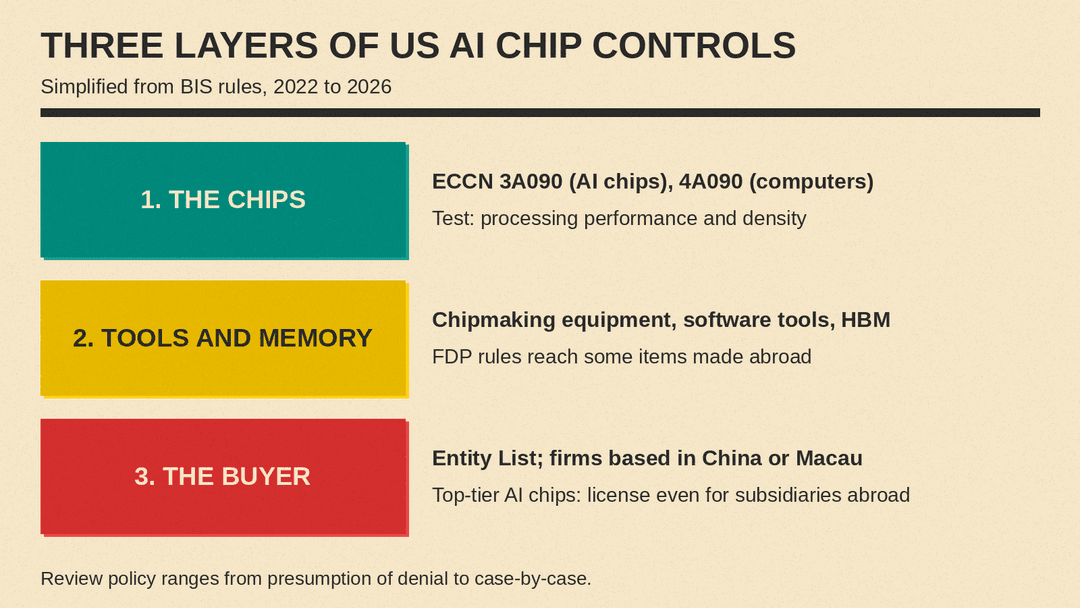
- They cover three things: advanced AI chips (and computers that contain them), the tools and memory needed to make advanced chips, and specific companies placed on a blacklist called the Entity List.
- A covered chip is not automatically banned. It needs a license, and BIS sets a "license review policy" that ranges from "presumption of denial" (licenses are expected to be refused) to "case-by-case."
- The official reason, in BIS's own words from the first rule in October 2022, is to restrict China's "ability to both purchase and manufacture certain high-end chips used in military applications."
Why AI chips are export-controlled at all
Large AI models are trained on big clusters of specialized chips. DeepSeek's V3 report, for example, describes a training cluster of 2,048 Nvidia GPUs. The US government's case, stated in its October 2023 rule, is that advanced AI models trained on these chips "can be used to improve the design and use" of weapons and surveillance systems, and that China seeks to use advanced chips to further its goal of surpassing US military capabilities.
The rules reach US-made chips directly, and through the foreign direct product rules described below, some items made abroad with US technology.
Layer 1: the chips themselves
Under the EAR, every controlled item has a code called an Export Control Classification Number (ECCN). Two codes matter most for AI:
- 3A090 covers advanced computing integrated circuits, meaning the AI chips themselves.
- 4A090 covers computers, servers and other hardware that contain those chips.
A chip lands in 3A090 based on a formula, not a brand name. The rule uses two measures:
- Total processing performance (TPP). The rule defines it as "2 x MacTOPS x bit length of the operation," added up over all processing units on the chip. In simpler terms, it is how many multiply-and-add operations the chip can do per second, weighted by how precise those operations are. For chips that handle both sparse and dense math, the rule uses the dense figure.
- Performance density. TPP divided by the chip's die area. BIS added this test in 2023.
Under the October 2023 rule, the top tier, 3A090.a, covers chips with a TPP of 4800 or more, or a TPP of 1600 or more combined with a performance density of 5.92 or more. A second tier, 3A090.b, covers somewhat less capable chips. The same rule removed an earlier test based on interconnect bandwidth (how fast chips talk to each other). BIS's announcement said the new density test is "designed to preempt future workarounds."
Because the line is a formula, a chip designed to sit just under it may fall outside 3A090 until BIS moves the line or adds a new test. The 2023 density test is one example. Another is the 2025 license requirement for Nvidia's H20, which also covered "any other circuits achieving the H20's memory bandwidth, interconnect bandwidth, or combination thereof" (see the timeline below).
Layer 2: the tools and memory to make chips
Blocking finished chips only works if China cannot easily make equivalent chips at home. So the controls also reach upstream.
The October 2022 rule added license requirements for items going to Chinese chip factories that make:
- logic chips with non-planar transistors (FinFET or GAAFET) at 16nm or 14nm, or below;
- DRAM memory chips at 18nm half-pitch or less;
- NAND flash memory chips with 128 layers or more.
For factories owned by Chinese entities, licenses face a presumption of denial. For factories owned by multinationals, BIS decides case by case. The same rule restricted "U.S. persons" from supporting chip development or production at certain Chinese factories without a license.
In December 2024, BIS widened this layer. It added controls on 24 types of chipmaking equipment and 3 types of software tools, new controls on high-bandwidth memory (HBM), and 140 additions to the Entity List. BIS called HBM "critical to both AI training and inference at scale" and "a key component of advanced computing integrated circuits."
The foreign direct product rule
BIS uses foreign direct product (FDP) rules to extend US jurisdiction to certain items made outside the United States. The October 2022 rule expanded "the scope of the Export Administration Regulations (EAR) over certain foreign-produced advanced computing items." The December 2024 package created two new FDP rules for specified foreign-produced chipmaking equipment, plus de minimis provisions that reach such equipment if it contains "any amount of U.S.-origin integrated circuits."
Layer 3: who is buying
The third layer looks at the buyer rather than the product.
- The Entity List. Companies on this list face extra license requirements. The December 2024 additions alone covered "semiconductor fabs, tool companies, and investment companies" that BIS said were acting for Beijing's chip goals.
- Headquarters, not just location. Since November 17, 2023, a license has been required to send advanced computing items to companies headquartered in China, Macau or another Country Group D:5 country (the US arms-embargo group that includes China), or with an ultimate parent there, even when the buyer is a subsidiary in another country. For the top-tier ".a" items, BIS restated this in guidance on May 31, 2026, after questions about whether the requirement was still enforced. Its answer: "The answer is yes." Renting chips in a third country is a separate route; our report on Oracle's reported cancellation of a Tencent chip lease shows how that route is now under pressure.
- Country groups. China is in Country Group D:5. BIS's 2023 announcement describes the related rules as covering "arms embargoed countries, including the PRC." Many of the chip rules are written to cover "Macau or a destination in Country Group D:5" rather than China by name.
How the rules changed, 2022 to 2026
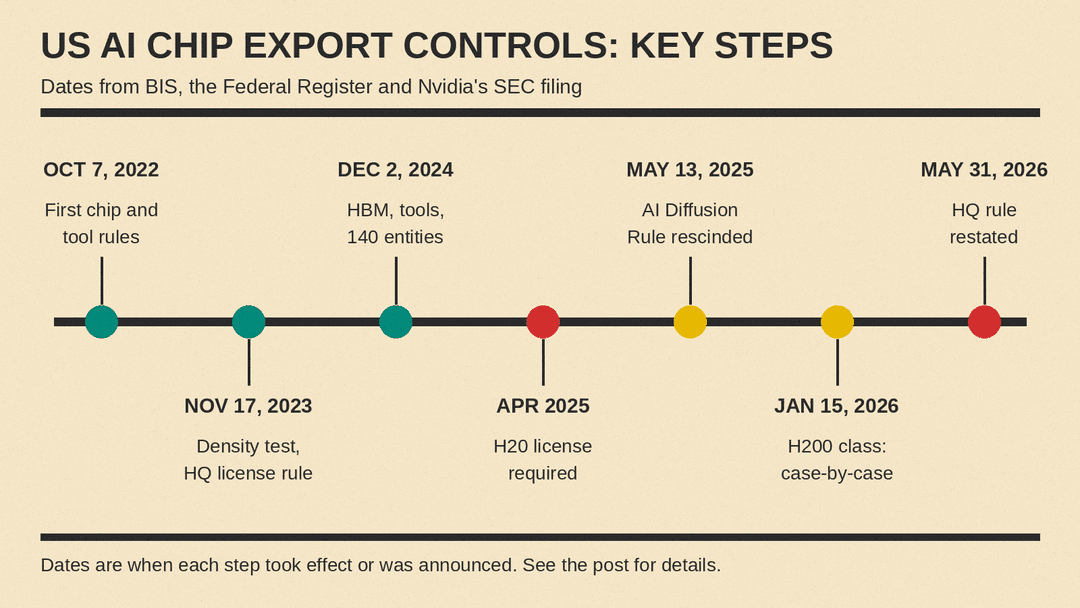
The controls have moved in both directions. These are the main steps, with dates from the official documents.
- October 7, 2022. BIS issues the first broad rule on advanced computing chips, supercomputers and chipmaking items for China. Parts took effect in phases through October 21, 2022.
- November 17, 2023. A revised rule takes effect. It adds the performance density test, removes the interconnect test, splits 3A090 into .a and .b tiers and adds the headquarters-based license requirement.
- December 2, 2024. New controls on chipmaking equipment, software tools and HBM, plus 140 Entity List additions.
- January 15, 2025. BIS issues the AI Diffusion Rule, which would have sorted countries into tiers for AI chip exports.
- April 2025. Nvidia disclosed in an SEC filing that on April 9, 2025, the US government told it that its H20, a chip built for the Chinese market, now required a license for export to China (including Hong Kong and Macau) and other Country Group D:5 destinations. The filing says the government cited "the risk that the covered products may be used in, or diverted to, a supercomputer in China," and on April 14 said the requirement would be in effect "for the indefinite future."
- May 13, 2025. Two days before the AI Diffusion Rule's compliance date, BIS announced a rescission of the rule and said it would issue a replacement rule in the future. BIS's May 2026 guidance describes this as a decision not to enforce the rule's new compliance requirements. The same announcement added guidance on the risks of using Chinese chips, "including specific Huawei Ascend chips," and on diversion.
- January 15, 2026. BIS changes the license review policy for chips such as the Nvidia H200 and AMD MI325X from presumption of denial to case-by-case, for chips with a TPP below 21,000 and total DRAM bandwidth below 6,500 GB/s. BIS's press release says this followed President Trump's December 8, 2025 announcement that the H200 could be shipped to approved customers in China.
- May 31, 2026. BIS guidance confirms the license requirement for China-headquartered companies abroad still applies.
What "case-by-case" means for the H200
The January 2026 rule is a good example of how conditional a "yes" can be. To get case-by-case review, an exporter must certify, among other things, that:
- there is enough US supply that the export will not delay US customers' orders;
- total shipments of the product to China and Macau will be "no more than 50%" of what is shipped to US customers for US use;
- the buyer will use "rigorous Know Your Customer (KYC) procedures" to block unauthorized remote access;
- every shipment is checked by a qualified third-party testing lab in the United States before export.
Chips above those limits are not covered by the change.
Licenses on paper did not mean chips in China right away. The South China Morning Post reported on August 27, 2026 that Nvidia had confirmed its first H200 shipments to China, and that Beijing "initially restricted purchases as it promoted home-grown alternatives" before allowing selected Chinese AI companies to buy limited quantities. So, in the SCMP's account, a US license alone did not decide whether the chips were bought.
What the controls mean for Chinese AI labs
For Chinese labs, the controls shape three practical choices.
Which chips they train on. DeepSeek's V3 technical report says the model was trained on a cluster of 2,048 Nvidia H800 GPUs.
How much they invest in efficiency. When compute is scarce, getting more out of each chip matters more. Chinese labs publish work on cheaper serving, for example DeepSeek's DeepInfer serving engine. How much of that focus comes from export controls is hard to measure from public data.
Whether to move to domestic chips. BIS's May 2025 announcement added guidance on the risks of using certain Huawei Ascend chips. On the Chinese side, the SCMP reports that Beijing promoted home-grown alternatives while it restricted H200 purchases.
What export controls do not do
A few common misunderstandings:
- They do not ban Chinese AI models in the United States. Export controls govern what leaves the United States (and some foreign items made with US technology). Restrictions on using Chinese AI inside the US come from other tools, such as the DHS order on DeepSeek in federal agencies.
- They do not cover every chip. Chips below the thresholds fall outside 3A090, and BIS said its 2023 update added an exemption that "will permit the export of chips for consumer applications."
- They are not only about China. Many provisions apply to all of Country Group D:5 and Macau, and some, like the AI Diffusion Rule, tried to set global terms.
- They are not one-way. China has proposed its own export controls on frontier AI models, agents and chip design.
How to read export control news
When a new headline appears, these questions help sort out what actually changed:
- Is it a rule, guidance or a license? A Federal Register rule changes the law for everyone. Guidance explains how BIS reads existing rules. A license is granted to a specific applicant.
- Which layer does it touch? Chips (3A090 and 4A090), chipmaking tools and memory, or specific buyers on the Entity List.
- What is the review policy? "Presumption of denial" and "case-by-case" sound similar but lead to very different outcomes.
- What does the other side allow? As the H200 case shows, a US license does not guarantee a Chinese purchase.
- Who is the source? Some export-control stories rely on unnamed people familiar with the matter. Rule texts on the Federal Register and BIS's own press releases are the primary record.
Rules and guidance described here are as of October 2026. This is a general explainer, not legal advice. Check with an export-control lawyer or BIS for your situation.
Sources
- BIS: Commerce Implements New Export Controls on Advanced Computing and Semiconductor Manufacturing Items to the PRC (October 7, 2022)
- BIS: Commerce Strengthens Restrictions on Advanced Computing Semiconductors (October 17, 2023)
- Federal Register: Implementation of Additional Export Controls: Certain Advanced Computing Items (October 25, 2023)
- BIS: Commerce Strengthens Export Controls to Restrict China's Capability to Produce Advanced Semiconductors (December 2, 2024)
- BIS: Rescission of the AI Diffusion Rule (May 13, 2025)
- Nvidia Form 8-K on the H20 license requirement (April 2025)
- Federal Register: Revision to License Review Policy for Advanced Computing Commodities (January 15, 2026)
- BIS: Department of Commerce Revises License Review Policy for Semiconductors Exported to China (January 13, 2026)
- BIS guidance on license requirements for entities headquartered in Country Group D:5 and Macau (May 31, 2026)
- South China Morning Post: Nvidia ships first H200 chips to China (August 27, 2026)
- DeepSeek-V3 Technical Report (arXiv)
