
DeepSeek is a Chinese AI chatbot that governments and regulators have questioned closely. Australia and the US have barred it from government systems, privacy regulators in Italy and South Korea have acted against its app, and news outlets have reported it dodging questions about Chinese politics. So is it safe to use?
The short answer: it depends on how you use it. The DeepSeek app and website send what you type to servers in China. The downloadable DeepSeek models are a different thing, and you can run them without sending anything to DeepSeek at all. This guide explains the difference, what DeepSeek's own privacy policy says, what governments have done and why, and how the censorship works.
Two ways to use DeepSeek
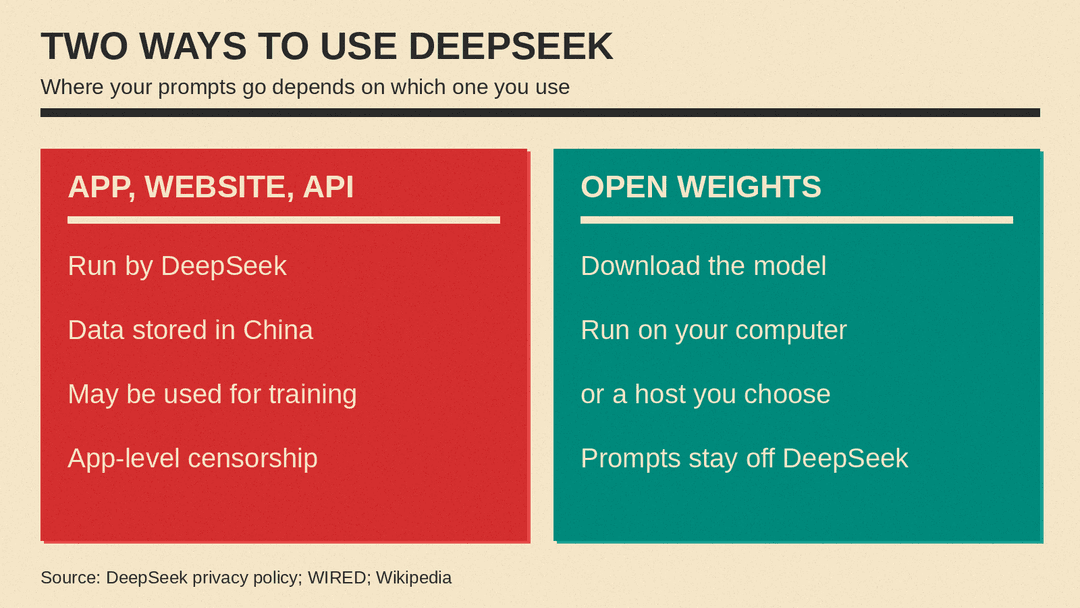
People say "DeepSeek" for two different things.
- The DeepSeek service. This is the chatbot app, the website and DeepSeek's paid API (the interface developers use to plug the model into their own software). It is run by Hangzhou DeepSeek Artificial Intelligence Co., Ltd., a company registered in China, according to its privacy policy.
- The DeepSeek models. DeepSeek publishes many of its models as open weights, the trained model files that anyone can download. For example, DeepSeek's model page for DeepSeek R1 says the model weights are licensed under the MIT License, a permissive open-source license. You can run these on your own computer, on your company's servers, or through a cloud host outside China.
Almost every privacy concern below is about the first one, the service. Censorship concerns apply to both, in different ways.
What DeepSeek's privacy policy says
DeepSeek's privacy policy (last updated February 10, 2026, as of October 2026) is fairly direct about the main points.
Where your data goes. The policy says: "To provide you with our services, we directly collect, process and store your Personal Data in People's Republic of China."
What it collects. It lists account details such as email or phone number, and "text input, voice input, prompt, uploaded files, photos, feedback, chat history." It also collects device and network data, including device model, operating system, IP address and device identifiers, plus logs of which features you use and your approximate location based on your IP address.
How it uses your chats. One listed purpose is "to train and improve our technology, such as our machine learning models and algorithms." The policy also lists "the right to opt-out of using your Personal Data for training our models," which you exercise by emailing privacy@deepseek.com, depending on where you live.
Who else can see it. The policy says data is shared with service providers, with entities in DeepSeek's corporate group, and with "law enforcement agencies, public authorities" when DeepSeek believes it is needed to "comply with applicable law, legal process or government requests."
What it tells you not to share. The policy says the service is "not designed or intended to process sensitive Personal Data," such as health, religious beliefs or precise location, and that "you should not provide sensitive Personal Data to the Services."
What you control. The policy says you can manage, copy or delete your chat history in settings, and that deleting your account is permanent.
The main concern is the location. Data stored in China is subject to Chinese law, and that is a concern several of the governments below have cited.
What governments have done
Several governments have restricted DeepSeek. Most actions target official devices or one app store, not ordinary people's personal use.
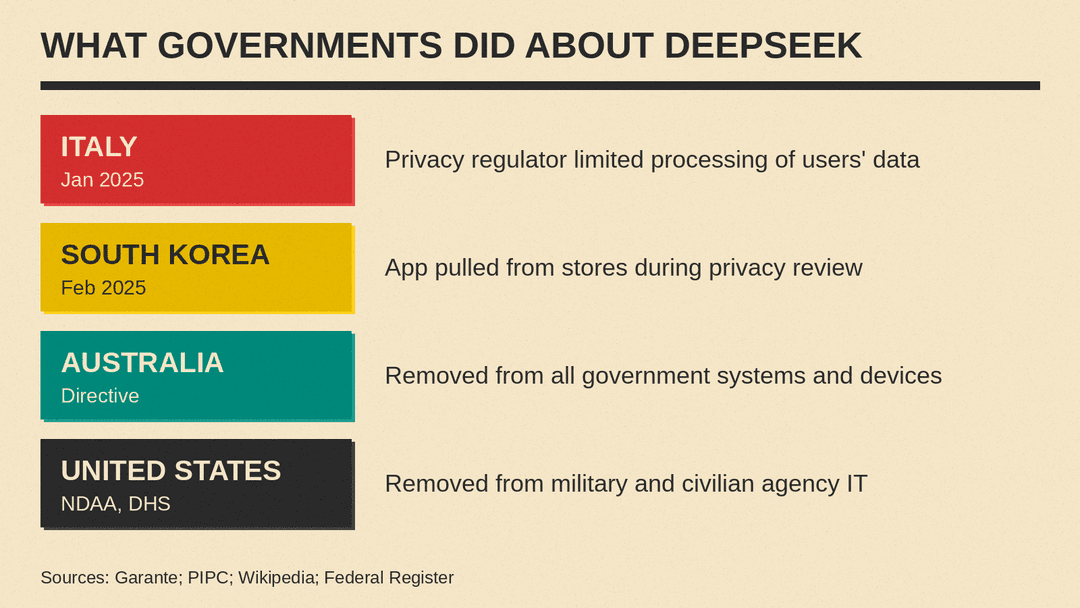
- Italy, January 30, 2025. The Italian data protection authority, the Garante, ordered an urgent limit, with immediate effect, on processing Italian users' data by Hangzhou DeepSeek Artificial Intelligence and Beijing DeepSeek Artificial Intelligence, the two Chinese companies behind the chatbot. The Garante said it found the companies' reply to its questions "entirely unsatisfactory," and that the companies had said they do not operate in Italy and that European law does not apply to them. It also opened an investigation.
- South Korea, February 2025. The Personal Information Protection Commission said its analysis found "traffic generated by third-party data transfers and insufficient transparency in DeepSeek's privacy policy," per its press release. The commission said DeepSeek, following its recommendation, removed its app from Apple's App Store and Google Play in Korea on February 15, 2025, while it worked on complying with Korea's Personal Information Protection Act. The commission urged existing users to avoid entering personal information. Downloads in Korea resumed on April 28, 2025, after DeepSeek published a revised Korean privacy policy, according to Yonhap News Agency.
- Australia. On February 4, 2025, the Department of Home Affairs issued a mandatory direction requiring government entities to prevent the use or installation of DeepSeek products and remove them from all Australian Government systems and devices, according to Direction 001-2025.
- United States, military and intelligence. The National Defense Authorization Act for Fiscal Year 2026, Public Law 119-60, requires the Secretary of Defense to remove DeepSeek AI from Defense Department systems and devices and bars Defense contractors from using it on Defense contract work. It also requires the Director of National Intelligence to set rules for removing the DeepSeek app from intelligence community national security systems, including those run by contractors. Both sections allow exceptions, including for research and national security purposes.
- United States, civilian agencies. The Department of Homeland Security issued an order, dated July 24, 2026 and published in the Federal Register on October 20, 2026, excluding DeepSeek from federal civilian procurement and requiring its removal from civilian agency IT. It does not cover those agencies' national security systems. The order says use of DeepSeek "may result in the transfer of sensitive data to the PRC if used by U.S. government employees or vendors." Our news report on the DHS order covers the details.
Note the pattern. These are mostly rules for government staff and contractors, or privacy regulators acting under their own laws. The DHS order also covers DeepSeek's models and third-party products built with them, not only the app. In its summary of risks, the order says "the models themselves may contain malware or other security vulnerabilities."
How DeepSeek's censorship works
All public generative AI services in China must follow Chinese content rules. China's interim measures for generative AI (English translation by China Law Translate) require services to "uphold the Core Socialist Values," as our guide to how China regulates generative AI explains. The Guardian noted, when it tested the app in January 2025, that Chinese generative AI must not violate "core socialist values," according to a technical document from China's national cybersecurity standards committee. The Guardian reported that the app appeared to censor answers to sensitive questions about China and its government, such as Tiananmen Square and Taiwan.
A WIRED investigation tested the R1 model three ways: on DeepSeek's own app, on a third-party host called Together AI, and on a WIRED computer. It found two layers.
- App-level censorship. On DeepSeek's website, app and API, refusals are triggered at the application level, so they are seen only through a DeepSeek-controlled channel. WIRED watched the model start a long answer about how Chinese journalists are treated, then delete it and replace it with a short refusal.
- Built-in bias. The version on Together AI did not refuse outright, but WIRED found it still gave short answers that leaned toward the Chinese government's position on political questions. That bias comes from training, and WIRED said removing it is "much more complicated."
So running the open model elsewhere removes the first layer, but not necessarily the second. For history, politics or news about China, check answers against other sources.
Is the open-weight version safe?
Running DeepSeek's open weights on your own hardware, or through a host you trust, means your prompts go to that machine or host, not to DeepSeek. The DeepSeek privacy policy itself says it does not cover apps that developers build on its platform; those apps' own policies apply.
That answers the "where does my data go" question. It does not answer every question. A model's built-in bias stays with it, as WIRED found. And any AI model connected to tools, files or the internet can take actions you did not expect, which is a risk for models from every country. Treat a downloaded model like any other software: get it from the official source, and limit what it can reach.
A simple checklist
- Casual use, nothing sensitive: The app works, but assume what you type is stored in China and may be used for training. Delete chats you do not want kept.
- Personal, health, legal or financial details: Do not paste them in. DeepSeek's own policy says not to share sensitive data.
- Work use: Check your employer's rules first. Australia and the US ban DeepSeek on government systems and devices.
- Developers and companies: If data location matters, run the open weights yourself or use a host in your own country, and read that host's terms.
- Questions about China: Expect refusals or one-sided answers, especially in the official app. Cross-check.
Our take: for most readers, the main question is not the model. It is where your words end up, and the app and the open weights give very different answers.
This article summarizes public reports, government statements and DeepSeek's own published policies as of October 2026. It is not legal advice.
Sources
- DeepSeek Privacy Policy
- Hugging Face: DeepSeek R1 model card
- Congress.gov: Public Law 119-60, NDAA for Fiscal Year 2026
- Garante Privacy: press release on DeepSeek (Italian and English)
- China Law Translate: Interim Measures for the Management of Generative Artificial Intelligence Services (translation)
- PIPC: DeepSeek Temporarily Suspends Its Application Service in Korea
- Yonhap: DeepSeek resumes service in South Korea
- Australian Government: PSPF Direction 001-2025 on DeepSeek
- Federal Register: Order on exclusion and removal of DeepSeek products
- The Guardian: We tried out DeepSeek. It worked well, until we asked it about Tiananmen Square and Taiwan
- WIRED: Here's How DeepSeek Censorship Actually Works
