
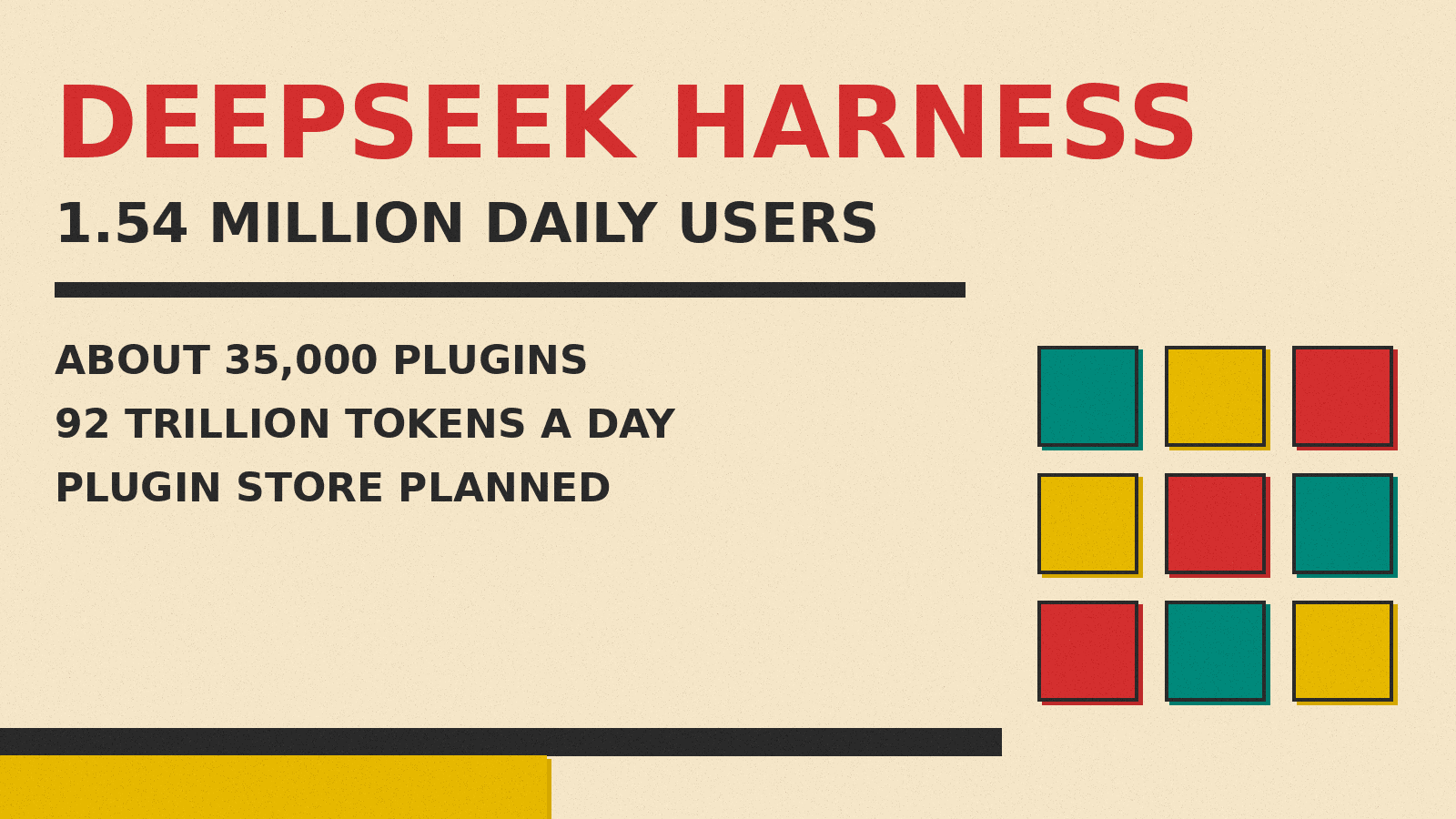
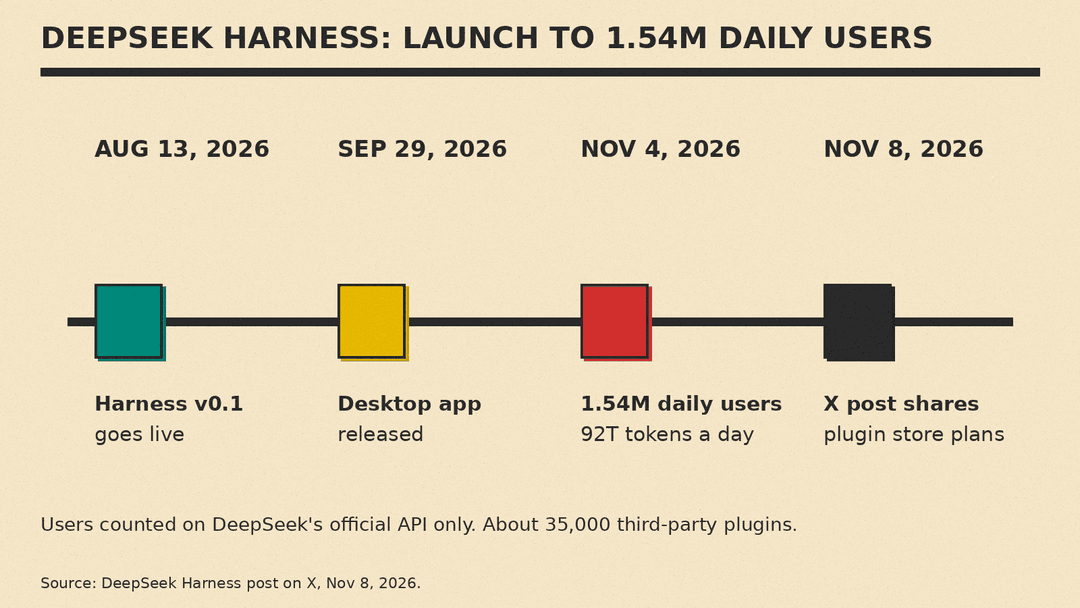
DeepSeek shared usage figures for Harness, its agent software, in an X post on Sunday, November 8, 2026. The post, titled "Growing Together with Our Plugin Community" and published by the @DeepSeekHarness account, said Harness had reached 1.54 million daily active users as of November 4, consuming roughly 92 trillion tokens per day. DeepSeek said it plans an official plugin marketplace and a support program for plugin authors. It gave no dates for either.
What is an agent harness?
A harness is the software layer that turns a model into an agent. The model does the reasoning. The harness gives it tools, access to files, and a loop for running multi-step tasks. The Harness product page says the product "is now in public preview worldwide and open source, with composable plugins that extend what agents can do." The page lists everyday work such as documents, data and slides, along with coding, research and background tasks. Harness runs as a desktop app or as a web interface started with npx. A feature called Creator mode builds plugins through chat. Official plugins listed on the page include agent teams, auto approval review, scheduled tasks and voice input, each marked Experimental, plus terminal, agent loop and subagents.
The X post described the design as "everything is a plugin", meaning built-in features can be replaced by third-party plugins. DeepSeek said: "Our hope is that DeepSeek Harness can serve as the operating system of the agent era". Readers new to the company can start with our DeepSeek explainer.
How fast did daily users grow?
According to the post, Harness v0.1 went live on August 13 and the desktop app was released on September 29. The Asia Business Daily reported on November 9 that daily users stood at about 271,000 shortly after the desktop version launched in late September. It put growth at about 5.7-fold in just over a month. The figures were public before the X post: TechNode reported them on November 6, citing the Chinese outlet IT Home.
One caveat applies to the numbers. DeepSeek said the count covers users on the official API, so people who run the open-source harness with other model providers are not included. The figures are self-reported and have not been independently verified.
Why does 92 trillion tokens a day matter?
The South China Morning Post calculated that 92 trillion tokens a day works out to "about 1.1 billion tokens consumed per second". The Asia Business Daily reported that each user consumed an average of about 60 million tokens per day, which lines up with the totals (92 trillion divided by 1.54 million is roughly 59.7 million).
That per-user number is the more telling one. A single agent request can involve reading files, calling tools and running many steps, so token use per person can run high. The Asia Business Daily wrote that Bloomberg noted the figures show how the spread of AI agents is rapidly increasing demand for computing resources. How much a given task consumes also depends on how the model is instructed, and our guide to prompting DeepSeek's reasoning model covers the practical side.
SCMP framed agents as a new battleground between leading Chinese and US AI companies. DeepSeek has been active on that front beyond Harness. It has also published an open-source router and worker coding agent prototype.
How big is the plugin ecosystem?
DeepSeek said third-party plugins had grown to roughly 35,000 and that about 60 percent of active users had built or installed at least one. The post noted that community plugins "vary in maturity and in the scenarios they serve".
Four plugins named in the post show the range. dsh-media-desk, by GitHub user woniuniuniu, is a creator workbench for scripts, cover images and storyboards. dsh-guizang-design, by op7418, is a design and copy plugin that turns an article into a web page, image card or cover. dsh-context, by bowenliang123, shows what context an agent works with. agentero-dsh, by Phil-Fan, handles paper reading, highlighting, translating and notes.
What did DeepSeek say it will build next?
DeepSeek said it will improve the stability and compatibility of the plugin API, strengthen plugin security, and build an official plugin marketplace where developers can publish plugins and users can find them. The South China Morning Post reported that Cui Tianyi, a member of the Harness team, likened Harness to a smartphone operating system whose built-in tools users can swap for third-party plug-ins. No dates or revenue terms were given.
The company said it is preparing a support program for plugin authors offering token grants, technical discussions and promotion of their work. "Participation rules and support details will be announced when the program officially launches," DeepSeek said. A Feishu form is collecting initial expressions of interest. The post also invited startups and companies to bring products and services into Harness through plugins.
What is still unknown?
Several details were not disclosed. There is no launch date for the marketplace and no published rules for the support program. It is not clear whether plugin authors will be paid beyond token grants, and DeepSeek did not describe how plugin security review will work. Given that the company said community plugins vary in maturity, those answers will shape how the ecosystem holds up as usage grows.
