
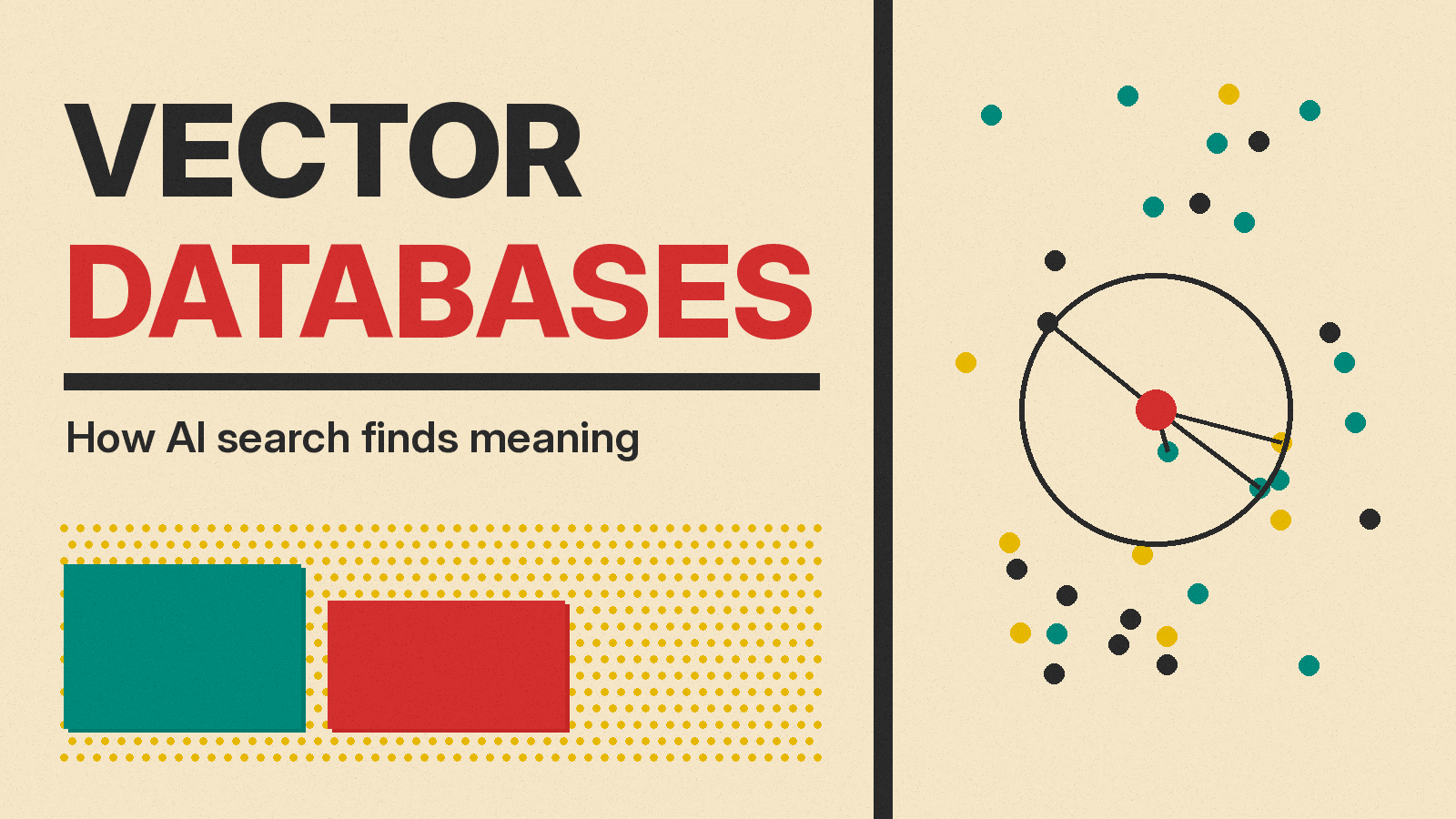
A vector database is a system that stores, manages and indexes data as vectors, which are arrays of numbers that represent the meaning of content such as text and images. Instead of matching exact keywords, it compares those numbers and returns the stored items whose vectors sit closest to the vector for your query, so results can match on meaning even when they share no words with the search terms. This is the machinery behind semantic search, chatbots that answer from stored documents, and image tools that find similar photos.
What is a vector database?
IBM defines the technology directly: "A vector database stores, manages and indexes high-dimensional vector data." In these systems, data points are stored as arrays of numbers called vectors, which can be compared and clustered based on similarity.
In plain English, every item in the database, whether a word, a sentence, a document, or an image, gets an ordered list of numbers. Those numbers describe the item, and items with similar meanings receive similar vectors. Related items therefore land close to each other, and unrelated items land far apart. Clustering groups nearby vectors together, and comparison measures how close any two vectors are.
IBM uses a simplified toy example to show the idea. The word cat might be represented as [0.2, -0.4, 0.7] and the word dog as [0.6, 0.1, 0.5]. Because the two words have related meanings, their vectors are expected to be close together. The example uses three numbers per word to keep it simple.
The numerical representations that convert data such as text and images into arrays of numbers are called vector embeddings. For a deeper look at how that conversion works, see our explainer on embeddings. If words like embedding, index, and query are new to you, our AI glossary defines common AI terms in plain English.
How does a vector database work?
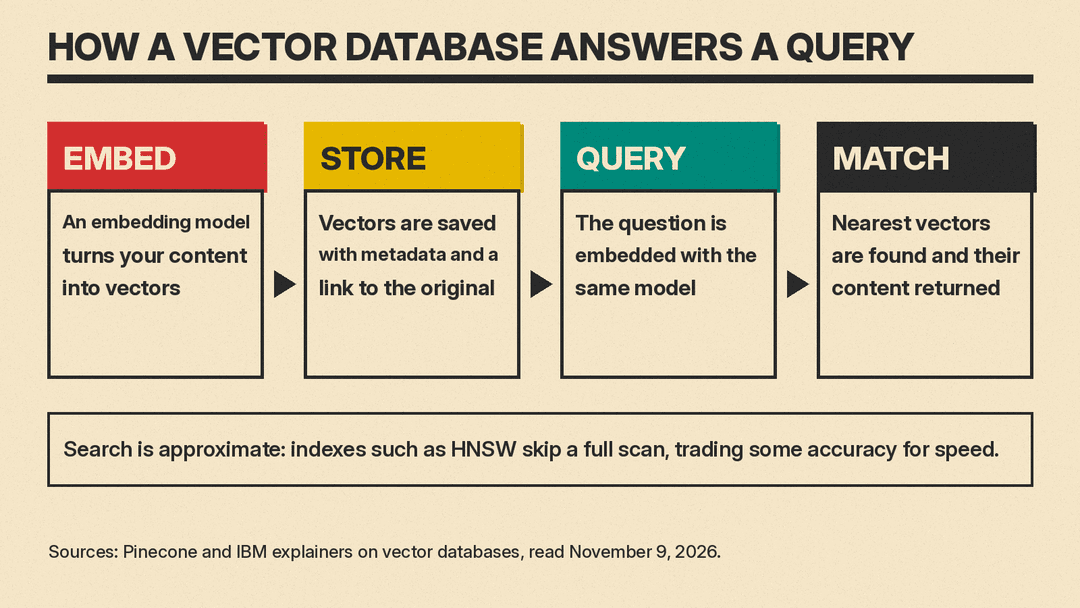
Pinecone describes the overall flow: use an embedding model to create embeddings for your content, insert those embeddings into the vector database with a reference to the original content, and at query time use the same embedding model to embed the query and find similar embeddings, which link back to the original content. The named steps below walk through each stage.
The embedding step. An embedding model converts data such as text and images into arrays of numbers. These embeddings are generated in advance and stored, so the database does not recompute them at query time (IBM). The work of turning meaning into numbers happens before anyone searches.
The storage and indexing step. Embeddings are inserted into the database along with a reference to the original content (Pinecone). IBM notes that embeddings are typically stored alongside metadata such as title, source, timestamp, or category, and that this metadata can be used in filters to narrow a search. The database also builds indexes that support approximate nearest-neighbor (ANN) search, which retrieves similar vectors without scanning the entire dataset. Common ANN algorithms include hierarchical navigable small world (HNSW), a multi-layer graph, and locality-sensitive hashing (LSH), which groups similar vectors into buckets. AWS also lists Inverted File Index (IVF). A related technique, product quantization (PQ), reduces memory use by storing short codes.
What makes the result a database rather than a bare index: AWS says vector databases add data management, fault tolerance, critical security features, and a query engine on top of nearest-neighbor indexes. Pinecone points out that stand-alone vector indexes like Faiss improve search but lack database features such as inserting, deleting and updating data, metadata filtering, backups, and access control.
The query step. At query time, the query itself is turned into an embedding, called a query vector. The database compares the query vector with the indexed vectors and calculates similarity scores to find the nearest neighbors. Common similarity measures include cosine similarity, dot product, and Euclidean distance. IBM also lists Jaccard and Hamming. The matching embeddings link back to the original content, which is what the searcher receives.
Because ANN search returns approximate results, Pinecone says the main trade-off is accuracy versus speed.
How is a vector database different from a regular database?
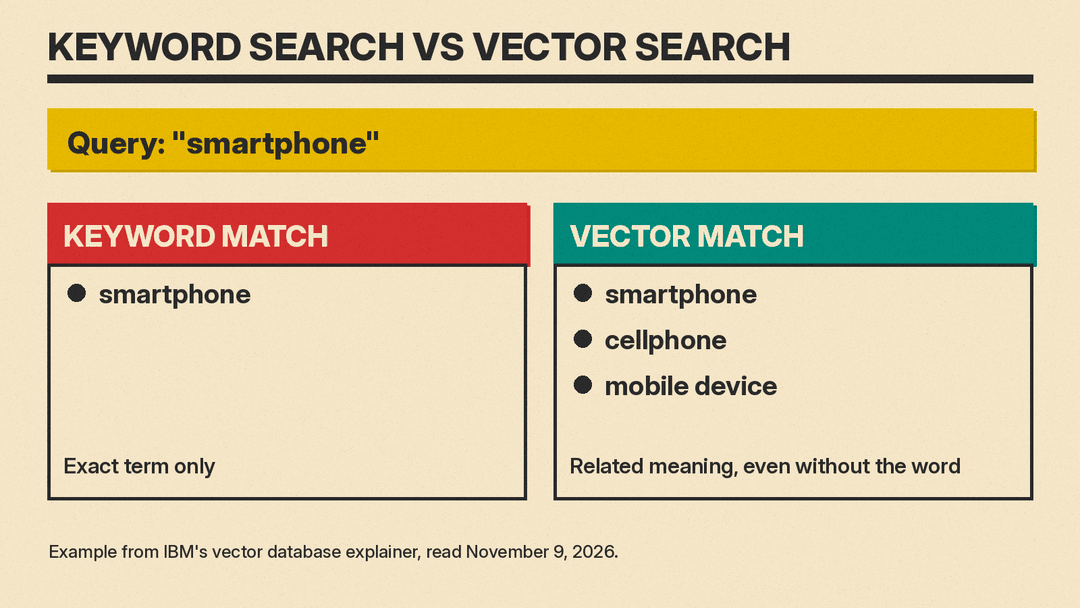
IBM notes that traditional search relies on keywords, tags, or metadata and returns exact matches. A search for "smartphone" retrieves only content containing that term. A vector search for "smartphone" can also return semantically related results such as "cellphone" or "mobile device", even if those exact words do not appear.
The difference is what gets compared. A regular database matches the characters and values you type. A vector database matches numerical representations of meaning, so related content can surface without any shared wording.
The two approaches can also be combined. AWS describes hybrid search, which indexes metadata alongside vectors so a system can search on both keywords and vectors, and can blend scores from term-frequency models like BM25 with vector similarity scores. Vector search can also be added to software you may already run instead of living in a separate system, as with pgvector, a vector extension for PostgreSQL (IBM).
What is a vector database used for?
IBM lists four main use cases: retrieval-augmented generation (RAG), conversational AI, recommendation engines, and anomaly detection.
RAG is a pattern that connects a large language model to a store of trusted data, and vector databases supply the retrieval part. Our plain-English explainer of RAG covers how the pattern works. IBM says grounding a model in trusted data through RAG reduces hallucinations and gives users access to the underlying sources. AWS makes a similar point from the other direction: generative models are prone to hallucinations, and vector databases can provide an external knowledge base for chatbots. For background on why models invent things, see our explainer on AI hallucinations.
For conversational AI, IBM says vector databases, particularly when used for RAG, can help virtual agents parse knowledge bases and give answers along with the source documents and page numbers for reference.
Image search is an everyday example. AWS describes taking a photo with your smartphone and searching for similar images. The system embeds both your photo and the stored images as vectors and returns the closest matches.
The other two items on IBM's list work the same way. Recommendation engines represent customer preferences and product attributes as vectors to suggest items similar to past purchases. Anomaly detection represents normal behavior as vectors, so data points that fall far from established clusters can signal fraud, system faults or unusual activity.
What are examples of vector databases?
IBM groups the available options into these types:
- Stand-alone vector databases such as Pinecone, which is proprietary.
- Open source vector databases such as Weaviate or Milvus.
- Data lakehouses with vector capabilities.
- Vector extensions for existing databases, such as PostgreSQL's open source pgvector extension.
- Search engines with vector support such as OpenSearch.
- Serverless vector databases, which remove the need to manage infrastructure.
Specific tools, described the way their own pages or IBM describe them:
- pgvector: open-source vector similarity search for Postgres. It lets you store vectors with the rest of your data.
- Faiss: a library for efficient similarity search and clustering of dense vectors, developed primarily at Meta's Fundamental AI Research group. It is a library, not a full database.
- Chroma: describes itself as open-source search infrastructure for AI.
- Qdrant: describes itself as an open-source vector search engine written in Rust.
- Milvus: describes itself as a high-performance vector database built for scale.
- Weaviate: an open source vector database, per IBM.
- Pinecone: a proprietary stand-alone vector database, per IBM.
- OpenSearch: a search engine with vector support, per IBM.
When don't you need a vector database?
IBM cautions that vector databases are not ideal for every query. Topic summarization or broad thematic analysis needs a large language model to read all relevant context rather than rely only on nearest-neighbor matches.
Traditional search also still has a job. IBM notes that it returns exact matches on keywords, tags or metadata. Our reading: if your lookups hinge on one exact term, a regular database search may be all you need.
Finally, keep the approximation in mind. Pinecone says results are approximate and that the main trade-off is accuracy versus speed. If a workload cannot accept approximate matches, that trade-off needs to be weighed before choosing this approach.
How can a beginner try one?
If you already use Postgres, pgvector adds vector search to it, so vectors can live alongside your existing data. Chroma and Qdrant call themselves open source on their own sites, Milvus calls itself an open-source project on GitHub, and IBM lists Weaviate as open source. Frameworks like LangChain connect LLM applications to vector stores (IBM), which is one common way an AI application reaches a database.
Ready for the engineering details? Our technical comparison of Qdrant, Milvus, Weaviate and pgvector in production covers index types, filtering and serving costs, and our guide to embedded vector databases compares options such as LanceDB, sqlite-vec and Chroma.
Who works with vector databases?
You do not need one specific job title to encounter this technology. IBM groups the people who use vector databases into builders (developers, data engineers, AI and ML engineers, and data scientists) and operators (operations and site reliability teams, enterprise architects, security and governance teams, and business and data executives). Our reading for students and career switchers: the skill shows up across many roles, not one specialty. See our AI engineer vs ML engineer vs data scientist guide for how those roles differ.
Bottom line
A vector database stores content as arrays of numbers called vectors and finds the closest matches to a query by comparing those numbers, so results can align with meaning instead of exact words. It supports retrieval-augmented generation, conversational AI, recommendation engines, anomaly detection, and similar-image search, and grounding a model in stored sources through RAG can reduce hallucinations. It is not a replacement for regular databases: exact keyword lookups still suit traditional search, summarization needs a model that reads all relevant context, and vector results are approximate, trading accuracy for speed.
