
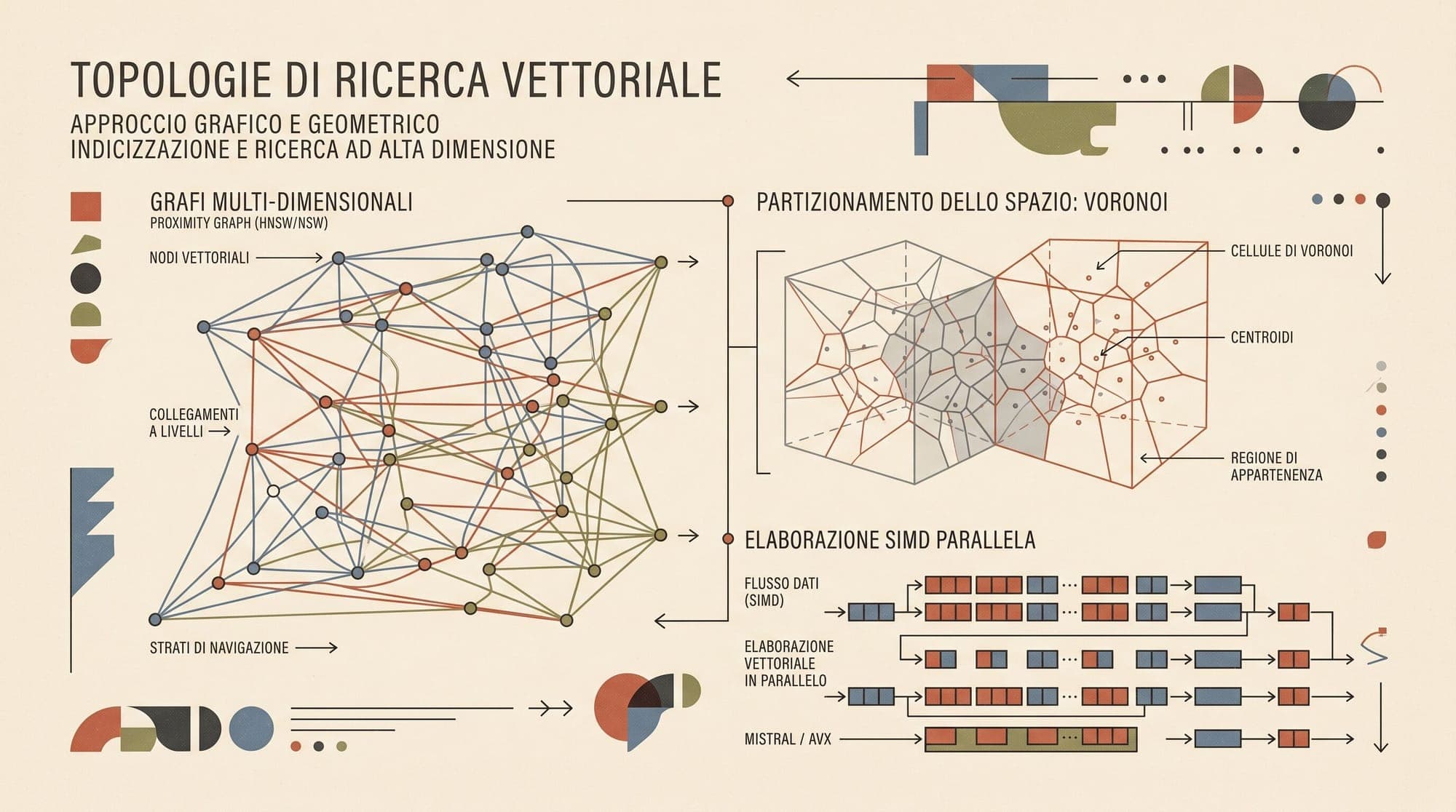
Vector retrieval systems across modern retrieval-augmented generation (RAG) pipelines, multimodal search engines, and recommendation systems depend on low-level Approximate Nearest Neighbor (ANN) search libraries. While production systems often wrap these engines inside managed vector databases such as Qdrant, Milvus, Weaviate, or ClickHouse, the fundamental compute bottlenecks, memory limits, and latency profiles are dictated by the underlying C++ vector indexing libraries.
Four open-source libraries dominate production indexing and research deployments: Meta AI's Faiss, Yury Malkov's HNSWLib, Google Research's ScaNN, and Unum's USearch. Each library embodies distinct engineering priorities, ranging from composite quantization pipelines and GPU kernel acceleration to single-header zero-dependency graph traversals and SIMD-driven out-of-core execution.
Core Indexing Topologies and Mathematical Foundations
Approximate nearest neighbor algorithms trade absolute recall accuracy for orders-of-magnitude faster retrieval times by structuring high-dimensional space into navigable graphs, inverted clusters, or quantized subspaces.
Hierarchical Navigable Small World (HNSW)
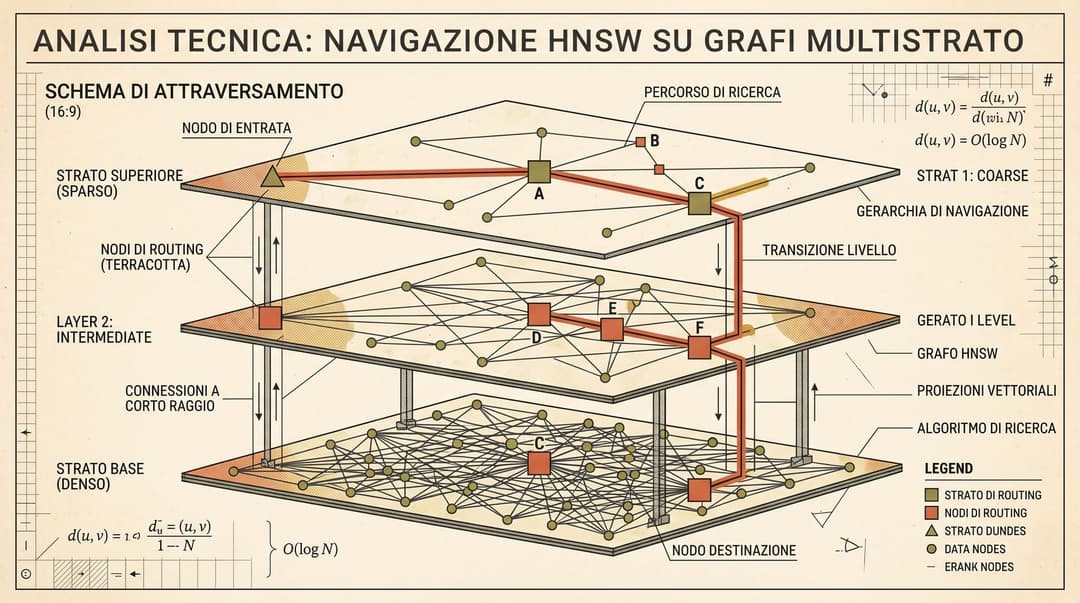
HNSW constructs a multi-layer graph where each layer represents a proximity network with decreasing link density. The structure functions analogously to a probabilistic skip-list:
- Upper layers contain sparse long-range connections between vectors, enabling fast greedy routing across distant regions of the vector space.
- Lower layers contain dense short-range edges that refine the search neighborhood.
- The bottom layer contains all indexed vectors connected to their nearest neighbors within a degree bound parameter
M.
At query time, the search begins at an entry point in the top layer, performs greedy routing to find the closest node in that layer, drops to the corresponding node in the layer below, and repeats until reaching the bottom layer. At layer 0, an exploratory beam search bounded by the efSearch parameter identifies the top-k nearest neighbors.
HNSWLib, USearch, and Faiss (via IndexHNSWFlat) implement variants of this topology. HNSW achieves high Recall@K (often exceeding 98 percent) at sub-millisecond latencies, but incurs high memory overhead due to graph pointer storage (typically 32 to 64 bytes of structural overhead per vector).
Inverted File Indexing (IVF)
Inverted File indices partition the vector space into Voronoi cells using k-means clustering. Index construction involves two stages:
- A coarse quantizer clusters the training corpus into
nlistVoronoi centroids. - Each vector is assigned to its nearest centroid and appended to the corresponding inverted list.
During inference, a query vector is compared against all nlist centroids to identify the nprobe closest clusters. The engine then scans only the vectors stored within those selected inverted lists. IVF reduces distance computations from N to approximately (nprobe / nlist) * N, but recall drops if the nearest neighbors fall across Voronoi cell boundaries that are not probed.
Tree-AH Hybrid Partitioning (ScaNN)
Google's ScaNN combines a vector quantization tree for search space pruning with Asymmetric Hashing (AH) for rapid distance calculation. The index groups vectors into coarse clusters using a balanced hierarchical tree, identifies candidate leaves for a query, computes fast quantized distances across candidates, and performs exact-distance rescoring on the top-ranked candidates using uncompressed vectors.
Quantization Mechanics and Residual Error Modeling
Compression techniques allow index structures to fit massive multi-million or billion-scale vector datasets into host RAM or GPU VRAM.
Product Quantization and FastScan (Faiss)
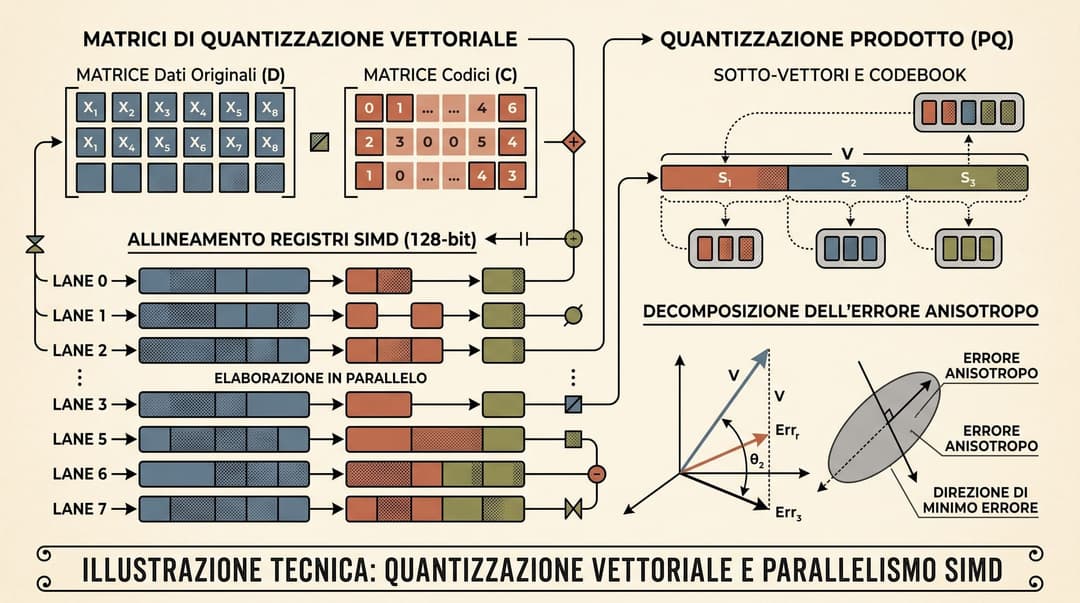
Product Quantization (PQ) decomposes a D-dimensional vector into M orthogonal sub-vectors of dimension D / M. For each sub-space, a codebook of K centroids (typically 256 centroids, represented by 1 byte) is learned via k-means. A 1536-dimensional float32 vector (6144 bytes) decomposed into 64 sub-vectors is represented as 64 bytes, yielding a 96x compression ratio.
In asymmetric distance computation (ADC), the query remains unquantized while indexed vectors are represented as PQ codes. Faiss precomputes a lookup table of distances between query sub-vectors and codebook centroids.
Faiss FastScan optimizes this process by packing 4-bit quantized codes across consecutive SIMD registers. Using AVX-512 and ARM NEON register interleaving, FastScan computes distance lookups across multiple vectors simultaneously using parallel shuffle instructions (vpshufb on x86, vtbl on ARM), drastically reducing memory bandwidth bottlenecks.
Anisotropic Vector Quantization (ScaNN)
Standard vector quantization minimizes isotropic reconstruction error (the Euclidean norm of the residual vector between the original and quantized points). However, Google Research demonstrated in ICML 2020 that for Maximum Inner Product Search (MIPS), isotropic error minimization degrades ranking accuracy.
Quantization errors parallel to the original vector directly distort the magnitude of dot products and alter candidate rankings. In contrast, orthogonal quantization errors have a negligible impact on dot products with query vectors that align with the original point.
ScaNN introduces Anisotropic Vector Quantization (AVQ), which applies an asymmetric loss function that penalizes residual errors parallel to the data vector significantly more than orthogonal errors:
- Parallel error penalty: Heavily weighted to preserve relative inner-product magnitudes.
- Orthogonal error penalty: Loosely constrained, allowing the codebook to optimize for directional fidelity.
This formulation allows ScaNN to maintain high retrieval precision for top inner products at compression levels comparable to standard product quantization.
Native Sub-Byte and Reduced Precision (USearch)
USearch avoids codebook training overhead while cutting memory footprint by supporting native hardware scalar quantization types:
- Half-precision: Standard IEEE 754 16-bit floats (FP16) and Brain Floating Point (BF16).
- Quarter-precision: 8-bit integer formats (INT8) and 8-bit floating point (E5M2).
- Sub-byte quantization: Down to 1-bit and 4-bit scalar projections.
Distance kernels in USearch dynamically dispatch to SIMD intrinsics from SimSIMD, executing direct vector comparisons over mixed-precision buffers without runtime decompression to float32.
Unquantized High-Precision Graph Traversal (HNSWLib)
HNSWLib stores raw vector buffers (float32, with extensions for float16 or uint8) directly alongside graph adjacency lists. Because it avoids quantization artifacts, HNSWLib delivers high raw recall on datasets with subtle geometric boundaries, but requires memory equivalent to (dimensions * sizeof(float) + M * sizeof(int32)) * N bytes.
Deep Library Profiles
1. Meta Faiss (Facebook AI Similarity Search)
Faiss is a comprehensive vector retrieval library designed for both CPU and GPU execution. Developed by Meta AI Research, it provides a modular ecosystem of composable index types.
- Core Index Types:
IndexFlatL2,IndexIVFFlat,IndexIVFPQ,IndexHNSWFlat,IndexHNSWPQ,IndexPQFastScan, and Additive Quantization variants (IndexResidualQuantizer,IndexLocalSearchQuantizer). - Hardware Support: x86 AVX2/AVX-512, ARM NEON, NVIDIA CUDA (via
GpuIndexIVFPQand cuVS integration). - Concurrency Model: OpenMP multithreading across CPU cores; multi-GPU sharding with concurrent kernel execution.
- Key Strengths: Unmatched breadth of indexing algorithms, specialized GPU acceleration, advanced composite pipelines (e.g.,
IVF65536,PQ64x4fs), and billion-scale partitioning. - Limitations: Large codebase footprint, complex build dependencies (BLAS, LAPACK, CUDA), high memory overhead for pure HNSW implementations, and limited real-time dynamic update capabilities for quantized indices without full retraining.
2. HNSWLib
Authored by Yury Malkov, HNSWLib is a minimalist, header-only C++ library dedicated exclusively to Hierarchical Navigable Small World graphs.
- Core Index Types: Hierarchical Navigable Small World graph over raw vectors.
- Hardware Support: SSE, AVX, AVX2, AVX-512, and ARM NEON SIMD optimizations.
- Concurrency Model: Native C++11 standard library threads with fine-grained per-node locking, enabling thread-safe concurrent vector additions and searches without external threading dependencies.
- Key Strengths: Header-only zero-dependency integration, rapid compile times, straightforward API, support for dynamic vector insertions/deletions, and custom boolean filtering callbacks during graph traversal.
- Limitations: Limited to in-memory HNSW graphs without native quantization or disk-backed structures, leading to substantial RAM requirements at scale.
3. Google ScaNN (Scalable Nearest Neighbors)
ScaNN is Google Research's vector similarity search library, providing the indexing engine behind Google Cloud Vertex AI Vector Search.
- Core Index Types: Anisotropic Vector Quantization with tree-based inverted search space pruning and candidate rescoring.
- Hardware Support: Heavily tuned for x86 architectures with AVX2 and AVX-512 FMA instructions.
- Concurrency Model: Multi-threaded batch query execution and OpenMP-accelerated index builds.
- Key Strengths: Benchmark-leading QPS for Maximum Inner Product Search (MIPS) at medium-to-high recall targets; anisotropic loss preserves ranking precision; efficient three-phase pipeline (partitioning, asymmetric hashing, exact rescoring).
- Limitations: Primarily optimized for x86 CPU architectures; limited native GPU support; static index architecture requiring batch retraining for significant dataset updates; heavier build setup tied to Bazel.
4. Unum USearch
USearch is a modern, single-header C++11 vector search engine created by Unum, designed for cross-language embedding and low-latency execution across edge and server hardware.
- Core Index Types: HNSW graph indexing over scalar, quantized, and custom metric spaces.
- Hardware Support: Tailored SIMD kernels using SimSIMD for AVX2, AVX-512, ARM NEON, and ARM SVE with masked loads to eliminate loop tails.
- Concurrency Model: Lock-free reads, atomic graph updates, and concurrent multi-threaded batch insertion.
- Key Strengths: Single-header simplicity with zero mandatory external dependencies; broad language bindings (Python, Rust, JavaScript, Go, Swift, Java, C#, C); native support for FP16, BF16, and INT8; out-of-core memory mapping (
mmap) allowing multi-terabyte indexes to be served directly from SSD without RAM residency; arbitrary user-defined metric functions. - Limitations: Does not implement complex composite product quantization trees like Faiss or anisotropic residual loss like ScaNN.
Production Trade-Off Comparison
Evaluating vector indexing libraries requires balancing algorithmic trade-offs across four operational dimensions:
1. Build Latency and Training Overhead
- Faiss (IVF/PQ): Requires an explicit offline training step on a representative vector sample to learn k-means centroids and PQ codebooks before inserting data.
- ScaNN: Requires training for tree partitions and anisotropic quantization codebooks.
- HNSWLib and USearch: Do not require offline codebook training. Vectors can be streamed incrementally into the graph immediately upon instantiation.
2. Query Latency vs. Recall Economics
- At high recall thresholds (Recall@10 > 0.98), HNSWLib and USearch deliver lower query latencies because graph traversal navigates continuous geometric manifolds without quantization error.
- At moderate recall thresholds (Recall@10 between 0.85 and 0.95) under heavy QPS loads, ScaNN and Faiss FastScan achieve higher throughput by evaluating thousands of quantized candidates per millisecond via SIMD register lookups, followed by lightweight top-k rescoring.
3. Memory Footprint and Storage Hierarchy
- In-Memory Unquantized HNSW (HNSWLib): Requires approximately 6.5 GB of RAM per million 1536-dimensional float32 vectors (6.14 GB vector data + ~400 MB graph edges).
- Native Reduced Precision HNSW (USearch with FP16/BF16): Cuts memory requirements to roughly 3.5 GB per million vectors while retaining high recall.
- Disk-Mapped Serving (USearch
view): Serves indexes directly from NVMe storage usingmmap, keeping memory usage proportional only to the active OS page cache. - Quantized Inverted Lists (Faiss IVFPQ / ScaNN AH): Compresses 1 million 1536-dimensional vectors down to 64-128 MB of RAM, trading index reconstruction precision for density.
4. Mutability and Dynamic Updates
- HNSWLib and USearch support real-time point insertions, vector deletions, and in-place graph updates without degrading graph connectivity.
- Faiss and ScaNN are primarily designed for static or batch-append workflows; deleting or updating vectors in quantized IVF indices often requires rebuilding the inverted lists or retraining codebooks to prevent centroid drift.
Architectural Decision Framework
When selecting a low-level vector indexing library for production workloads, align your choice with operational constraints:
- Choose Meta Faiss when workloads require GPU acceleration (NVIDIA Hopper/Blackwell clusters), multi-billion-scale dataset sharding across distributed nodes, or composite multi-level quantization schemes (such as IVF-PQ with FastScan).
- Choose HNSWLib when building a lightweight, C++ or Python service requiring maximum Recall@K, fast compilation without third-party dependencies, and thread-safe real-time insertions.
- Choose Google ScaNN when serving high-throughput Maximum Inner Product Search (MIPS) on x86 CPU servers, where search space pruning, anisotropic asymmetric hashing, and unquantized rescoring deliver optimal QPS-to-accuracy ratios.
- Choose Unum USearch when deploying across heterogeneous environments (embedded edge devices, polyglot microservices in Rust/Go/Node), when memory constraints necessitate native FP16/BF16/INT8 storage, or when large indexes must be served out-of-core from NVMe disks via zero-copy memory mapping.
Sources
- Meta AI: Faiss GitHub Repository
- Johnson, Douze, and Jégou: Billion-scale similarity search with GPUs (IEEE TBD 2019 / arXiv:1702.08734)
- Douze et al.: The Faiss library (arXiv:2401.08281)
- Malkov and Yashunin: Efficient and robust approximate nearest neighbor search using Hierarchical Navigable Small World graphs (IEEE TPAMI 2018 / arXiv:1603.09320)
- nmslib / HNSWLib: Header-only C++ library for fast approximate nearest neighbors
- Google Research: ScaNN GitHub Repository
- Guo et al.: Accelerating Large-Scale Inference with Anisotropic Vector Quantization (ICML 2020 / PMLR)
- Google Research Blog: Announcing ScaNN: Efficient Vector Similarity Search
- Unum Cloud: USearch GitHub Repository
- Unum Cloud: USearch Architecture and SIMD Benchmarks
