
Generating temporally coherent, high-resolution video from natural language prompts has transitioned from UNet-based frame interpolation pipelines to scalable Diffusion Transformers (DiT) operating over compressed spatiotemporal latent spaces. The release of open-weight video foundation models has established production-viable alternatives to proprietary commercial APIs. However, engineering teams deploying video generation pipelines face stark trade-offs across transformer parameter scaling, 3D latent compression topologies, conditioning mechanisms, VRAM constraints, and generation latency.
This technical analysis evaluates four prominent open-source video generation models across architecture, compression mechanics, serving infrastructure, and deployment economics: Tencent HunyuanVideo, THUDM/Zhipu AI CogVideoX, Genmo Mochi 1, and Lightricks LTX-Video.
Architectural Taxonomies: Dual-Stream, Single-Stream, and Asymmetric DiT
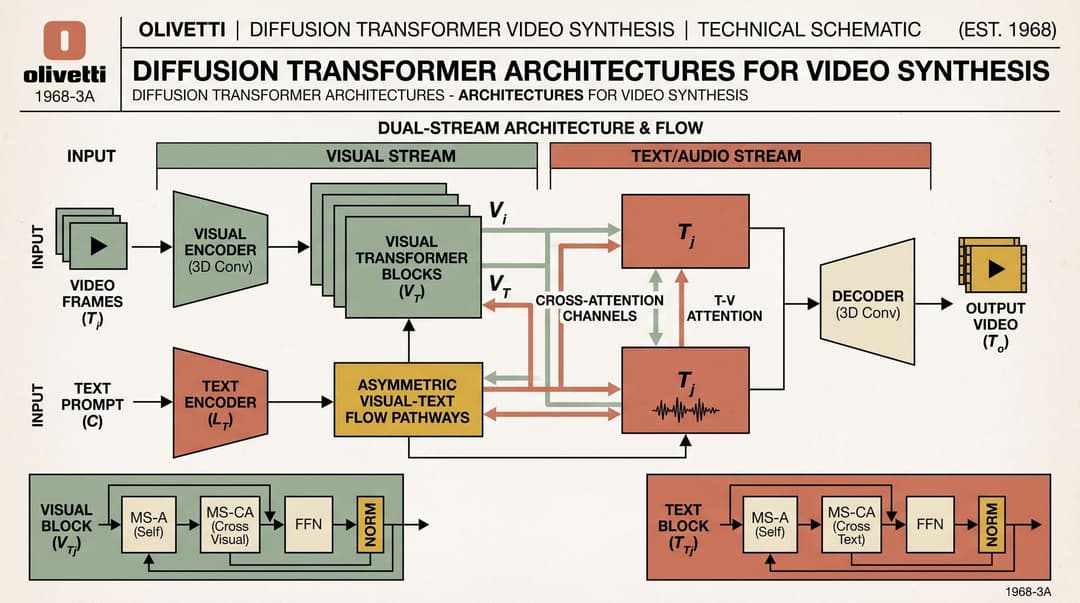
Video generation requires modeling high-dimensional correlations across both space and time while maintaining alignment with complex textual conditioning. The evaluated models diverge fundamentally in how their transformer backbones distribute compute between visual latent tokens and text conditioning representations.
Tencent HunyuanVideo: Dual-Stream to Single-Stream Hybrid DiT
Tencent's HunyuanVideo scales to over 13 billion parameters, making it one of the largest openly released text-to-video foundation models. HunyuanVideo implements a unified image and video framework using flow matching over a dual-stream to single-stream hybrid architecture:
- Dual-Stream Stage: Video latent tokens and text embeddings pass through 20 independent transformer blocks. Processing modalities in isolated streams allows visual features and linguistic semantics to apply specialized modulation parameters without cross-modal interference in early layers.
- Single-Stream Stage: After initial feature refinement, video and text tokens are concatenated and routed through 40 unified single-stream blocks with shared self-attention. This enables deep bidirectional cross-modal fusion across 60 total transformer layers.
- Conditioning Stack: Unlike architectures reliant solely on frozen CLIP or T5 encoders, HunyuanVideo pairs a decoder-only Multimodal Large Language Model (MLLM) with a bidirectional token refiner alongside a CLIP-Large pooled token for global semantic guidance.
- Output Capabilities: Generates native 1280x720 resolution video at 24 frames per second for up to 129 frames (approximately 5.4 seconds).
THUDM / Zhipu AI CogVideoX: 3D Expert Transformer
THUDM and Zhipu AI developed CogVideoX across 2B and 5B parameter configurations (as well as dedicated CogVideoX-1.5 checkpoints) centered on an Expert Transformer architecture:
- Expert Adaptive LayerNorm (adaLN): Instead of duplicating full transformer streams, CogVideoX applies modality-specific timestep conditioning via specialized normalization layers. Text and visual tokens share attention and feed-forward pathways while preserving distinct modulation trajectories.
- 3D Rotary Position Embeddings (3D-RoPE): Decomposes token coordinate indices across temporal, height, and width axes, enabling the model to extrapolate across variable aspect ratios and extended frame sequences without spatial distortion.
- 3D Full Attention: Attention matrices span all spatiotemporal tokens concurrently, avoiding the temporal-spatial factorized attention bottlenecks characteristic of earlier video UNet designs.
- Output Capabilities: Produces 768x1360 or 720p output at 16 frames per second for 6 to 10 seconds of continuous duration.
Genmo Mochi 1: Asymmetric Diffusion Transformer (AsymmDiT)
Genmo's Mochi 1 introduces a 10 billion parameter model designed around the Asymmetric Diffusion Transformer (AsymmDiT) paradigm:
- Asymmetric Capacity Allocation: Mochi 1 identifies that visual token synthesis demands significantly higher representational capacity than text representation processing. The visual stream hidden dimension is approximately 4x larger than the text stream dimension.
- Joint Multimodal Self-Attention: Visual and text streams maintain separate MLP layers while interacting in shared multi-modal attention layers via non-square query-key-value (QKV) and output projection matrices.
- Streamlined Text Conditioning: Employs a single T5-XXL encoder without auxiliary CLIP layers, simplifying the preprocessing pipeline.
- Output Capabilities: Generates 848x480 resolution clips at 30 frames per second with high physical fidelity for fluid dynamics, cloth motion, and hair physics.
Lightricks LTX-Video: Real-Time Lightweight DiT
Lightricks designed LTX-Video as a compact, high-throughput transformer scaling to approximately 2 billion parameters:
- Single-Stream Spatiotemporal DiT: Built on architectural principles derived from PixArt-alpha and standard Diffusion Transformers, LTX-Video concatenates text embeddings and spatiotemporal video latents directly into a single transformer stream.
- Flow Matching Formulation: Operates under linear velocity flow matching objectives, enabling high-quality trajectory integration with fewer sampling steps (typically 20 to 30 steps).
- High-Throughput Focus: Prioritizes real-time generation latency on consumer and edge GPU hardware.
- Output Capabilities: Produces 1216x704 resolution video at 24 to 30 frames per second, with execution times suitable for interactive applications.
3D Variational Autoencoders and Spatiotemporal Latent Compression
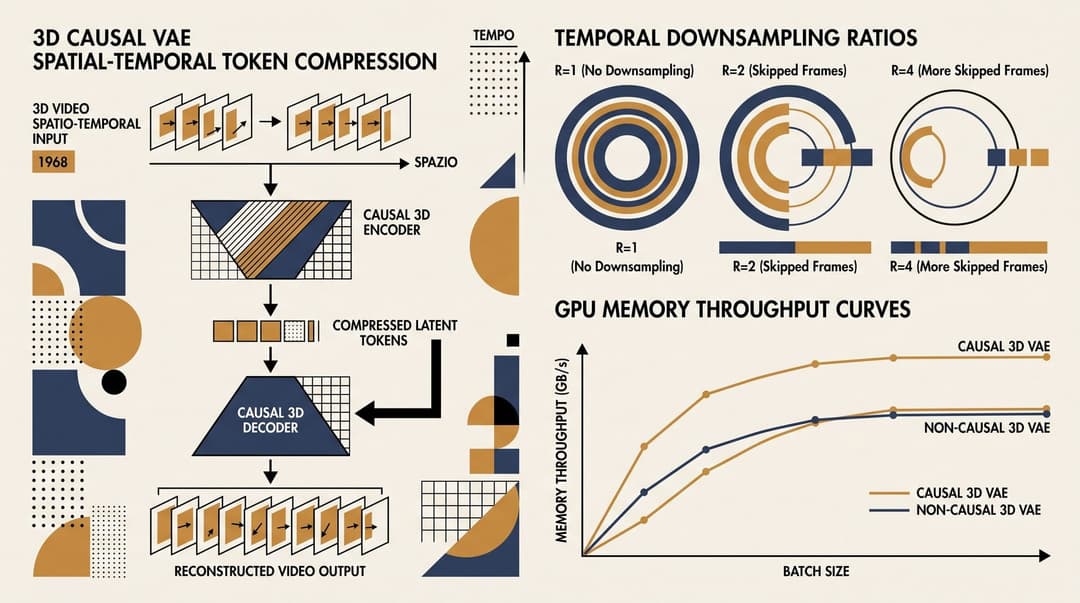
Directly evaluating self-attention over raw video pixel volumes is computationally intractable. A 5-second 720p video clip at 24 fps contains over 100 million RGB values. All modern video DiT models depend on 3D Variational Autoencoders (3D VAEs) to compress raw pixel data along both spatial and temporal dimensions into compact latent representations.
Causal 3D Convolutions vs. Frame Tiling
- HunyuanVideo Causal 3D VAE: Uses CausalConv3D layers that restrict temporal receptive fields to current and preceding frames, preventing future information leakage and maintaining temporal consistency during streaming decoding. Compresses raw video by 4x temporally, 8x spatially (height and width), and across 16 latent channels (resulting in an 8x8x4 spatial-temporal downsampling ratio).
- CogVideoX 3D Causal VAE: Implements an 8x spatial and 4x temporal compression pipeline with causal 3D convolutional blocks, reducing memory footprint by over 98% relative to uncompressed pixel tensors while mitigating temporal flicker.
- Mochi 1 3D Video VAE: Compresses 848x480 video at 30 fps into high-density latent channels, balancing high-frequency spatial detail with smooth temporal transitions.
- LTX-Video High-Compression VAE: Utilizes an aggressive 32x spatial and 8x temporal compression ratio, reducing the sequence length of the latent representation significantly and enabling fast forward passes through its DiT backbone.
Hardware Footprints and Memory Optimization
Serving video diffusion models in production introduces severe GPU memory and bandwidth requirements. Transformer sequence length scales with , where represents the patchification kernel dimensions.
VRAM Requirements and Precision Scaling
- HunyuanVideo (13B): Running HunyuanVideo at native BF16 precision requires approximately 80GB VRAM (an NVIDIA A100 or H100 80GB GPU). With FP8 weight and activation quantization (via bitsandbytes or torchao) combined with CPU parameter offloading for text encoders, HunyuanVideo can run on a single 24GB VRAM GPU (such as an NVIDIA RTX 4090 or RTX 3090), though offloading incurs significant data transfer latency.
- Mochi 1 (10B): Native BF16 inference demands at least 48GB to 80GB VRAM. Community FP8 implementations and context parallelism run across multiple 24GB GPUs or a single A6000 48GB GPU.
- CogVideoX (2B / 5B): CogVideoX-2B fits comfortably in 16GB to 24GB VRAM, making it deployable on entry-level enterprise or consumer cards. CogVideoX-5B operates in 24GB VRAM with FP8 quantization and pipeline offloading.
- LTX-Video (~2B): Highly memory-efficient, fitting inside 12GB to 16GB VRAM at native precision. It serves as the baseline choice for deployments constrained to standard cloud instances with NVIDIA L4 or T4 GPUs.
Attention Optimizations
Standard scaled dot-product attention scales quadratically with sequence length. Production inference harnesses for these models incorporate advanced attention kernels:
- FlashAttention-3 and SageAttention: Replaces naive attention operations with tiled, I/O-aware kernels that reduce intermediate memory footprint and maximize Tensor Core utilization.
- Context Parallelism (RingAttention / DeepSpeed Ulysses): Distributes long video token sequences across multi-GPU nodes along the sequence dimension, amortizing KV cache and activation memory across cluster nodes for high-resolution generation.
Production Serving, Latency Profiles, and Inference Economics
Generation latency dictates whether a video model can support interactive user-facing workflows or batch processing pipelines.
Latency Profiles Across Hardware Tiers
- Lightricks LTX-Video: Generates a 5-second clip in under 5 seconds on an NVIDIA H100 GPU and approximately 60 to 90 seconds on a single NVIDIA RTX 4090. Its low step count (20 to 30 flow matching steps) and compact parameter size provide the highest token-per-second throughput.
- CogVideoX-2B / 5B: CogVideoX-2B generates clips in approximately 90 to 120 seconds on an RTX 4090, while CogVideoX-5B requires 3 to 4 minutes on 24GB hardware.
- HunyuanVideo: Requires approximately 5 to 7 minutes on an RTX 4090 with FP8 quantization and CPU offloading. On an NVIDIA H100 GPU without offloading, generation time drops to under 45 seconds per 5-second clip.
- Mochi 1: Compute-intensive due to its 10B parameter AsymmDiT backbone and 64 diffusion steps, requiring 7 to 9 minutes on a single consumer GPU or under 60 seconds across multi-GPU H100 clusters.
Downstream Capabilities and Fine-Tuning Ecosystem
- Image-to-Video (I2V) Support: CogVideoX offers dedicated, mature CogVideoX-5B-I2V checkpoints with strong conditioning stability. LTX-Video features native image-to-video framing. HunyuanVideo and Mochi 1 have active community I2V pipelines and LoRA adapters.
- Ecosystem and Tooling Integration: CogVideoX and HunyuanVideo have extensive support across ComfyUI, Diffusers, and Kohya LoRA training scripts, facilitating rapid domain adaptation for custom art styles and character consistency.
- Licensing Considerations: Mochi 1 and LTX-Video are released under permissive open-source licenses (Apache 2.0). CogVideoX and HunyuanVideo operate under customized open model licenses that permit commercial deployment subject to specific revenue and compliance thresholds.
Production Selection Guide
Engineering teams selecting an open-source video generation model should evaluate their operational constraints against the following deployment profiles:
- Select HunyuanVideo when maximum visual fidelity, photorealistic texturing, and adherence to complex multi-sentence prompts are the primary requirements, and infrastructure budgets allow for 80GB enterprise GPUs or quantized batch clusters.
- Select CogVideoX when building structured Image-to-Video and Video-to-Video production pipelines that require extensive LoRA fine-tuning support and manageable memory footprints on 24GB GPUs.
- Select Mochi 1 when physical motion plausibility, fluid mechanics, and organic dynamics take precedence over inference speed, and an Apache 2.0 license is mandatory.
- Select LTX-Video when low latency, high request throughput, and low cost-per-minute of generated video are the driving constraints, such as real-time interactive generation or high-volume edge deployments.
Sources
- HunyuanVideo: A Systematic Framework For Large Video Generative Models
- Tencent HunyuanVideo Repository
- CogVideoX: Text-to-Video Diffusion Models with An Expert Transformer
- THUDM CogVideoX Repository
- Genmo Mochi 1 Repository and Technical Overview
- LTX-Video: Realtime Video Latent Diffusion
- Lightricks LTX-Video Repository
