
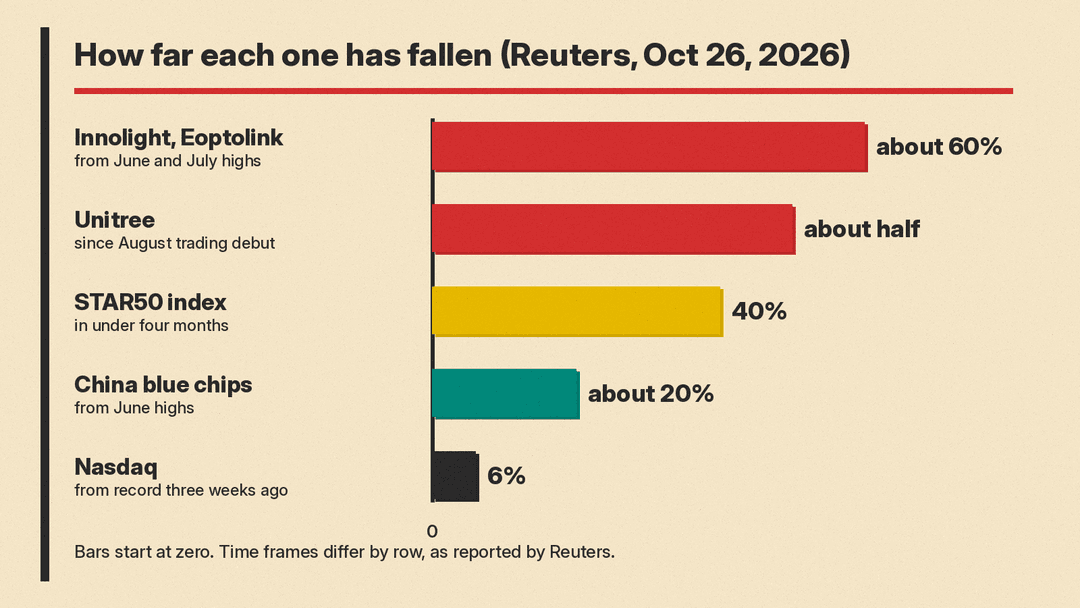
China's AI stock boom has turned into a crash. The STAR50, Shanghai's index of leading AI and semiconductor companies, has fallen 40% in less than four months and erased about $480 billion in market value, Reuters reported on October 26.
That is a far bigger drop than in the US. Reuters notes that US AI stocks have led a 6% drawdown in the Nasdaq from a record high set three weeks ago, which it calls "a mere prick" by comparison.
This is market news, not investment advice.
What fell, and by how much
Reuters lists the damage among retail favourites:
- Unitree, the robot maker whose listing was 8,000 times oversubscribed by retail buyers, has halved since it started trading in August. We covered its early post-listing slump in August.
- CXMT, the memory chipmaker, has lost more than a quarter of its value in the past month.
- MetaX Integrated Circuits and Moore Threads Technology, which jumped 700% and 400% on their market debuts last year, have also halved since July.
- Zhongji Innolight and Eoptolink Technology, which make optical parts, are down roughly 60% from their June and July highs. Reuters says that is partly because Washington is moving toward banning them from supplying US data centers.
China's broad blue-chip index has dropped about 20% from its June highs, according to Reuters. Seoul Economic Daily, citing Reuters, reports that the STAR50 closed at 1,315.50 on October 26, down 2.23% that day. The same report puts the index's three-month loss at 26.39%.
CXMT was already falling earlier this month. Caixin reported that the stock fell 7.79% on October 8, its largest single-day drop since it listed in July, amid concerns that memory chip prices may be nearing a peak.
Why it happened
Reuters says there was no obvious trigger for the selling. Traders told the news agency that high prices, tax bills and the threat of the US or other nations banning Chinese equipment in data centers all contributed.
The exposure is wide. AI stocks make up 42% of China's market capitalization and 57% of turnover across mainland A-shares and Hong Kong H-shares, according to Goldman Sachs figures cited by Reuters. In a market dominated by small investors, Reuters writes, few have escaped pain.
"The stock market later evolved into a speculative crazy bull," said Beijing-based fund manager Dong Baozhen. "And now we see the bubble bursting," Dong added.
Reuters also spoke to Chen Wensheng, a small business owner and investor from Hainan, who said he bought into the rally because he felt there was official support for companies like Unitree, which counted state-backed funds as investors. Chen told Reuters he and his friends are now nursing losses.
Valuations are still high
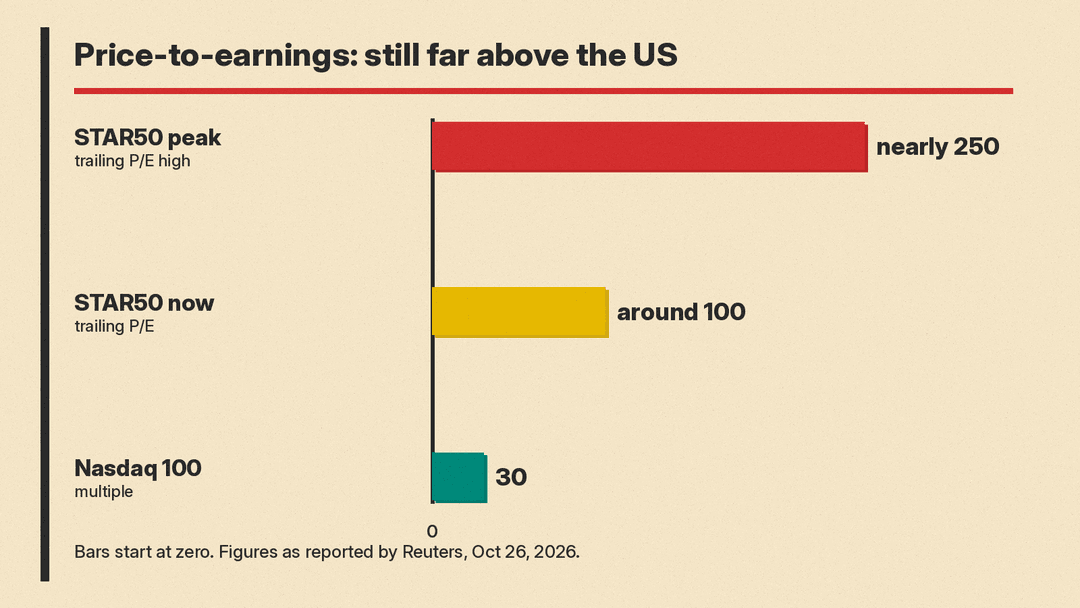
Even after the drop, the STAR50 trades at around 100 times trailing earnings, down from a high of nearly 250, Reuters reports. Investors compare that with the Nasdaq 100's multiple of 30 and worry the selloff could get worse before it gets better.
That matters beyond trading screens. Reuters says frustration over a Beijing-backed investment theme ending badly has pushed many investors into defensive assets and is likely to slow equity fundraising by tech firms.
"What's happening is now going to put a stop to many of the companies trying to get themselves listed," said Hong Hao, managing partner and chief investment officer at Lotus Asset Management in Hong Kong.
What regulators and analysts say
The frenzy contrasts with Beijing's own goals. Reuters says authorities had been trying to improve returns and dampen volatility by cracking down on leverage and high-frequency trading, and state-backed investors sold into rallies to keep gains in check. The aim was a steady "slow bull" market instead of China's long boom and bust pattern.
The China Securities Regulatory Commission did not immediately reply to questions Reuters faxed last week. Its chairman, Wu Qing, met market participants earlier this month to hear suggestions on improving capital markets, the regulator said on its website.
Some in the investment community blame how indexes are built. "Overemphasising the 'technology content', that is, the weighting of tech companies by market value in major indexes, leads to a deviation, even a distortion, in capital behaviour," said Leo Wang, partner at Beijing-based Qianchuang Capital. "This created a severe bubble in certain sectors and a serious drain on others," Wang said.
Not everyone is bearish. Reuters reports that some see value in the selloff and say it does not hurt longer-term market reforms. Asia funds in general are still overweight China, according to HSBC research, even though they have been sellers over the past three months. Goldman Sachs put Innolight and CXMT on a revamped recommendation list of Chinese AI stocks earlier this month, and BNP Paribas Securities strategist William Bratton has said the market offers buying opportunities for the careful.
Others are waiting. "Just like all other Chinese manufacturers, (chipmakers and AI suppliers) will eventually end up in a price war," said fund manager Wang Zhuo, partner at Shanghai Zhuozhu Investment Management. "There's no exception," Wang Zhuo said. "All bubbles inevitably burst."
The selloff hit listed stocks, not model releases: Moonshot AI launched Kimi K3.1 Pro on October 23, three days before the Reuters report. See our Kimi K3.1 Pro explainer.
Sources
- Reuters via Aaj English TV: China's AI stock rout wipes out $480 billion as bubble bursts
- Reuters via Investing.com: In China, the AI bubble has already burst (Oct 26, 2026)
- Seoul Economic Daily: China's AI Rally Unravels as Unitree Halves, CXMT Slides 25%
- Caixin Global: CXMT Shares Suffer Biggest Drop Since July IPO
