
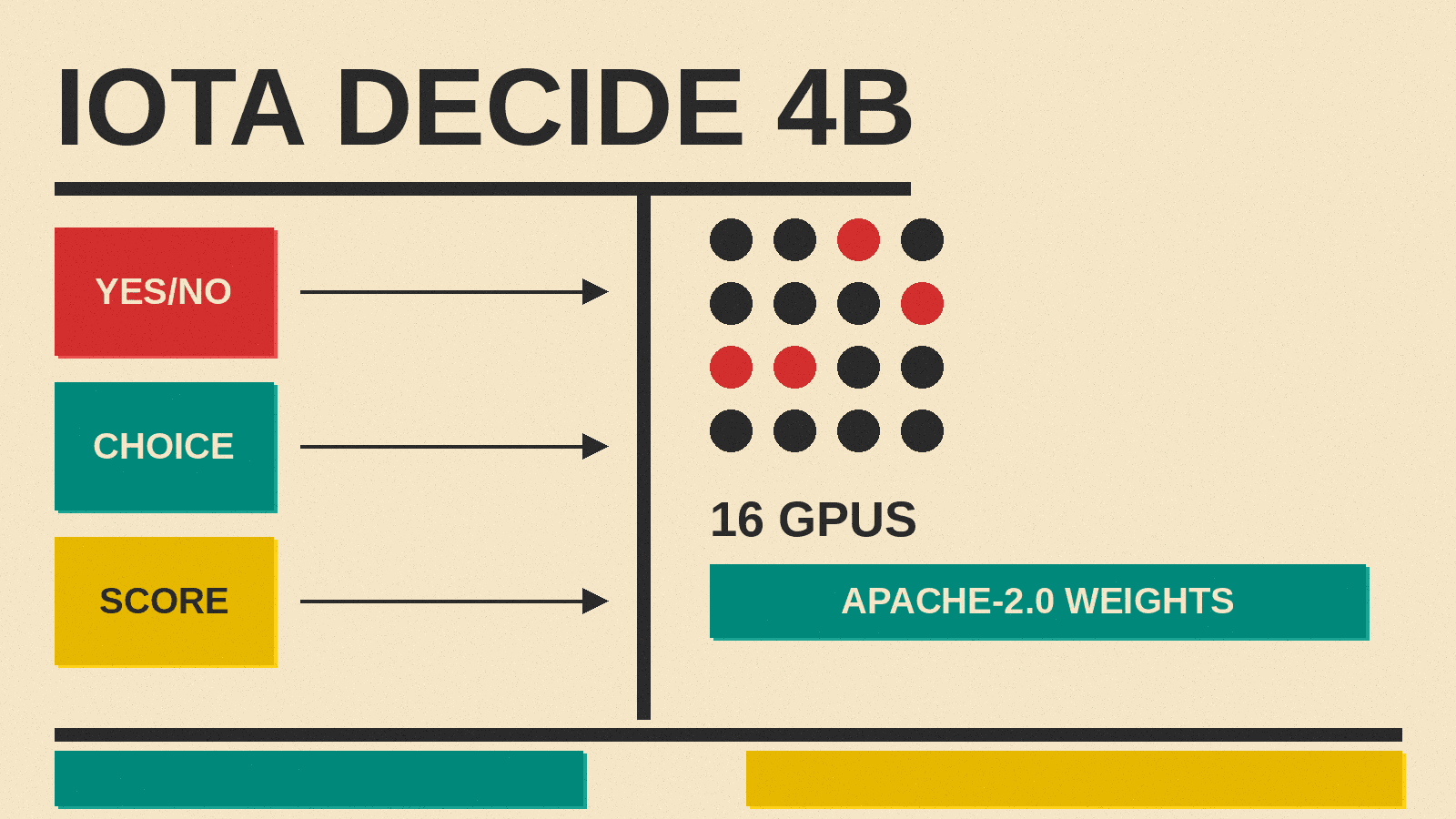
Macrocosmos has published IOTA Decide 4B v0.4, an open-weight model that does not write text. You give it a situation and a few typed questions, and it returns a probability for every answer. The weights are Apache-2.0, and the model card says it was trained on 16 consumer GPUs kept in sync over the internet instead of a GPU cluster. Tao Media reported the release on November 4, 2026.
What a decision model does
A chat model answers with a paragraph. A decision model answers with numbers that ordinary software can act on. Macrocosmos describes the input as a state, such as a support ticket, an agent trace, or a policy plus a request, along with typed questions about it. Each question gets its own forward pass through the model, and nothing is generated.
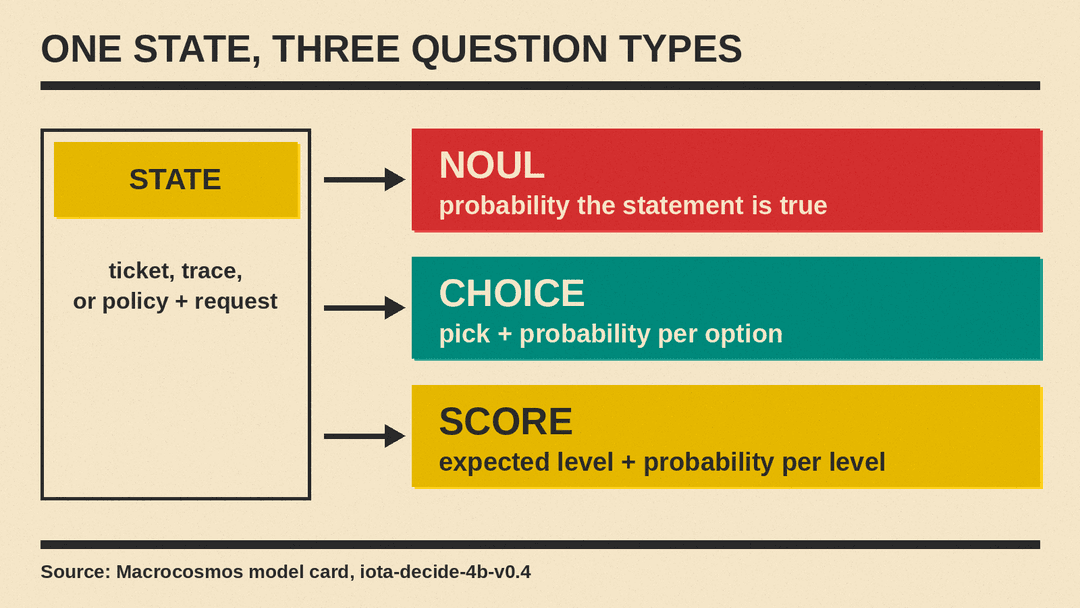
The model card lists three question types:
noulreturns the probability that a statement is true.choicereturns the chosen option, a confidence, and a probability for every option. Lists take 2 to 26 options.scorereturns an expected level, a confidence, and a probability for every level.
The example on the card sends a refund request made 45 days after purchase, plus a policy that allows refunds within 30 days. The questions ask whether the customer is eligible, which team should handle the ticket, and how urgent it is. Requests and responses use the SystemOne /v1/systemone format. A developer can threshold on the probabilities, for example by automating only above a set confidence and sending the rest to a person.
One detail matters for anyone setting thresholds. Yes/no answers are reported with at least 0.801 on the chosen side, because the JevBench test treats probabilities between 0.2 and 0.8 as abstentions. The answer itself does not change, but the reported number is not a raw uncertainty estimate.
This is the same kind of model as Baseten's joey-1, which we covered on October 29. joey-1 is a 2B model that Baseten fully fine-tuned on 16 H100 GPUs under the MIT license, and it can also read images. IOTA Decide is text only and used LoRA on distributed consumer GPUs.
Trained on 16 consumer GPUs
According to the model card, Macrocosmos started from Qwen3.5-4B and applied LoRA, a method that trains small adapter updates instead of every weight. The adapters were rank 64 with alpha 128, applied to every linear layer of the language model, then merged into the released weights. Training ran for 750 steps on 879,000 de-duplicated records. The run used streaming DiLoCo across 16 RTX A4000 machines, with four fragments, staggered merges, and no synchronous waits.
The card says the model is built with the company's IOTA SDK. Tao Media reports the SDK is still listed as coming soon, with registration open. You do not need the SDK to run the weights.
The benchmark numbers
Macrocosmos reports a JevBench composite of 78.6, measured by Benchmark Heaven. The composite weights intelligence, calibration, speed, and cost equally. The card gives the four parts as 60.2, 87.8, 92.2, and 83.0, and about 33 milliseconds per decision on one GPU, as measured by Benchmark Heaven.
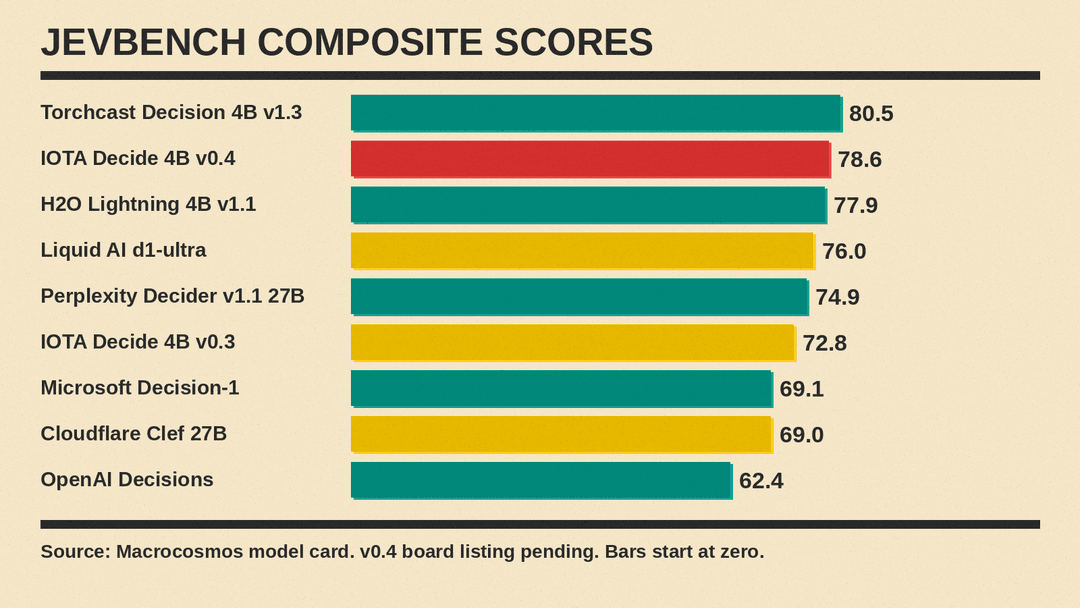
IOTA Decide v0.4 ranks second in that list, behind Torchcast Decision 4B v1.3 at 80.5. Three caveats come from the card itself:
- The board listing for v0.4 is pending. Benchmark Heaven measured it on a newer question draw that the board has not yet equated. The other systems' scores come from the v1.8.1 board.
- On Macrocosmos's own cross-domain test of 15 benchmarks, v0.4 scores 63.0, up from 55.4 for v0.3 and below Torchcast at 65.6.
- Macrocosmos chose the checkpoint using the public JevBench split, so its own score on that split is not an independent estimate. It also found text overlap between training records and 387 of 9,012 cross-domain questions (4.3%). Without those questions the score is 62.9 instead of 63.0.
The model card lists its weak spots: multi-step arithmetic and quantitative reasoning, causal and multi-step narrative reasoning, and humor judgment. It is text only, English is the only language evaluated, and the card says to keep a human in the loop for high-stakes medical, legal, credit, or hiring decisions.
Running it locally
The download is about 8.41 GB in bf16. Macrocosmos removed the base model's 333.5-million-parameter vision encoder, which cut the upload from 9.08 GB. Install transformers version 5 or later and use the loader file that ships in the repository.
The loader is not optional. Version 0.4 reads the prompt in both directions in its full-attention layers, while its linear-attention layers stay causal. Plain causal inference, including model.generate, stock vLLM or SGLang, and llama.cpp, runs the model differently from how it was trained and scores lower. For that reason there is no GGUF build of v0.4. If you are new to file formats, see our GGUF vs safetensors guide and our guide to how much memory a local model needs.
An older repository, macrocosm-os/iota-decide-4b, shows a different card that links GGUF builds. Check which version you download.
Why it matters
A team that routes tickets or checks policies with a chat model has to parse the text it writes. A model that returns a probability per option gives software a number to put behind a threshold. This release gives developers downloadable weights for that job, with the license and training recipe stated on the card. The result that matters is the independent board listing, which was still pending when the card was written.
