
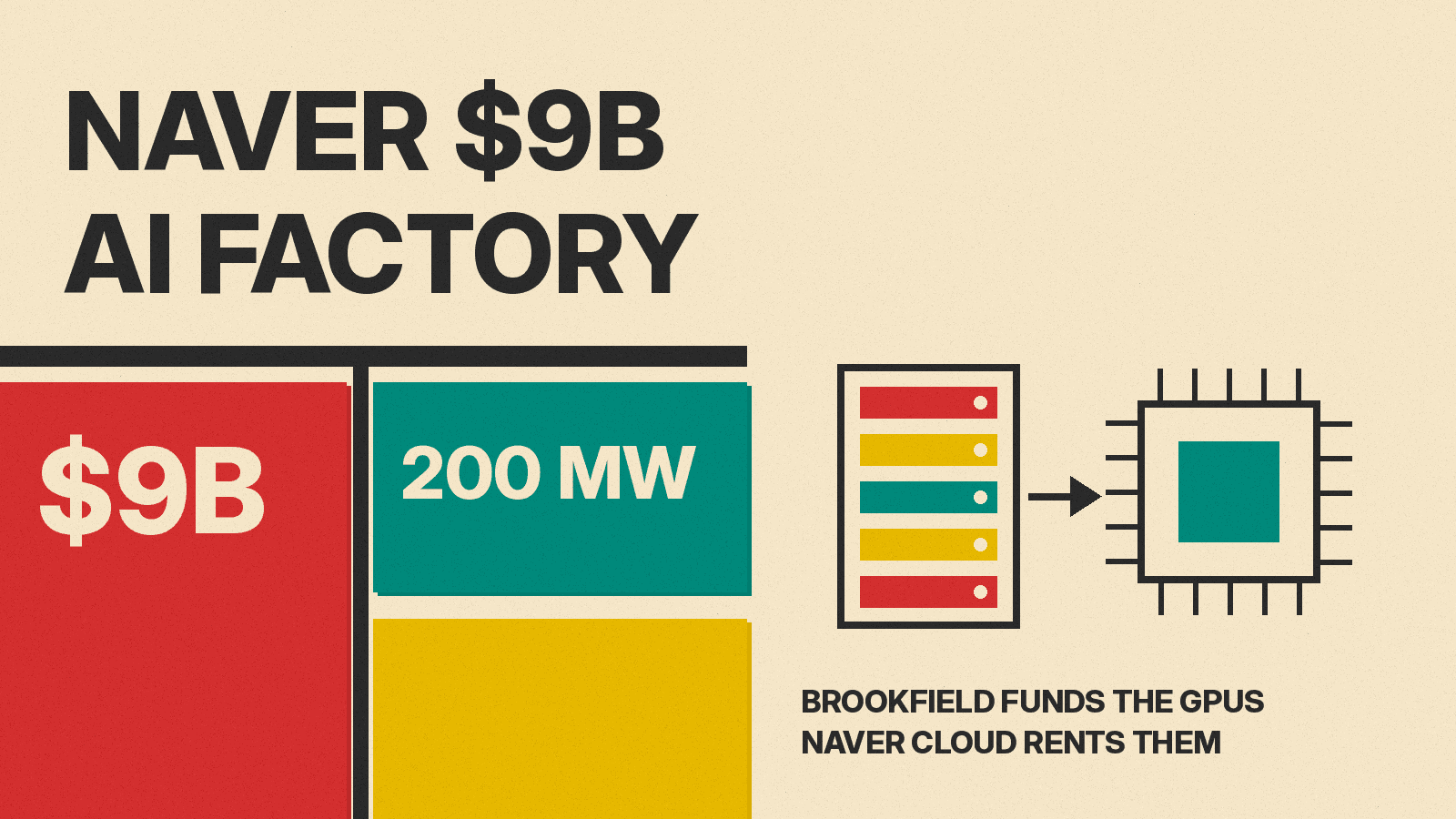
Naver has signed the financing deal behind its AI factory in South Korea. In a regulatory filing on October 27, the company said a vehicle set up by Brookfield's AI infrastructure fund will build up to $9 billion of computing infrastructure, and Naver Cloud will rent it as a service. The deal also meets a condition of Nvidia's planned $1 billion investment in Naver, which required this financing.
The structure is the main story. The Korea Herald says it is designed to reduce Naver's upfront capital burden: Brookfield finances the infrastructure, and Naver Cloud pays usage fees over time instead of buying the hardware.
What Naver signed
According to the Korea Herald and Digital Today, the deal works like this:
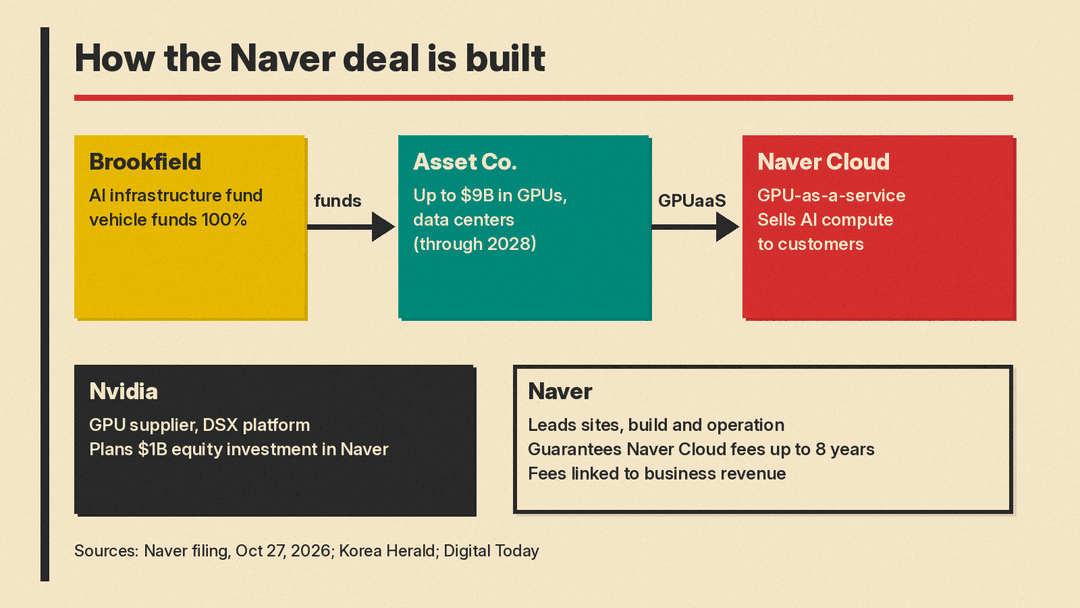
- Brookfield will set up a special purpose vehicle, tentatively named Asset Co. A Brookfield investment vehicle will fund it 100 percent.
- Asset Co. will invest up to $9 billion in GPUs, data centers and other AI infrastructure. The filing says this is the expected investment through 2028.
- Naver Cloud, a Naver subsidiary, will receive GPU-based computing from Asset Co. as a service (GPU-as-a-service) and sell AI data center services to outside customers.
- Naver Cloud will pay usage fees linked to revenue from the business, instead of buying the hardware itself.
- Naver will guarantee Naver Cloud's usage fee payments for up to 8 years. Digital Today reports that Naver said the guarantee builds trust in the contract and does not by itself cause a cash outflow.
The filing also has an accounting detail. Brookfield owns Asset Co., but the filing says Naver's control over the entity is recognized under Korean IFRS, so Asset Co. will be consolidated as a Naver subsidiary. In other words, the infrastructure is expected to show up in Naver's consolidated financial statements even though Brookfield puts up the money.
Who does what
The July announcement from Nvidia and Naver set out a $10 billion project: Brookfield would fund up to $9 billion, Nvidia would invest $1 billion, and Naver would fund the rest. At that point Brookfield had only a nonbinding term sheet, and Naver's July filing said it had picked Brookfield as its exclusive preferred negotiating partner for 12 weeks. The October filing turns that into a signed structure.
The roles in the October filing:
- Naver leads site selection, construction and operation of the data centers.
- Nvidia takes part as the GPU supplier. The filing also lists technical cooperation: adopting Nvidia's next-generation DSX infrastructure platform to make data center operations more efficient. (We explained DSX in our post on Nvidia's DSX POD factory-built AI factories.)
- Brookfield, which the Korea Herald says manages more than $1 trillion in assets, funds the infrastructure through Asset Co.
Nvidia's July release said the 200 megawatt factory is expected to use its Vera Rubin and Blackwell platforms.
The Nvidia stake
Nvidia's $1 billion investment had two conditions in the July release: customary closing conditions, and Naver finalizing at least $9 billion of committed financing for the project, separate from Nvidia's money. Digital Today reports that the Brookfield contract meets that condition, and that Naver plans to complete the share issue to Nvidia quickly. Nvidia will buy newly issued Naver shares through a third-party allotment. The Korea Herald says that would make Nvidia Naver's third-largest shareholder. A Naver official said details of the share issue will be announced later, according to Digital Today.
The buildout timeline
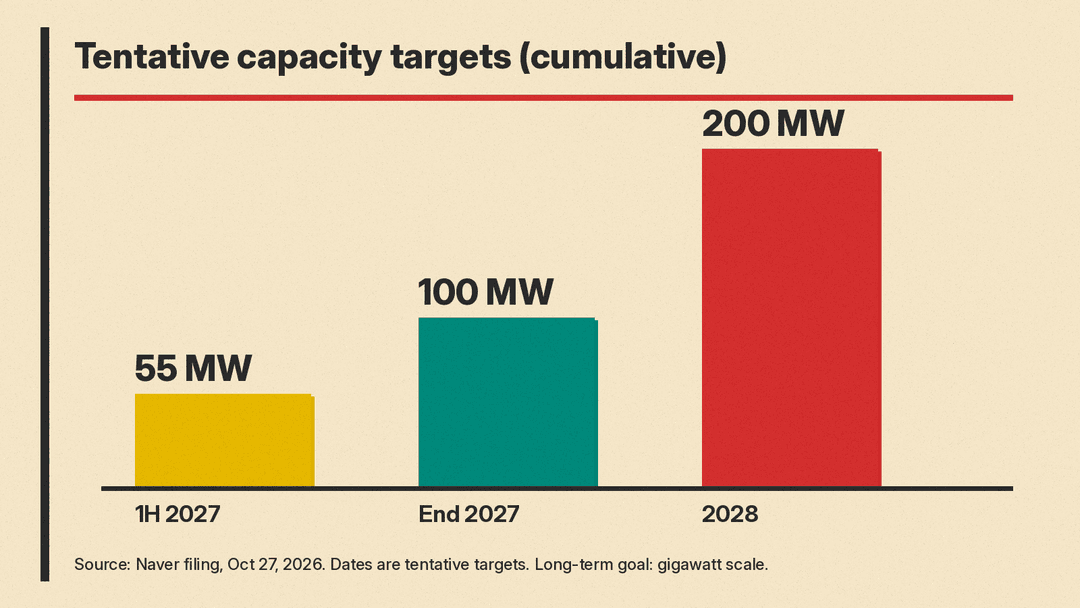
The filing gives a phased plan, and it says the dates are tentative targets still under discussion:
- First half of 2027: 55 MW
- End of 2027: 100 MW cumulative
- 2028: 200 MW cumulative
- Long term: gigawatt-scale infrastructure
The first site is Naver's GAK Sejong hyperscale data center. The filing says Naver plans to expand from there beyond Asia-Pacific to Europe, the Middle East and other regions in stages.
Why it matters
This is the third large GPU deal in a week that moves the cost of AI hardware into a separate financing vehicle. Broadcom's $63B SPV for Anthropic's chips and SpaceX's $40B Apollo GPU lease use different terms, but the idea is similar: someone else buys the hardware, and the user pays to use it over time.
For Naver, the Korea Herald says the structure is meant to reduce the upfront capital burden and let Naver Cloud add capacity in stages as demand grows. The revenue-linked fees tie its payments to the business the factory brings in. The 8-year guarantee shows the other side: Naver still stands behind those payments.
For Nvidia, the Naver stake, first announced in July, now moves toward completion in the same week as its $3B stake in Meta's equity offering. Nvidia's July release describes Naver as an Nvidia Cloud Partner and pitches the factory as sovereign AI infrastructure for enterprises, industries and government, and as compute for Korea- and U.S.-based AI innovators.
What to watch
The plan still has open risks. Naver's July filing listed uncertainty over data center sites and permits in each country, possible delays in securing power, swings in global AI infrastructure supply, and possible changes to terms or delays during contract talks. The October filing also says each phase's size and timing can change with market conditions and the results of negotiations, and that Naver will file separately on any later contract above the disclosure threshold.
The next concrete steps are the Nvidia share issue and the first 55 MW, which the filing targets for the first half of 2027.
Sources
- Naver regulatory filing, October 27, 2026 (via AwakePlus)
- Korea Herald: Naver seals $9b Brookfield deal to finance AI factory
- Digital Today: Naver signs $9 billion AI infrastructure deal with Brookfield
- Nvidia Newsroom: NAVER, NVIDIA and Brookfield to expand Korea's national AI factory buildout (July 24, 2026)
- Naver press release, July 25, 2026
- Naver July filing on KRX KIND
