
Ricursive Intelligence released Ripple-65B Preview on November 4, and the first day of reaction on X and Hacker News split along a clear line. Many people liked a 65 billion parameter open-weight coding model that the lab says fits on consumer hardware such as a DGX Spark. Others spent the day arguing about what the benchmark chart leaves out. This roundup collects the posts we could read and checks the numbers against the lab's own pages.
Ricursive's launch post on X went up at 10:24 AM PT. By about 3:20 PM PT it had 2,448 likes, 296 reposts, 247 replies, 178 quote posts and 278,352 views. The Hacker News thread had 184 points and 60 comments. Reddit cannot be read from our tools, so everything below comes from X, Hacker News and the lab's pages.
What Ricursive released
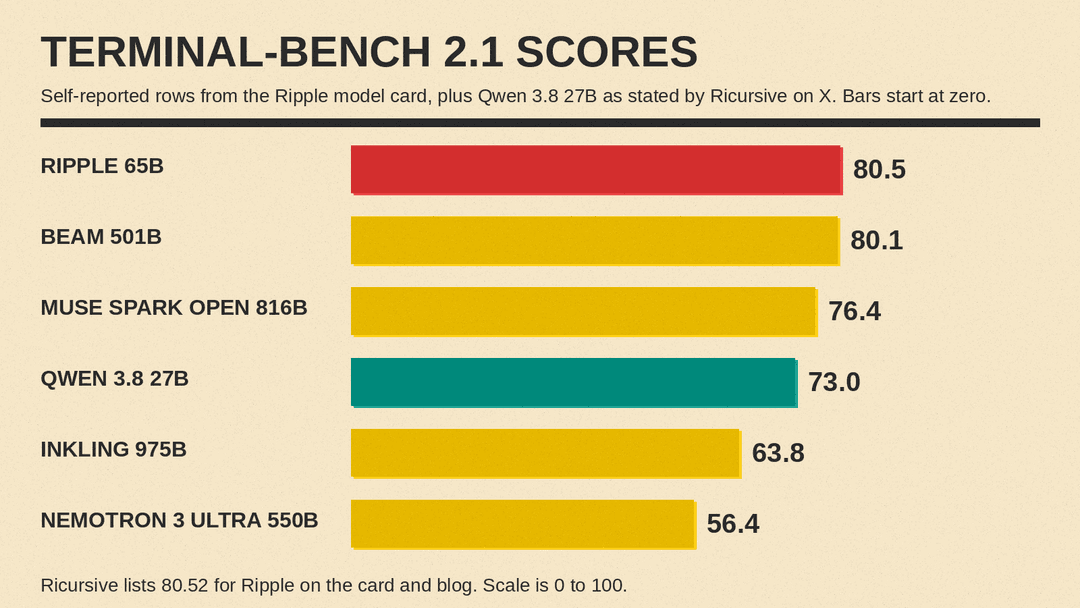
According to the launch blog, Ripple-65B Preview is a dense model pretrained on 12 trillion tokens, with support for up to 1M context. The model card lists an Apache 2.0 license. Ricursive says it scores 80.52 on TerminalBench 2.1, ahead of Reflection Beam 501B at 80.1, Meta Muse Spark Open 816B at 76.4, Thinking Machines Inkling 975B at 63.8 and NVIDIA Nemotron 3 Ultra 550B at 56.4. It also says the model cost $32M to develop, which it calls its full R&D cost.
Ricursive calls itself a full-stack AI lab, and says Ripple is a general-purpose variant of the proprietary model that powers its AI chip design platform.
For background on what a dense model and open weights mean, see our open-weight vs closed models explainer.
The positive reaction: it runs on a desktop
One of the most-liked outside posts we found came from @kimmonismus (Chubby), with 307 likes and 77 replies. He called the release impressive and said it runs locally on his DGX Spark, an NVIDIA desktop AI computer. He added a qualifier: "The size comparison comes with a detail: Ripple uses all 65B parameters for each task, while Beam activates 23B of its 501B parameters."
Replies to that post were mostly short approval. @TheMortz wrote: "Running it locally is the part I care about most. A coding model that good on your own box changes the maths for small teams." @EndroCb wrote: "A 65B model on a DGX Spark hitting 80.5% on Terminal-Bench 2.1 is the story: agentic coding is decoupling from model size." @bludr5 said "the $32M training budget caught my eye more than the benchmark scores." On Hacker News, thesnarkitecht said of their Mac Studio setup: "In my experience, the sweet spot for Mac Clusters is around 200GB of weights, which this is far under." Tepix replied: "It will be slow on Macs, it's a dense model."
Some people started testing quickly. @kevintheoo reported that the official weights are about 130 GB, "too big for a single Spark," but that they "fit on my Spark ring with room to spare," and added: "Looking forward to real business tests." @mariogray noticed the model was already on OpenRouter and asked whether to "give it a spin in CC," which we read as Claude Code. We did not find posts yet from anyone who ran it on real repositories and reported results.
The benchmark argument
Much of the Hacker News thread was about the comparison chart. User wmf wrote: "Congratulations I guess but it's a pretty bad look to not even mention those other open weight models." User syntaxing wrote: "When a post doesn’t mention Qwen for comparison, you know the performance isn’t going to be great." A reply from ethan-boneh pointed out that Qwen 3.8 27B "hits 73% on TB2.1 and 42.2% on DeepSWE." Ricursive gave the same numbers itself in a reply to another X user: "Qwen 3.8 27B: 73% TB2.1" and "Ripple-65B: 80.5% TB2.1."
@Omnicognia summed that up in six words: "It's slightly better than Qwen3.8 27B." Hacker News user mrinterweb wrote that not comparing to Qwen "gives cherry-picked benchmark comparison energy," then added: "Still, Ripple-65B outscores Qwen3.8 27B, according to the reported benchmarks." User 2001zhaozhao said Qwen 3.8 Flash Next, which they described as bigger than Ripple but "probably cheaper to run due to MoE," scores 84.3 on the same test. We did not verify that figure.
@Gangadhar_P called Ripple "a new good addition to oss" but weighed the cost: "about 2.4× params for a +7.5 points on Terminal-Bench and +2.1 on DeepSWE." The post adds that the open mixture-of-experts Flash models, with "low total active weight footprints," are "a better trade off for inference."
On the size of the lead, yorwba wrote: "Still they score 0.42 percentage points higher than the second-best model on their chosen benchmark, so it's hardly a meaningful lead." That matches the lab's own numbers, 80.52 against 80.1. A few people questioned the choice of tests. User purplemantis wrote: "These are pretty odd benchmarks to use."
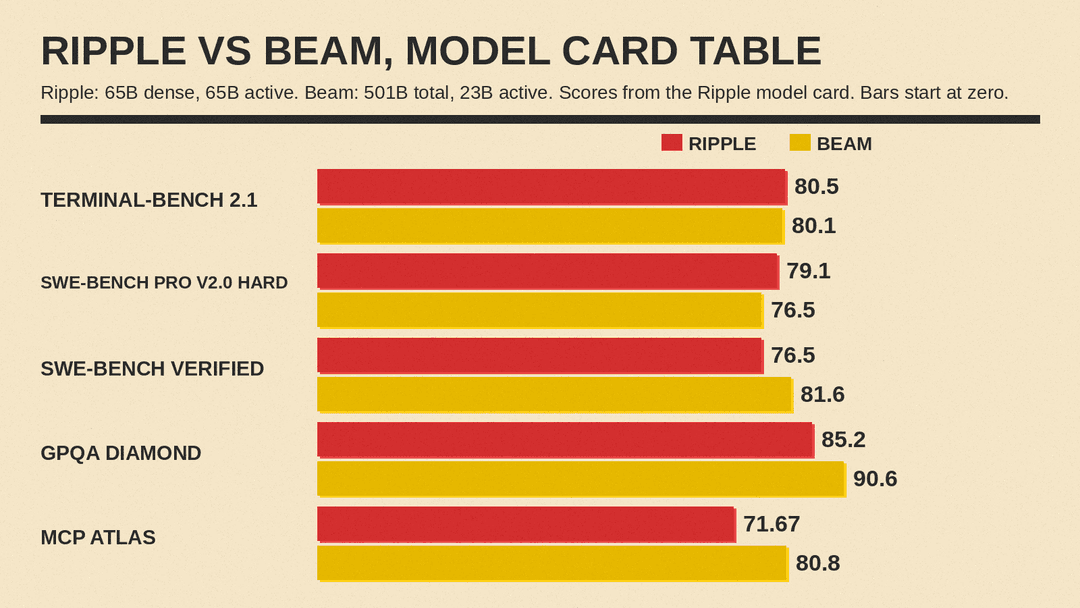
The model card's own table shows where Ripple does not lead. Against Beam it trails on SWE-bench Verified (76.5 to 81.6), SWE-bench Pro v1.0 (61.42 to 66.1), GPQA Diamond (85.2 to 90.6) and MCP Atlas (71.67 to 80.8). It leads Beam on SWE-bench Pro v2.0 Hard (79.1 to 76.5). Muse Spark Open scores higher on DeepSWE 1.1 (60.0 to 44.3). The card notes that some scores in the table, marked in italics, come from Ricursive's own in-house evaluations rather than from each lab's model card.
Is it SOTA, and for whom
Several commenters objected to the phrase "U.S. open-weight state-of-the-art." User advael wrote that narrowing the category to this degree "really has diluted the term" SOTA. Others replied that the narrowing is the point. Onawa wrote: "US Gov won't let Chinese models be hosted on any internal infra, not even supposed to use them for local AI. So there is absolutely a market for US-made or non-Chinese models there." User bluejay2387 wrote: "There are several situations where some of us are explicitly prohibited from using models from companies not under the jurisdiction of the United States."
User stewartpark read the release as aimed at companies, not hobbyists: it is "probably hard to become popular amongst hobbyists and local model enthusiasts like Qwen's 27B class models or MOE models because it's a 65B dense model." User regularfry wanted a different test: "What'll be interesting is how it performs relative to Qwen3.8 27b when quantised to the same size." User antoineMoPa offered the joke of the thread, after describing a tiny model of their own: "can I call it SOTA for my neighborhood?"
Questions about the $32M figure
The cost claim drew pushback. @teortaxesTex quoted Ricursive's "one-tenth the cost" line and asked: "What previous open-weight SOTA had a $320M compute budget?" Ricursive's blog gives its basis in a footnote: that Reflection was reported to commit to $150M per month for compute at SpaceX Colossus, and that Beam took four weeks to pretrain and four weeks to post-train. The blog calls the one-tenth figure an estimate "to the best of our knowledge." We could not confirm Reflection's spending independently.
The $32M figure also covers more than a final training run. Ricursive says it includes pretraining ladder development, data mixing, evals, debugging, synthetic data generation and post-training recipe work. User cyberax on Hacker News took the number as a trend: "the cost of the training is interesting."
Other complaints and caveats
@victor_vibing asked, under the Chubby post: "Why nobody compared to Opus 5.5?" The chart compares only US open-weight models, so closed frontier models are not in it. @AliChherawalla reminded readers of the label on the release: "It's a preview, so expect rough edges." The model card says post-training for this release was "relatively light" and focused on agentic coding.
One practical gap showed up in the listings. The model card says context up to 1M, but the OpenRouter listing showed a 16,384 token context window at $0.20 per million input tokens and $0.60 per million output tokens when we checked on the afternoon of November 4. Listing-tracker accounts such as @gptbotio posted the same 16,384 figure. Providers may raise it later.
There was also a name mix-up. On Hacker News, dofm asked: "So we have a R e cursive and a R i cursive, both making LLMs?" User soundworlds wrote "Not to be confused with" and linked recursive.com.
What to take from it
The reaction is early and thin on independent tests. Every benchmark number in the posts above traces back to Ricursive, and the strongest praise is about size and cost, not measured results. If you want to try it, the weights, an NVFP4 build for smaller machines and a base model are listed on the model card. If you are sizing hardware, our guide to how much memory you need to run an AI model locally gives the rules of thumb, and how to read AI model scores explains why one benchmark rarely settles the question.
