
OpenAI's post "A thousand fewer paths to root" went up on November 4, and by about 11:30 PM PT it had 273 points and 174 comments on Hacker News. OpenAI's own X post about it, published at 3:13 PM PT, showed 7,227 likes, 735 reposts and 414 replies at the same time. The post describes an automated pipeline that, in one mid-October run with an upcoming cyber model, validated and generated patches for 948 local privilege escalation bugs in the Linux kernel at an API cost of $1,213,430. This roundup collects what people said on Hacker News and X, and checks the main objections against the OpenAI post. Reddit cannot be read from our tools, so it is not covered. For the facts of the announcement itself, see our news report on the pipeline.
A local privilege escalation, or LPE, is a bug that lets someone with an ordinary account on a machine take full control of it. The attacker already needs an account on the machine.
What OpenAI says it did
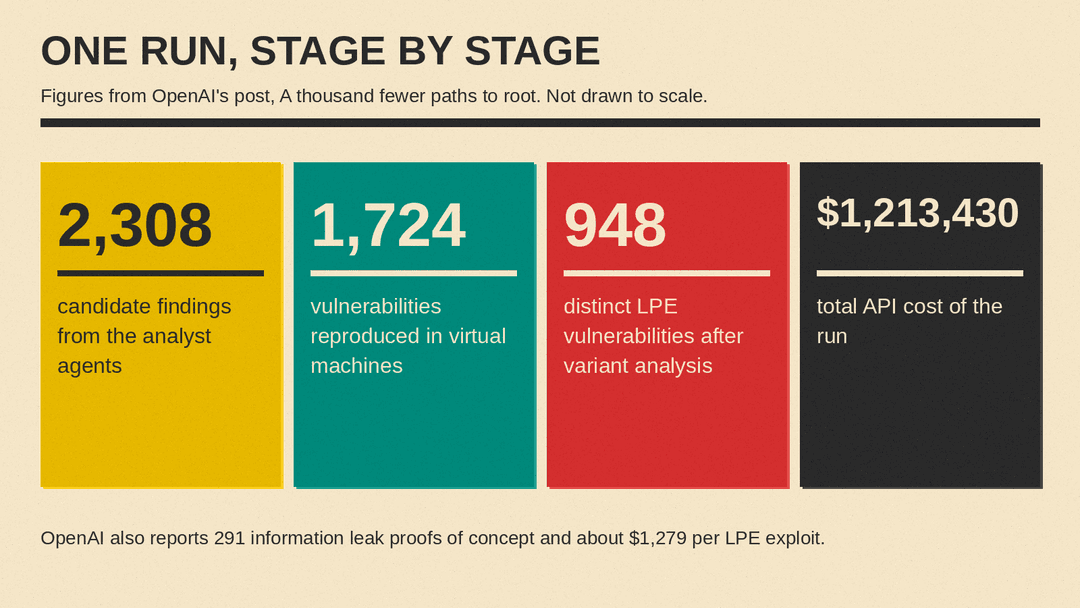
The numbers come from OpenAI's post. Scout agents picked 5,034 audit targets, about 7% of the kernel's code. Analyst agents produced 2,308 candidate findings, and triage agents reproduced 1,724 of them in virtual machines. OpenAI then reports 1,169 working LPE exploits, which it reduced to 948 distinct vulnerabilities after variant analysis, plus 291 information leak proofs of concept. The exploit stage was the biggest cost, at $775,929 of the total, and the post gives an average of $1,279 per LPE exploit.
OpenAI also says the target was a stock desktop operating system with standard protections on, and it compares the 948 exploits with historical bounty amounts of $20,000 for Pwn2Own and $70,000 for TyphoonPWN, which gives a hypothetical $18.9 million to $66.3 million. Human researchers reviewed results before reporting, and the patches are described as candidates for maintainer review.
What OpenAI and its staff said on X
OpenAI's launch post on X read: "Our security researchers built an autonomous cyber vulnerability discovery, exploitation, and patching pipeline." Clint Gibler, who describes the author as his OpenAI colleague @ky1ebot, wrote, "To the best of our knowledge, the agents in this pipeline discovered and used at least 10 novel Linux exploitation techniques." His post had 116 likes and 15 replies when we checked. On Hacker News, a commenter named dangelosaurus wrote that "This is my team’s work. I’m happy to try to answer questions or take questions back to the team." Replies under that comment were mostly questions.
Hacker News: the questions people asked the team
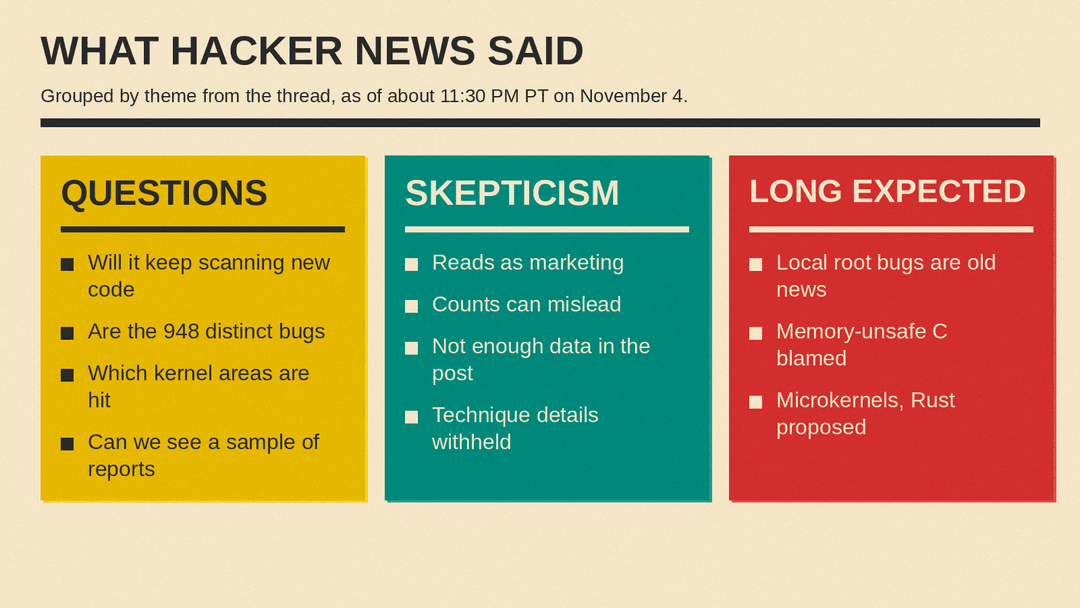
Several of those questions overlapped. BoppreH opened with a mood more than a challenge: "It's a bittersweet result, like finding asbestos in your house." The same comment then asked, "Will there be any continuous effort, scanning new PRs as they land, to prevent new weaknesses from being added?"
basilikum said the high count made the commenter skeptical and asked "Are these distinct vulnerabilities" or related ones, the way vulnerabilities often cluster. OpenAI's post speaks to part of this: it says it counts 948 as the number of unique LPEs after variant analysis of 1,169 working exploits. A commenter using the handle ky1ebot1337, who wrote that they were the pipeline's author, replied that the 948 are counted by patches, that each patch can stop several exploits, and that the raw exploit count is higher. OpenAI's post does not say how the 948 spread across kernel subsystems, which emmelaich asked for.
amluto gave the most useful reply for anyone who follows kernel security. The comment read, "As someone who used to handle nonpublic Linux kernel security reports and is still very interested in this stuff, I'd love to review a small sample of these reports to get a feel for what kinds of issues are being unearthed." The comment also asked for a list of the ones already public or fixed. The OpenAI post does not include a list of individual bugs.
Hacker News: skeptics and the "this was always true" camp
The sharpest criticism was about marketing. tamimio wrote, "These are becoming more and more marketing materials than actual findings." tzury argued that a count of bugs can mislead, comparing it to SQL injection, where thousands of payloads still add up to one flaw, and added, "There is no real data attached to the post." OpenAI's post does give stage-by-stage costs and counts, but it leaves out the technique details, which it says it omits for safety reasons.
A different group said the headline number should not shock anyone. Replying to a commenter who quoted OpenAI's line that an out-of-date machine with a low-privileged account is "functionally equivalent to root access" for a well-resourced attacker, rubinlinux wrote, "This has been true for DECADES." nas landed in the middle: "I've always considered local escalations to be possible in Linux (i.e. having user access almost certainly means you can get root). However, 948 vulnerabilities is kind of shocking."
Another thread turned the news into an argument about language and design. est31 wrote, "The kernel has the problem that basically every bug in it is also a security vulnerability," and argued that a rewrite in Rust would still have bugs but fewer of them. Others argued for microkernels such as seL4. None of that is in OpenAI's post, which recommends sandboxes and isolation such as Firecracker and gVisor, more secure-by-default code, less attack surface and formal verification as areas for further research.
Who pays for this
One side thread was about access. zahlman wrote, "Imagine if open-source organizations other than the Linux Foundation (and Mozilla I guess) could throw $1.2M of API-rate LLM usage at security." OpenAI's post says it is working with Patch the Planet partners to send out patches for the rest gradually.
On X the same cost point showed up as caution. coulditbecoley wrote, "Autonomous security works, but at that price it's enterprise-only, not your weekend repo." Bounty programs are also repricing for AI: Google Cloud added a $250,000 Root-in-Cloud reward tier on October 29, as our report on that change explains.
X: mostly summaries, with a few real opinions
X was noisy but thin. Most of the posts we found were short summaries of the OpenAI page, many from small accounts. Techmeme posted a summary line, and its post had 9 replies when we checked.
The reactions that said something repeated one theme: finding bugs may now be cheap, and fixing them is not. dhanyqaz wrote that the loop is the interesting part: "find, reproduce in isolation, patch, human review." Karthikvarmamkv put it as "finding bugs got cheap. the bottleneck is now maintainers reviewing 948 patches." MrComputerSci was more casual: "As an old-school IT nerd, I think that's cool AF." He added, "I'm shocked that decades of Linux nerds never found those flaws, lol." zesen88 joked, "Somewhere a Linux maintainer just got a very long patch queue and a very short nap."
OpenAI's post speaks to the patching worry directly. It says that when the scan and manual analysis finished after 10 days, 61 LPEs had been patched upstream, 43 had staging patches and 299 were being reported and discussed publicly, and that it has sent hundreds of reports and patches. It also says that in an early run, 20 of 200 reported exploits turned out to have reached root through a different 0-day than the one assigned, which is why it added an independent check.
What to take from it
Nobody we found said the run did not happen. The fight is over what the number means, and tzury argued the kernel is probably less vulnerable than the post makes it sound. Skeptics want a breakdown by kernel area and a sample of real reports, and the post does not list individual bugs. OpenAI and its supporters point to a cost per exploit that, by OpenAI's own comparison, is far below historic bounty values. The practical advice in the post is to keep systems patched, since it treats an unpatched machine with a local account as close to root for a well-resourced attacker. It is not the only lab reporting this kind of work: on October 27 Anthropic said an unreleased Claude model had chained flaws in Chrome, Safari, Android, Windows and Linux into five working exploits, as our report on those exploit chains describes.
These counts and likes are from the evening of November 4 and will move.
