
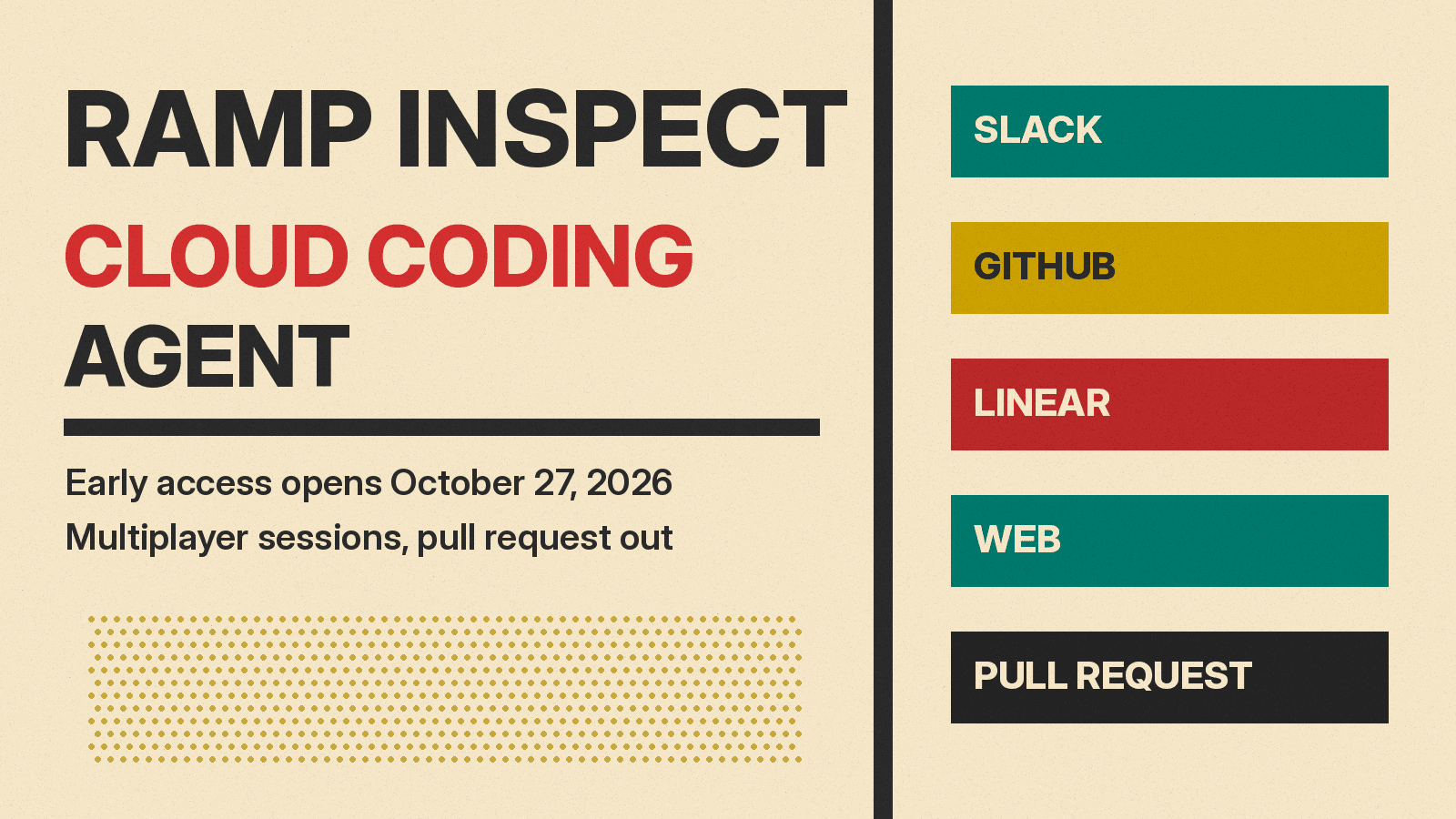
Ramp, the corporate card and finance software company, is opening its in-house coding agent to other teams. In a launch post dated October 27, 2026, co-founder and co-CEO Karim Atiyeh writes: "Today, we're opening early access to Inspect." The Inspect product page calls it "the collaborative, cloud-based coding agent by Ramp."
Inspect is not a new experiment. Ramp has described it publicly since January as a tool its own staff use. What changes today is that outside companies can ask for access.
What Inspect does
Per the launch post, you give Inspect a task from Slack, GitHub, Linear or the web, and "it converts your words into a visually validated and fully reviewed pull request using your team's development environment." The work runs in the cloud, so nobody has to set up a local environment first.
The feature Ramp leads with is collaboration. The launch post says "every session is multiplayer by default": teammates can join a session to add context, flag a constraint or steer the approach before review. Atiyeh's example is a person who spots a bug in the mobile app on the way to work, sends a screenshot with "@inspect fix this" in Slack, and finds a pull request with visual proof waiting for review.
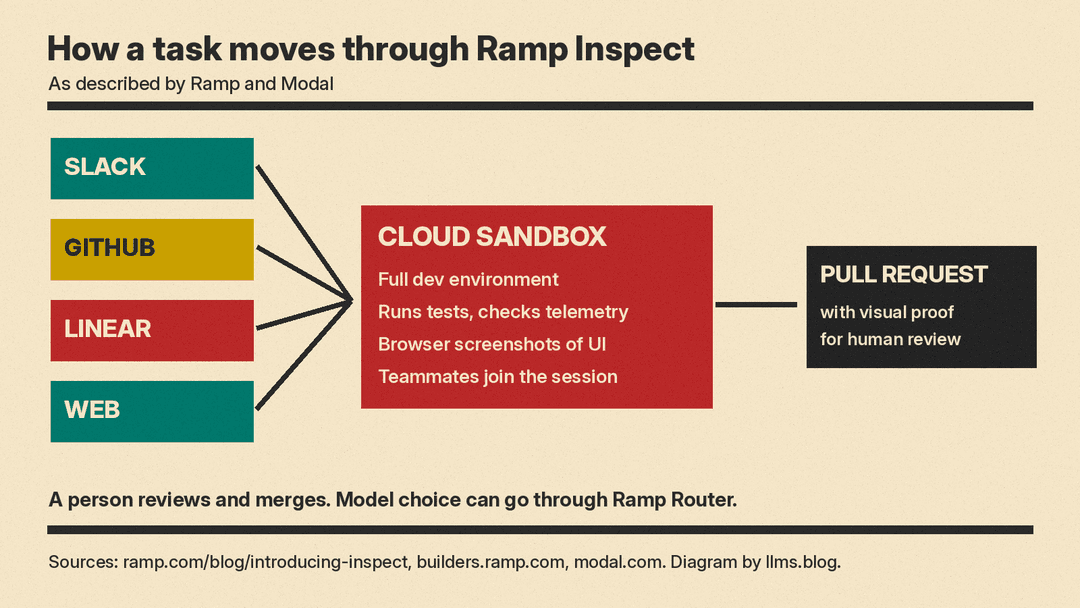
Two earlier posts explain how it works inside. Ramp's engineering blog post Why We Built Our Own Background Agent (January 12, 2026) says each session runs in a sandboxed VM on Modal "with everything an engineer would have locally," and is wired into Sentry, Datadog, LaunchDarkly, Braintrust, GitHub, Slack and Buildkite. For backend work it can run tests, review telemetry and query feature flags. For frontend work it gives users screenshots and live previews. The same post lists a Chrome extension, a web interface and a web-based VS Code editor as other ways to work with a session.
Modal's case study on Inspect (February 19, 2026) adds that OpenCode runs as the coding agent inside each sandbox, next to a VS Code server, a web terminal and a Chromium browser for visual checks. According to Modal, a scheduled job rebuilds filesystem snapshots every 30 minutes so sessions start from a near-current copy of the code.
The adoption numbers, and what they measure
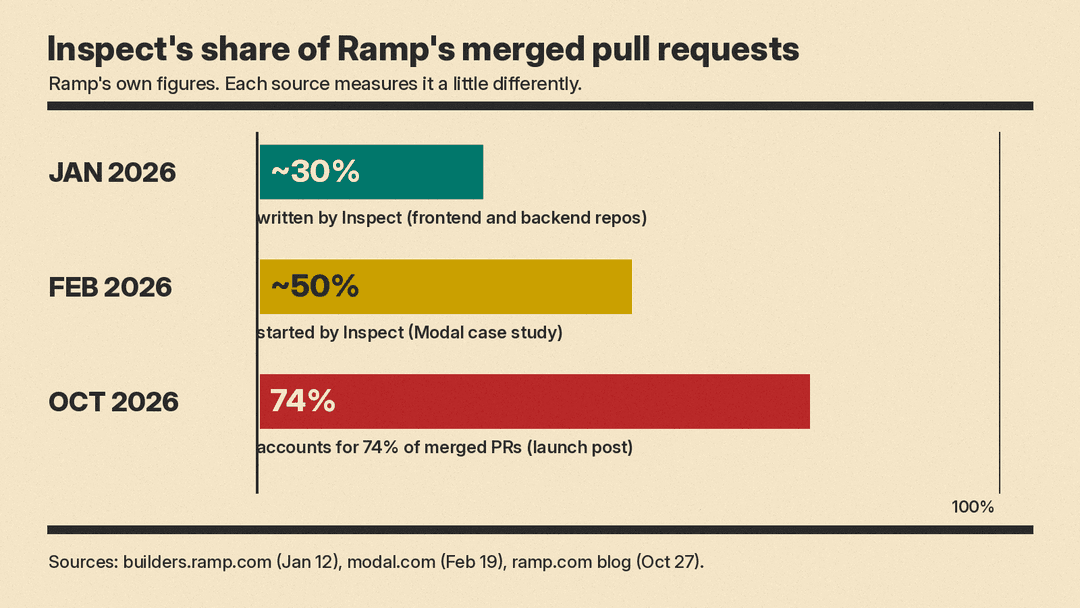
Ramp's main argument is its own usage. The launch post says that in the past month, "99% of our engineering, design, and product teams used Inspect, and Inspect now accounts for 74% of merged PRs." It also says Ramp's builders "now ship 6x as much code per person as they did a year ago, and Inspect is a big reason why."
These are Ramp's own figures, and the launch post gives no counts or method. Earlier figures used different wording. In January, Ramp's engineering blog said about 30% of pull requests merged to its frontend and backend repos "are written by Inspect." In February, Modal's case study said roughly half of merged pull requests across those repos "are started by Inspect." The October number does not say which repos it covers or whether "accounts for" means written or started.
Model choice and Ramp Router
The launch post says "Inspect connects with Ramp Router so you can choose the model that fits the work and switch when a new one comes along." Ramp Router is Ramp's gateway for OpenAI, Anthropic and open models. Its page says Router "is free through 2026," that you pay list price for the tokens you use, and that "your first $26 in credits are on us," subject to offer terms. The Router FAQ says you do not need to be a Ramp customer and that it works with Claude Code, Codex, OpenCode, Pi, Hermes, Conductor and Cursor.
Router is optional. The Inspect privacy notice says an organization can also use its own provider keys, in which case the provider handles prompts under the organization's own agreement with it.
Who can use it, and what it costs
Ramp has not published a price for Inspect. The privacy notice says "Inspect is offered to design partners for evaluation under an Inspect Trial Agreement," and that most users reach it through an account set up by their employer. In that case the employer decides what data Inspect connects to, and Ramp acts as a processor for prompts, source code and session transcripts. The product page invites visitors to apply for early access.
Why it matters
Inspect joins a crowded field of cloud agents that take a ticket and return a pull request. On llms.blog this month we covered Cursor's Agent SDK, Paradev's app for running many coding agents at once and Bito's Governor model router, which all target the same teams.
Ramp's angle is different in two ways. First, the product was built for one company's codebase and is now being offered to others. Ramp's January post argued that owning the tooling lets a team build "something significantly more powerful than an off-the-shelf tool will ever be" because "it only has to work on your code." Selling Inspect tests whether that holds for codebases Ramp did not build it for. Second, Ramp pitches Inspect to designers and product managers as well as engineers, with multiplayer sessions as the way non-engineers learn from each other.
The open questions are the ones the launch post does not answer: the price after the trial, how much setup a new company needs before sessions match Ramp's own speed, and how the 74% figure was counted.
Sources
- Introducing Inspect by Ramp: The Collaborative Coding Agent, Ramp, October 27, 2026
- Inspect by Ramp product page
- Why We Built Our Own Background Agent, Ramp Builders Blog, January 12, 2026
- How Ramp built a full context background coding agent on Modal, Modal, February 19, 2026
- Inspect Privacy Notice, Ramp
- Ramp Router and Router FAQ
