
Oracle announced its own AI video model on October 27, 2026, at Oracle AI World in Las Vegas. Oracle AI Media Models is a family of three models: video generation, image generation and image editing. According to Oracle's launch post, Oracle built them itself and trained them "from scratch on rights-cleared data" on Oracle Cloud Infrastructure (OCI). Oracle calls them its "first family of foundation models."
You cannot sign up and try it today. Video generation, image generation and image editing are in a Beta program for select customers. Oracle's product page says access "is limited to selected US companies," and that the models are available in the U.S. only for now.
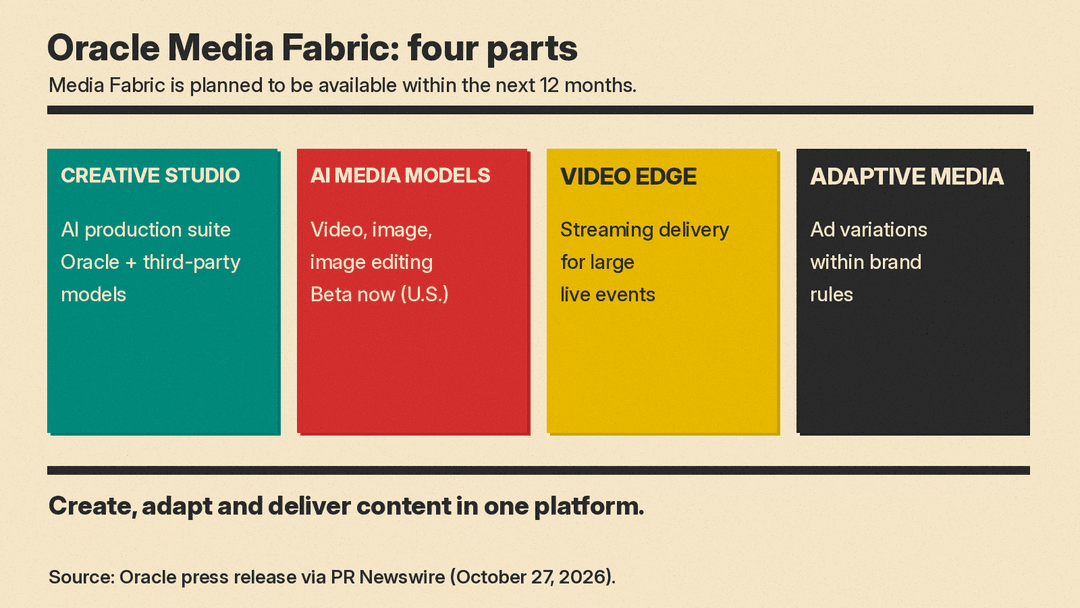
The models are also one part of a larger product. In a press release the same day, Oracle announced Oracle Media Fabric, a platform that joins AI production tools, these media models and video streaming delivery. Oracle says Media Fabric is planned to be available within the next 12 months.
What the three models do
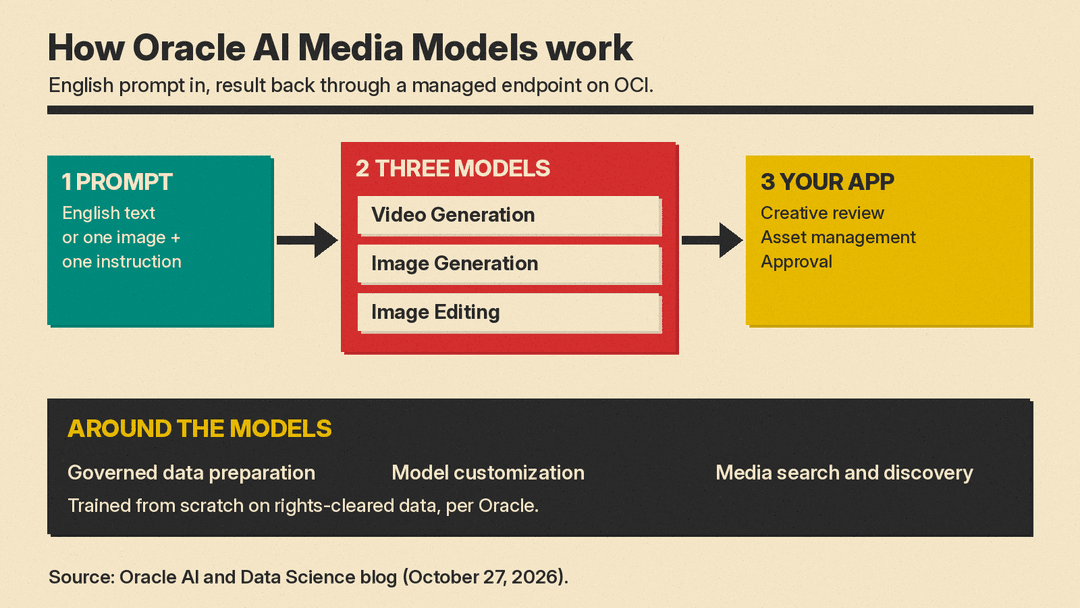
Oracle describes three separate tasks. Teams can connect them in their own applications.
- Oracle Video Generation makes a video from a text prompt. Oracle's example is a camera gliding over a calm blue lake below snow-capped mountains, used to explore a motion concept for a travel campaign.
- Oracle Image Generation makes an image from a text prompt that describes a subject, setting or visual style.
- Oracle Image Editing takes one existing image and one text instruction, then adds, removes or changes elements. Oracle's example adds a wooden canoe to the lake photo.
The product page says all three work from English-language prompts and instructions. Developers reach the models through managed endpoints on OCI: an application sends a request and gets a result back. Oracle says the customer's organization decides how those results move through creative review, asset management and approval.
Oracle has not published technical specs in its launch materials. There is no stated maximum clip length, resolution, frame rate, audio support or price. If you compare it with consumer tools (see our AI video generator pricing comparison), treat those as unknown until Oracle shares them.
The pitch: rights-cleared training data
The main selling point is not output quality. It is where the training data came from. Oracle says the models were trained on rights-cleared data. The Media Fabric release adds that the platform "includes safeguards to help protect customers' intellectual property (IP) and reduce the risk of generated content infringing the IP rights of others."
Shutterstock is named as one of Oracle's data partners. Daniel Mandell, SVP of Data Licensing and AI at Shutterstock, said in the launch post: "For generative AI to become a trusted tool in the entertainment industry, the quality and integrity of the data used to train models are critical." He said Shutterstock is "exploring Oracle AI Media Models' generation API and media search and discovery capabilities" for its own multimodal content.
Oracle aims this pitch at media companies, streaming providers and brands, the customers named in the Media Fabric release.
More than generation
Oracle lists other services that sit around the models:
- Governed data preparation, to organize media with attention to its source and usage permissions.
- Model customization, to adapt the models to a team's own content and creative requirements. The product page says customers can customize models with content they authorize, for personalization and localization.
- Media understanding and discovery, to search images and video in an existing library by scene, subject or action. Oracle's example is typing "a peaceful alpine escape" to find lake scenes, snowy peaks or canoeing footage.
Where it fits in Oracle Media Fabric
Media Fabric has four named parts, per the press release:
- Oracle Creative Studio: an AI production suite for storyboards, scenes, cinematic video, visual effects and virtual characters. It is model-agnostic. It combines Oracle AI Media Models with "leading third-party models" and can pick a model for each task based on security, provenance, cost and IP protection.
- Oracle AI Media Models: the Oracle-built video, image and image-editing models.
- Oracle Video Edge: a managed delivery platform meant to keep video quality high and latency low during large live events.
- Oracle Adaptive Media Platform: connects creation and delivery. Oracle says brands could generate variations of a base advertisement within brand guidelines and approval rules.
Oracle CEO Clay Magouyrk said: "Creating content and delivering it to viewers were separate processes. With Oracle Media Fabric, we're bringing content creation and streaming together, using AI across the entire production and distribution workflow."
The models were part of a busy day for Oracle. It also announced Google TPUs, Cerebras and Jalapeño on OCI and a deal to bring ChatGPT and Codex into its business apps.
Why it matters
Most AI video news comes from model labs or creator apps: Google with Veo, Kuaishou with Kling, Runway, ByteDance with Seedance. Oracle is a cloud and database company. Its entry signals that large enterprise vendors now want their own video models, not only to host other companies' models.
The angle is different, too. Oracle is not competing for TikTok creators. It is selling to studios and brands that worry about legal risk, want control over their own archives, and already run workloads on OCI. The Creative Studio design, which mixes Oracle and third-party models, suggests Oracle does not expect its first models to cover every task alone.
There is a lot still unknown. With no public demo access, no specs and no prices, nobody outside the Beta can judge the output against Veo or Kling yet. The full Media Fabric platform is up to a year away.
How to get access
Oracle says interested companies should contact their Oracle account team to discuss evaluation access, supported capabilities and integration requirements. Access is limited to selected U.S. companies for now. Independent creators who want to start today are better served by the tools in our guide to writing AI video prompts.
