
Superset, a desktop app for running many coding agents at once, is now called Paradev. In the rename announcement dated October 26, 2026, CEO Kiet Ho says the company raised an $11.5 million seed round led by Union Square Ventures. Existing users do not need to do anything: the same post says accounts, workspaces, settings, billing and contracts carry over.
The rename matters less than the bet behind it. In USV's words, the question for coding agents has shifted from "can agents do this work" to "how do we manage a team of them?"
What Paradev does
Paradev is a workspace for agents you already use. Union Square Ventures partner Nick Grossman describes it as "a system for orchestrating many coding agents in parallel." You bring your own agent or harness (USV names Claude Code, Codex and Pi), and the compute you already have, "or soon, the Paradev cloud."
The core idea is isolation. Paradev's workspaces docs say each workspace gives a task its own directory, terminals and ports. Local workspaces use isolated Git worktrees, and cloud workspaces use separate clones. So two agents fixing two bugs do not write over each other's files, and each task ends up on its own branch.
The Paradev home page lists agents it can start in a terminal, including Claude Code, Codex, OpenCode, Gemini, Cursor Agent, Kimi Code, Grok CLI, Devin and Kiro. It also has automations that start agents on a schedule or on an event, such as a review request, and then open pull requests for you to check.
Agents that run other agents
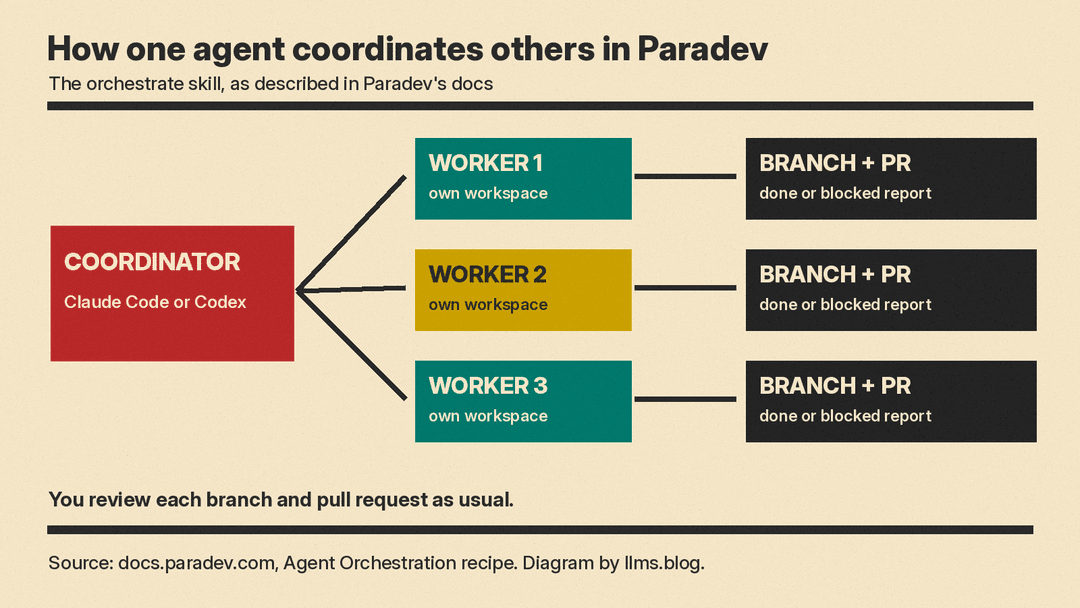
The newest piece is agent-to-agent work. Paradev's Agent Orchestration recipe describes a superset:orchestrate skill that lets one agent coordinate workers in separate workspaces through the Paradev CLI. The coordinator can be Claude Code or Codex, and the workers can be any mix of agents Paradev runs.
Under the hood, the coordinator creates a workspace per worker, launches each worker with a bounded prompt, and reads their terminals to track progress. The docs say workers finish with a structured completion or blocked message, which the coordinator checks before it integrates the work. You still review one branch and one pull request per worker. The docs suggest this mode for "mechanical" fan-outs, such as a migration split into many similar slices with tests to check them.
The October 25 changelog also turned plugins on for every account. Per that entry, you install a plugin once and Claude Code, Codex, Cursor and the other agents you run in Paradev get its skills on every machine, while Claude Code and Codex also get its tools.
The numbers, and who says them
Paradev's own figures are broad. The announcement says "hundreds of thousands of developers in 180 countries and one in eight Fortune 500 companies have used Paradev." That counts use, not paying customers.
More specific numbers come from a Dealroom news note, not from Paradev's post. Dealroom reports more than 145,000 developers across 180 countries, Japan as the second-largest market after the US with over 13,000 developers, and more than 1.85 million agent workspaces created. Dealroom also says the app is local-first: agents run on a user's own subscription or API keys, and Paradev never relays AI calls.
The GitHub repository has more than 15,000 stars at the time of writing. USV calls Paradev "open source and agent-agnostic by design." The repository's license file is the Elastic License 2.0, and Dealroom lists that license under its risks. Check its terms before you build a product on the code.
The announcement lists Y Combinator, BoxGroup, 468 Capital, Liquid 2 Ventures, Orange Collective, Palm Drive Capital, Pioneer Fund, Broom Ventures and Transpose Platform as investors, plus angels including Paul Graham and Browser Use CTO Gregor Zunic.
What it costs
Prices are from the Paradev pricing page as of October 2026:
- Free: $0 for one user, with local workspaces, the desktop app and the CLI.
- Pro: $20 per user per month billed monthly, or $16 per user per month billed yearly ($192 per user per year). Adds remote access, automations, Linear and Slack integrations, and mobile.
- Team: $60 per user per month billed monthly, or $54 per user per month billed yearly ($648 per user per year). Adds cloud workspaces, marked Beta.
- Ultra: $200 per user per month, billed monthly, with a larger cloud allowance.
- Enterprise: custom pricing, annual billing only, with SAML SSO, SCIM, audit logs and an uptime SLA.
These are Paradev fees only. Your agents still bill you on their own plans or API keys. The cloud workspaces docs say the feature is in early access and "not yet available to every account."
Limits to know
The Paradev FAQ says macOS is the supported desktop target. A Linux AppImage ships with each release but is "experimental and untested," and Windows is planned with no date. GitHub is fully supported through the gh CLI; other Git remotes work locally, but cross-machine project identity is tied to GitHub.
The FAQ also says a worktree is not a sandbox. Agents on the same machine still share processes, the network and files outside the worktree, and worktrees do not prevent merge conflicts.
Why it matters
USV frames the hard part as assigning agents work, reviewing what they produce and keeping them out of each other's way. That is the job Paradev wants. USV argues that orchestration layers that work "with any model, any harness, and any machine" are the most likely to win long-term developer adoption. That puts it next to agent-first tools like Entire's Git forge for agents and the Cursor Agent SDK, which tackle related problems from other angles.
The risk is competition. Dealroom notes that rival tools for orchestrating parallel agents keep appearing, and that skilled engineers can build their own setups. If you are still choosing an agent to put inside a tool like this, our Cursor vs Claude Code vs Codex comparison covers prices and models.
Sources
- Superset is now Paradev. Also, we raised an $11.5M seed (Paradev blog)
- Paradev (Union Square Ventures)
- Paradev raises $11.5M seed to run coding agents by the hundreds (Dealroom)
- Paradev pricing
- Paradev changelog
- Paradev docs: Workspaces
- Paradev docs: Agent Orchestration
- Paradev docs: Cloud Workspaces
- Paradev docs: FAQ
- ParadevAI/Paradev on GitHub
