
Phonic, a startup that builds only speech-to-speech voice models, released Phonic-1 on October 29, 2026, and announced a $27.5M Series A led by First Round. The company says Phonic-1 took the number one spot on the Artificial Analysis Speech to Speech Index and that it is the only model that can call tools while the caller is still talking.
That second claim is the interesting one for anyone building phone agents. An independent test from Cekura, covered below, also ranks Phonic-1 first on reliability, with interruptions as its weakest area.
What Phonic-1 is
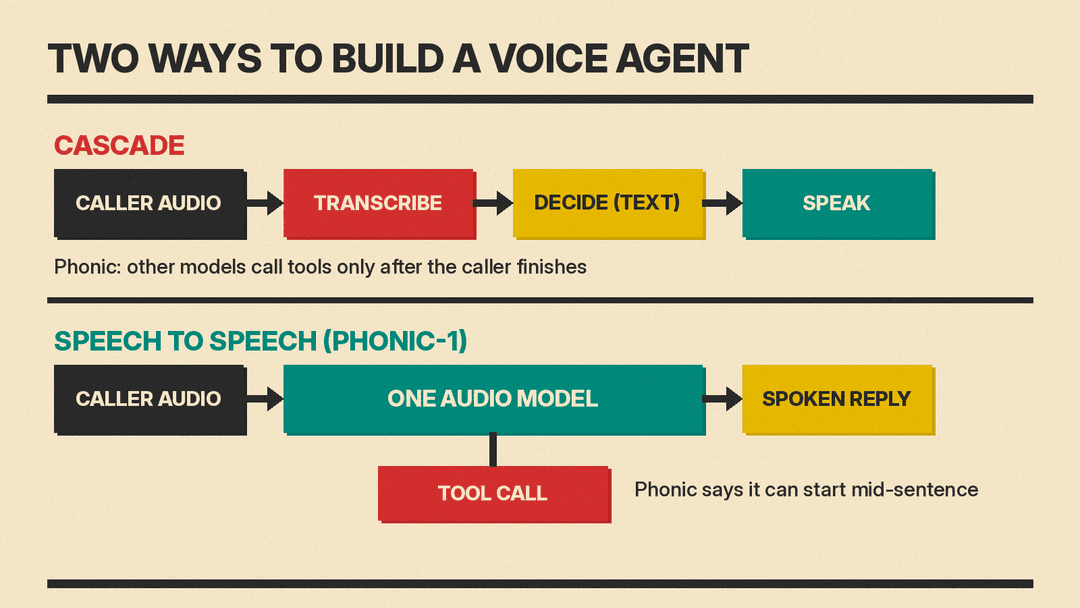
Phonic-1 is a speech-to-speech model for voice agents: it takes in the caller's audio and produces spoken audio back, without first turning the call into a text transcript. Phonic frames this against the usual "cascade" design, where one model transcribes, another decides what to say, and a third speaks. In its launch post, the company says a transcript "drops the frustration in a caller's voice, the long pause before an answer, even the way someone says their own name."
We explained that tradeoff in more depth in Speech-to-Speech vs Cascaded Voice Agents. The short version: cascades are easier to control and debug, while speech-to-speech models keep tone and timing but have often been weaker at reasoning and tool use. Phonic says that until now speech-to-speech models made you "trade intelligence for naturalness," and that Phonic-1 is built to remove that trade.
The main claims
Phonic lists four things it says set the model apart:
- Acting mid-sentence. Other models wait for the caller to finish, say something like "let me look that up," and only then call a tool. Phonic says Phonic-1 can act while the caller is still talking, so the answer is ready when they stop.
- Speed with reasoning. On end-to-end full-duplex benchmarks, Phonic says the model "stands alone on the Pareto frontier of intelligence and latency," citing Artificial Analysis.
- Natural turn-taking. The model was post-trained for conversation, to understand tone and handle turn-taking in noisy places. In blind tests run by a third party, judges preferred Phonic-1 over other models most of the time. Phonic also says that against real humans, humans still win about 60% of the time.
- Languages. Phonic-1 is trained on 50+ languages and can switch language mid-call while keeping the same voice. On Sierra's multilingual full-duplex τ³-Voice benchmark, Phonic reports a score of 83.2, against 79.9 for GPT-Live-1 and 68.5 for Gemini 3.8 Live.
The launch post also includes a demo of a 44-minute call with 123 tool calls, in which a maid of honor calls a hotel in Brazil to book a bachelorette party.
All of these numbers come from Phonic's own post, which cites Artificial Analysis, Sierra τ³-Voice and Cekura as sources.
What an independent test found
Cekura, which runs voice agent benchmarks, published a Phonic 1 results page. Cekura ran Phonic 1 as the whole agent in the same open-source Pipecat pipeline as every other model, with the same prompt, tools and connection, on 246 live calls (82 scenarios, three runs each). Cekura reran Phonic on October 22 on the same agent build as the rest of the board and replaced its earlier results, which listed the model as Phonic v1.
The results:
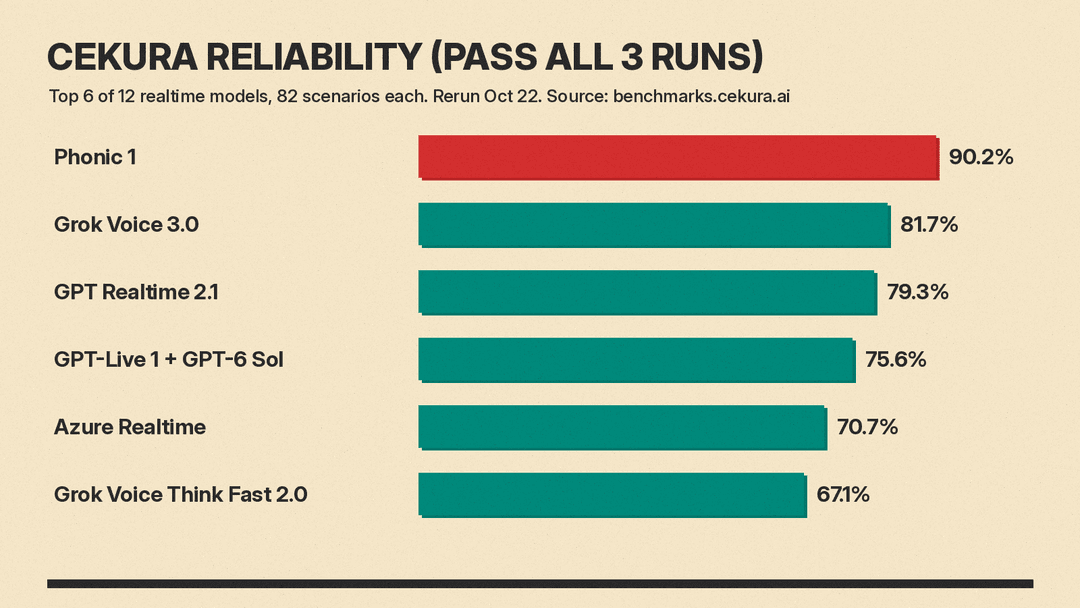
- Reliability: Phonic 1 passed 74 of 82 scenarios on all three runs, or 90.2%. That ranks 1st of 12 realtime models, ahead of Grok Voice 3.0 at 81.7% and GPT Realtime 2.1 at 79.3%. Across all 246 calls, 95.1% passed every check.
- Speed: half of its replies started within 1.63 seconds of the caller finishing, 3rd fastest of 12. Grok Voice 3.0 was fastest at 1.34 seconds.
- Weak spot: interruptions and barge-in, where 87% of calls passed against a median of 90% across models. Cekura says this is where Phonic 1 falls furthest behind the field.
- Strong spots: it passed 100% of plain booking and lookup calls, calls with tool or system errors, calls with background noise, and safety and scope calls. On Medicare compliance and routing calls, 92% passed against a median of 49%. It saved caller data exactly right on 97.5% of the calls that save data, 1st of 12.
So on Cekura's test, Phonic-1 is the most reliable of the 12 realtime models and among the fastest, and its weakest area is handling interruptions. The two results measure different things: the Artificial Analysis index blends reasoning, conversation dynamics, agentic tasks and listener preference, while Cekura counts whole calls that pass every check.
Pricing
Phonic charges by the minute, with "no LLM pass-throughs" and "no per-token charges," according to its pricing page:
- Starter: $0.07 per minute, no minimum, 10 concurrent calls, 10 agents, 3 workspace seats, unlimited voices.
- Pro: $0.065 per minute with a $200 monthly minimum (Phonic says this covers about 3,100 minutes), 50 concurrent calls, 50 agents, 30 seats and support over private Slack Connect.
- Enterprise: custom pricing, with on-prem or VPC deployment, custom voices, audit logs and BAAs for HIPAA compliance.
Cekura's page lists $0.060 per minute of call, 3rd cheapest of 9 priced models in its test. Cekura says that is the $0.06 per conversation minute rate Phonic gave it for Phonic 1, which is not yet on Phonic's public pricing page. Check the rate and billing unit with Phonic before you compare it against per-token or per-hour prices from other vendors.
Phonic's pricing page also lists $250 a month in free credits on Starter and Pro for customers who sign up by November 30. The launch post says customers who switch from another voice stack get three months free.
The funding
The $27.5M Series A was led by First Round, with Lux Capital, Felicis, Definition and Essence VC. Phonic says that brings its total funding to $31.5M. Angel investors named in the post include Erik Bernhardsson (Modal), Clement Delangue (Hugging Face), Amjad Masad (Replit) and Guillermo Rauch (Vercel).
Phonic says it powers calls on six continents for companies including Ashby, Maven AGI and Rho, across customer support, healthcare, recruiting and logistics. Ashby co-founder Abhik Pramanik is quoted saying "Phonic powers our AI interviews in 25 countries."
Why it matters
Phonic is not alone. In the past few weeks we have covered Eleven Realtime from ElevenLabs, Rime Prism and Mistral's Voxtral 3. On Cekura's leaderboard, Phonic, which describes itself as a small team, sits among models from OpenAI, Google and xAI.
Its pitch is specific: tool calls that start before the caller stops talking, and one flat per-minute price. If you run phone agents, the practical step is to test it on your own call types. Cekura's results suggest it does well on bookings, noisy lines and rule-heavy Medicare calls, and that interruption handling is the area to check before you switch.
