
A federal judge in Kentucky has let a wrongful arrest lawsuit over an alleged AI facial recognition misidentification proceed. On Monday, November 9, 2026, District Judge S. Chad Meredith denied Detective Ryan Kilmer's motion to end the case at the pleading stage in Osorio v. Kilmer, No. 2:26-cv-00004-SCM, in the US District Court for the Eastern District of Kentucky. Taking the plaintiff's allegations as true only for that motion, the judge wrote: "The Fourth Amendment to the United States Constitution does not allow a detective to delegate to AI the task of assessing probable cause." The order is not a final judgment that police cannot arrest on a facial match. The case continues, the decision can be appealed, and it binds only this case.
This is a pleading-stage ruling. The court assumed Alain Vizcay Osorio's allegations were true only to decide Kilmer's motion. The opinion says discovery "might show that there is more to the story than the Plaintiff alleges." Kilmer has not been found liable.
What the court decided at this stage in Osorio v. Kilmer
Judge Meredith denied Detective Ryan Kilmer's motion for judgment on the pleadings. Kilmer, of the Florence Police Department in Florence, Kentucky, had argued that the complaint failed to state a claim and that qualified immunity shielded him. The court rejected both arguments at this stage.
The opinion puts the court's reasoning this way: "the Fourth Amendment does not permit an individual to be arrested based on nothing more than an uncorroborated conclusion by AI that the individual in question has committed a crime." That statement is part of the court's analysis of the motion, not a final ruling after a trial.
The order also does three other things:
- It grants Alain Vizcay Osorio's motion to file a Second Amended Complaint, which becomes the operative complaint.
- It gives Kilmer 14 days from the order to file an answer or another responsive motion.
- It sets a status conference for Thursday, November 19, 2026, at 3:00 p.m. in Covington, Kentucky, to discuss whether an amended scheduling order is needed.
Bloomberg Law reported the ruling on November 10, 2026, under the headline "Cop Stuck With Wrongful Arrest Suit Over False AI Facial Match."
What the lawsuit alleges
The facts below are Osorio's allegations, as the opinion describes them.
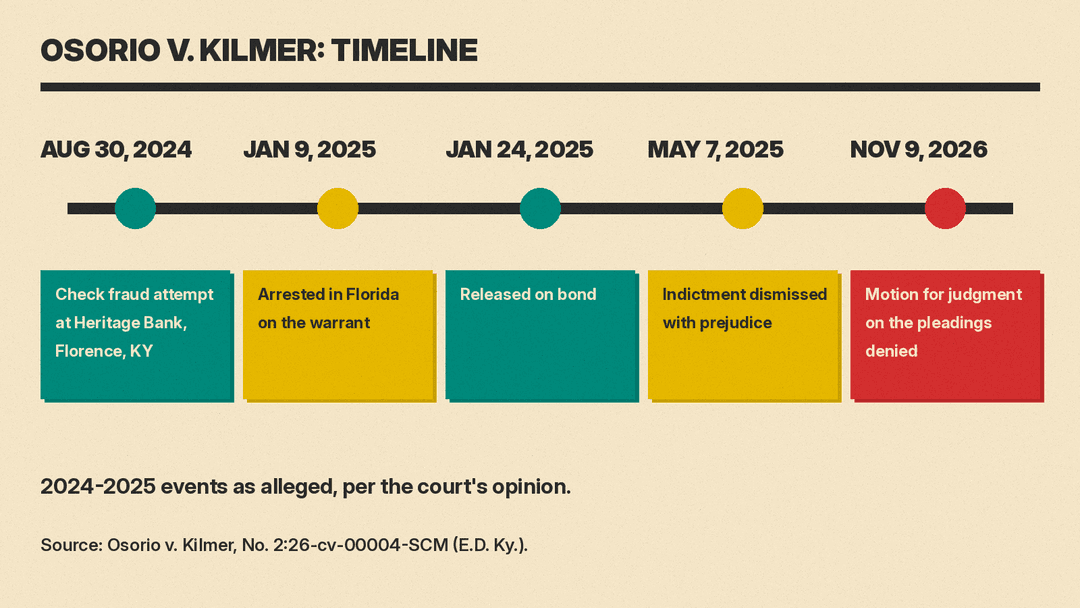
According to the complaint, as the opinion recounts it, on August 30, 2024, a man tried to cash a suspected fraudulent check at Heritage Bank in Florence, Kentucky, after showing a Texas operator's license. The teller thought the license looked fake and refused to cash the check. Security camera footage captured the man's face.
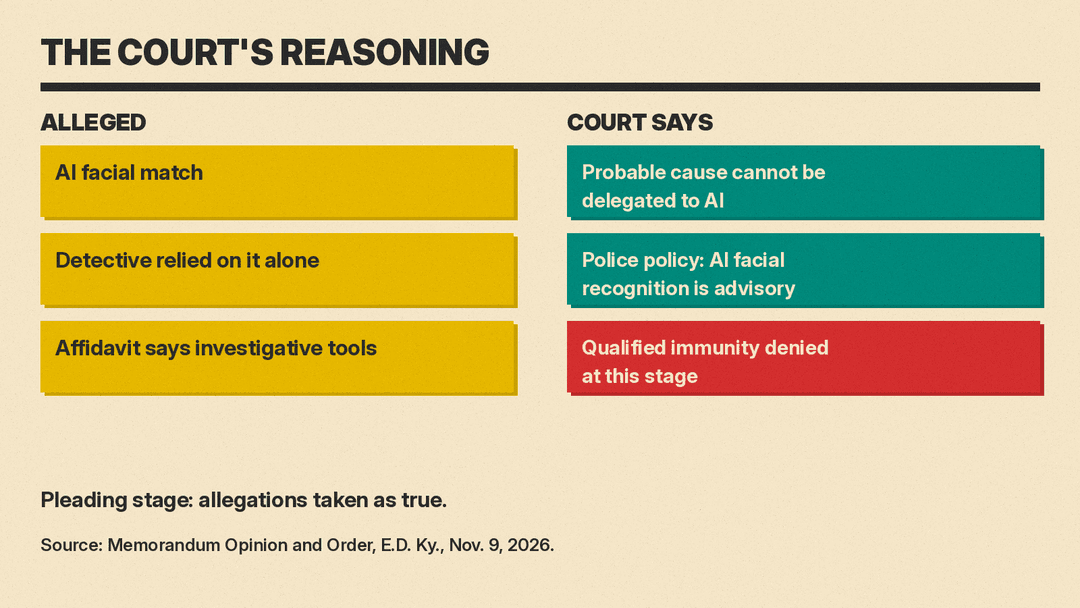
Osorio alleges that Kilmer took a screenshot of the suspect's face and used AI facial recognition technology to match the screenshot with a booking photo and a Facebook profile image. Relying solely on the AI identification, Kilmer concluded the match was accurate, according to the complaint. The Facebook profile belonged to a person known as "Yony Smith Npoles Charon." For a reason the opinion calls unknown, Kilmer concluded that "Yony" was actually Osorio, the man in the booking photo, the complaint says.
According to the complaint, Kilmer signed a criminal complaint saying he used "investigative tools" to find a booking photo and that he "observed that the subjects matched." That complaint was the basis for an arrest warrant. Officers executed it on Osorio, a Nebraska resident, in Florida on January 9, 2025, the opinion recounts.
Osorio was extradited to Boone County, Kentucky, and charged with criminal possession of a forged instrument in the first and second degrees. He pleaded not guilty at his arraignment on January 23, 2025, and was released on bond the next day. He was indicted in March 2025. On May 7, 2025, the Commonwealth Attorney's Office dismissed the indictment with prejudice because Osorio had proved he was working in Nebraska when the check was presented.
The opinion says: "Based on the booking photo, the only thing Osorio has in common with the suspect is that he is a black male with facial hair." It adds that Osorio appears to have a different head shape, haircut, facial features and complexion.
Osorio sued Kilmer on January 8, 2026. He brings federal claims under 42 U.S.C. § 1983 for false arrest and imprisonment and for malicious prosecution, under the Fourth and Fourteenth Amendments. He also brings Kentucky law claims for false arrest and imprisonment, malicious prosecution, assault and battery, and seeks punitive damages.
What the Florence police policy says about facial recognition
According to the opinion, Florence Police Department policy provides that AI facial recognition technology is "advisory" and does not "establish probable cause without further investigation."
The court leaned on that policy. It wrote that "the policy put Detective Kilmer on notice that he should not have been relying solely on AI to make arrests, and yet he allegedly did so anyway." It added that he "compounded the problem by failing to inform the reviewing court that he had relied solely on uncorroborated AI information."
Kilmer argued that saying "investigative tools" when he used one tool was an immaterial error. The court disagreed at this stage. Assuming the allegations are true, it said, "there is good reason to think that the warrant would not have been issued" if Kilmer had given a full picture of how he identified Osorio.
Kilmer also cited a Sixth Circuit case about police who failed to double-check information in an FBI file. The court said that "[f]ailing to double-check the FBI's work is materially different" from failing to do anything at all to corroborate information obtained from AI, which is what Osorio alleges.
Why the judge rejected qualified immunity: the Magic 8 Ball
Qualified immunity protects officers from personal liability unless their conduct violated clearly established law. Kilmer argued that Osorio "has identified no such case establishing that exclusively relying on [AI] facial-recognition technology to establish probable cause violated Osorio's Fourth Amendment rights."
The court said Osorio did not need a case directly on point. It relied on Sixth Circuit cases about unreliable evidence and false warrant statements, and on the "obvious case" exception, which applies when the unlawfulness of conduct is clear even without similar precedent.
To explain, the judge described a detective who asks a Magic 8 Ball whether each passerby is a bank theft suspect, then seeks a warrant saying he used "investigative tools." Any reasonable officer, the opinion says, would know more work is needed: "a Magic 8 Ball alone will not cut it."
Then the court applied it to AI: "while AI facial recognition technology has rapidly developed over recent years and is likely more reliable than a Magic 8 Ball, placing unquestioned reliance on such technology is still not much different in principle from placing unquestioned reliance on a Magic 8 Ball."
What this ruling does and does not mean
The order does not ban facial recognition, and it does not decide whether Kilmer is liable. It comes from one federal district court at the pleading stage, so it binds only the parties in this case. The opinion says: "It is certainly possible that discovery might uncover facts that would entitle Detective Kilmer to qualified immunity." The case continues. Kilmer has 14 days to answer or file another motion, and later proceedings or an appeal could change the result.
The opinion also notes that Kilmer's motion "does not explicitly address Osorio's claims under Kentucky law."
On the facts Osorio alleges, the court said an uncorroborated AI match was not enough for probable cause at this stage. It wrote that "[n]o reasonable officer would think that Detective Kilmer's allegedly exclusive reliance on AI is lawful," especially given how different Osorio's booking photo looks from the suspect in the footage, in the court's description. We covered a related police AI story in our report on leaked Flock Safety code and its OS Investigate AI system. Other recent AI cases that moved past early motions include the NotebookLM voice suit against Google and the Claude Max usage suit against Anthropic.
