
Magistrate Judge Alex G. Tse of the US District Court for the Northern District of California ruled on November 6, 2026 that a proposed class action over Anthropic's Claude Max marketing can go ahead in part. His order in Kahn v. Anthropic PBC, No. 26-cv-05763-AGT, grants in part and denies in part Anthropic's motion to dismiss. "The advertising in question is plausibly misleading, so the case will move forward," the order says.
This is a pleading-stage ruling. The court took the complaint's allegations of material fact as true. The order describes a "putative class"; it does not certify a class, and it does not find that Anthropic did anything wrong. It holds only that the advertising is "plausibly misleading" enough for the case to move forward at the pleading stage. Courthouse News reported that representatives for Anthropic and the plaintiffs did not immediately respond to a request for comment.
The claims
According to the order, Karl Kahn and Solomon Smith allege that Anthropic "misleadingly markets its Claude Max subscriptions as providing '5x or 20x more usage' than Pro plans." They sue on behalf of "a putative class of Claude Max subscribers" under California's CLRA, UCL and FAL, and for negligent misrepresentation, breach of contract, and breach of the implied covenant of good faith and fair dealing.
As alleged, Pro cost $17 to $20 per month, Max 5x $100 and Max 20x $200. On claude.com, Anthropic promised "5x more usage than Pro" and "20x more usage than Pro."
The order says Max users get 5x or 20x more usage per five-hour session, but their weekly limits "are not 5x or 20x higher." It cites the plaintiffs' calculation that, for Claude's Sonnet 4 model, Max 5x users get 3.5x more usage than Pro users per week, and Max 20x users get 6x more.
As Courthouse News reported, one customer said: "I am only on my third day of the week, and I have already used 50% of my weekly allowance on the 20x Max plan." The order cites this as a consumer complaint in the lawsuit.
The disclosure defense
Anthropic argued that its site explains the limits. One sales page puts an asterisk after "more usage" with the words "Usage limits apply." Two links on, a help page says Max plans give 5 or 20 times more usage per session than Pro.
The court held that, because payments are due monthly, reasonable consumers could plausibly read the promise as per month. "Anthropic's per session disclosure is located two hyperlinks away from the primary sales pages on claude.com," the order says. That disclosure "may persuade the fact-finder that [Anthropic's advertising] is not misleading, but it is not a basis for dismissal under FRCP 12(b)(6)." On the asterisk: "The disclaimer says nothing about usage limits per session."
Three claims survive
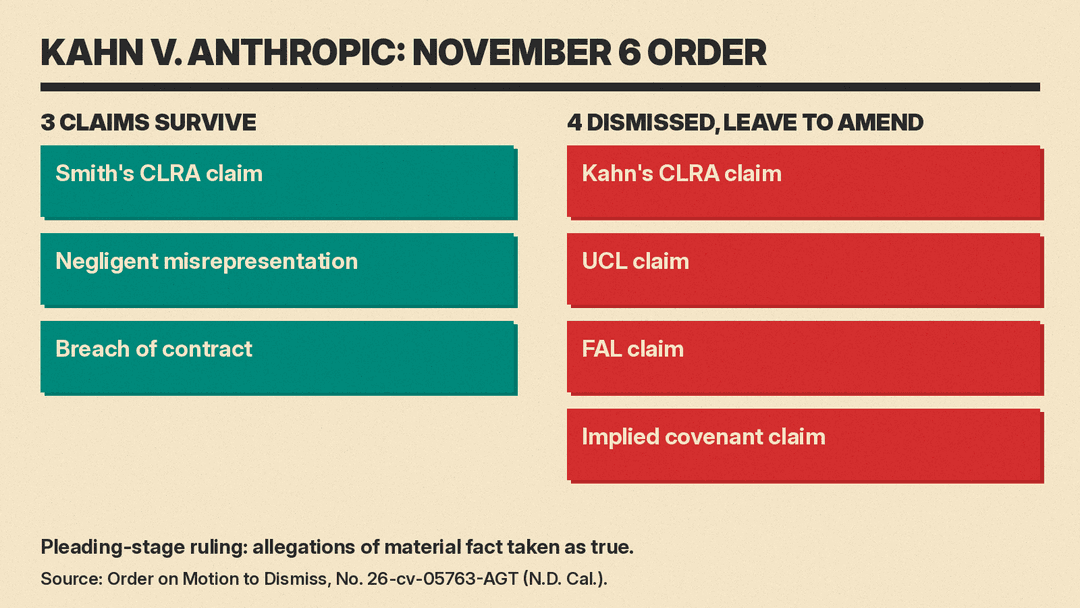
- Smith's CLRA claim. The court found that Claude Code, an "agentic coding system" in paid plans, is plausibly a "service" under the CLRA when not used for business. Smith, a computer-science student, uses Claude for "coursework, coding projects, and hackathon work." Quoting the plaintiffs' brief, the order notes that "Educational use is plainly not commercial use," and found he plausibly used Claude as a consumer.
- Negligent misrepresentation. The court rejected Anthropic's arguments, as it did on the CLRA claim, and held that the economic-loss rule does not bar it.
- Breach of contract. The Terms of Service point to "the order process" for what a subscription includes. The court found that process plausibly included the sign-up pages with the "more usage" promise.
Four claims dismissed, with leave to amend
- Kahn's CLRA claim. Kahn said he uses Claude Code "to accomplish computer programming tasks," without more detail. "He could be an entrepreneur who uses Claude Code to develop software for sale," the order says.
- The UCL claim and the FAL claim. Both plaintiffs remain Max subscribers, so the court found they lack standing to seek an injunction. For restitution, they did not explain why they lack an adequate remedy at law.
- The implied covenant claim. This claim targets changes Anthropic made during billing cycles. The Terms reserve Anthropic's right to "increase or decrease capacity limits," and the court found the contract was not illusory. As alleged, the order says, "Anthropic was trying to balance its supply of Claude with consumers' demand," and "Anthropic didn't tighten usage limits as a bait-and-switch."
What happens next
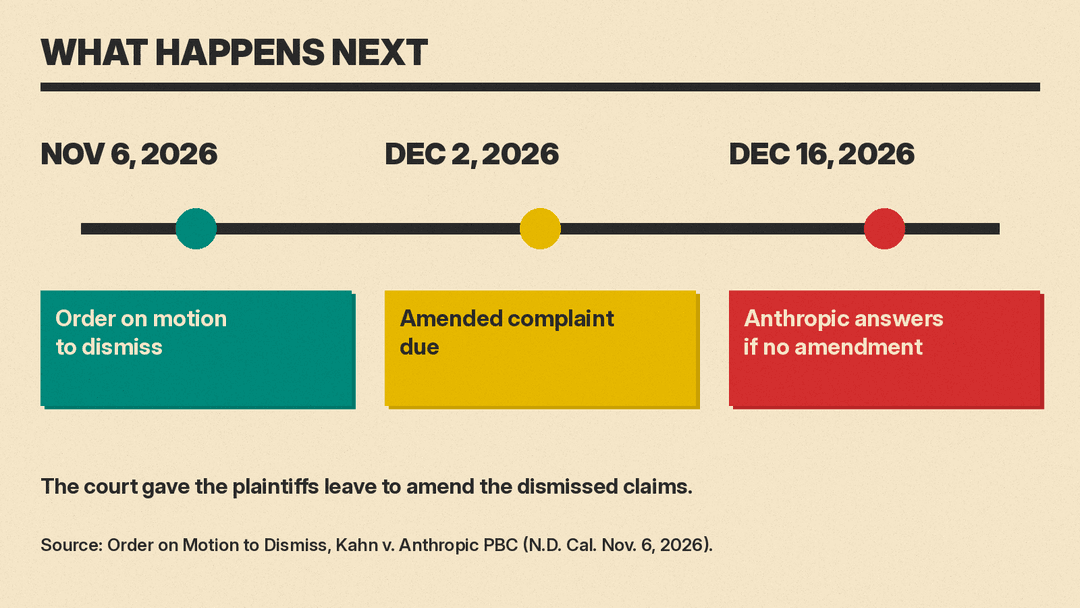
The amended complaint is due on December 2, 2026. If the plaintiffs do not amend, the order says Anthropic "shall answer the operative complaint by December 16, 2026."
The plans have new names
On October 30, 2026, the Claude account on X said Max 5x is now Max and Max 20x is now Ultra, still $100 and $200 per month. The pricing page now lists Ultra at "10x Pro usage every week."
In an X post the same day, Mike Overell, who wrote that he leads product for Claude subscriptions, said: "When we added weekly limits to Max 20x, we set them to 10x Pro's (the 5-hour limit stayed at 20x)." He added: "I get that some new users assumed 20x applied to both limits. We could have done better here, and I'm sorry."
The 10x weekly figure is Anthropic's. The 6x figure for Sonnet 4 is the plaintiffs' calculation. The court has not decided which reading of "more usage" is correct.
Anthropic also faces the music publishers' suit in the same district; see our report on the Concord lyrics hearing. For background on Claude Code, see What Is a Coding Agent?.
Sources
- Order on Motion to Dismiss, Kahn v. Anthropic PBC, No. 3:26-cv-05763-AGT (N.D. Cal. Nov. 6, 2026), GovInfo (also on Courthouse News)
- Courthouse News: Anthropic must face claims its Claude Max pitch misled users
- Sovereign Magazine: Claude Max lawsuit ruling
- Claude on X: plan rename, October 30, 2026
- Mike Overell on X, October 30, 2026
- Claude pricing page
