

Microsoft has put a version of the small language model it plans to build into Windows on Hugging Face. On November 18, 2026, the company published Aion 1.0 Instruct, a 2.3 billion parameter text model, under the MIT License. The model card credits the "Microsoft Windows Applied Sciences Group" and says a further optimized version will become the Windows OS small language model by the end of January 2027.
What Microsoft released
The model card describes the model this way: "Aion Instruct serves as the foundational Small Language Model (SLM) in the Windows ecosystem, specifically optimized for on-device AI, text and operating system use cases."
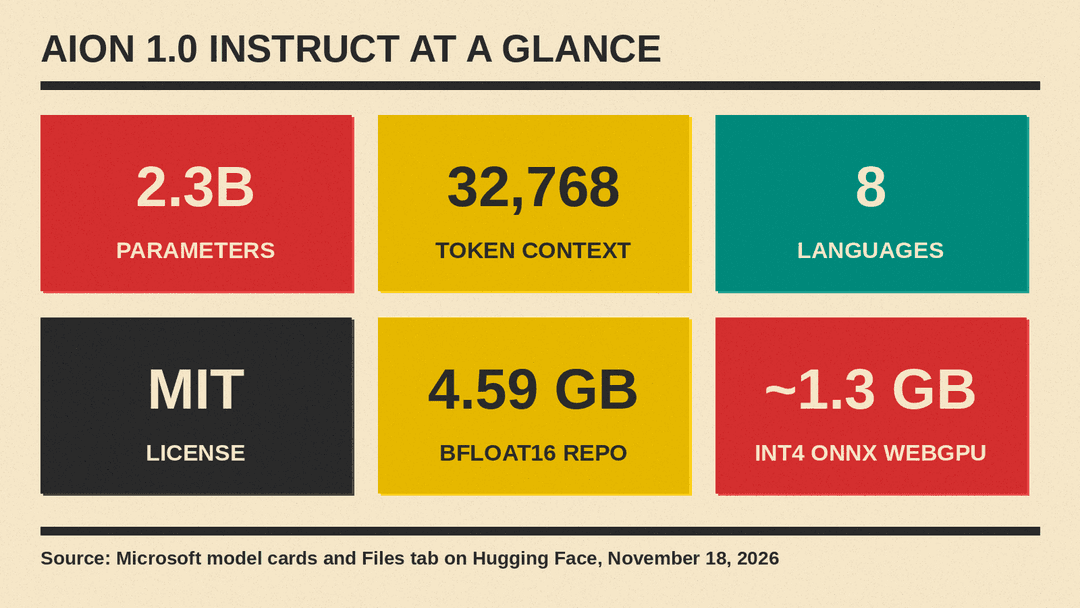
Per the same card, the model handles eight languages: English, German, Spanish, Portuguese, Italian, French, Chinese and Japanese. It has a context window of 32,768 tokens and a knowledge cutoff of December 2025. Its tags are summarization, rewriting and chat. The card says it "was primarily trained for general-purpose text scenarios including document comprehension, content analysis, question answering, and natural language understanding."
On training data, the card says it is "an extension of the data used for training Phi Silica (the previous generation Windows OS SLM)", and that multilingual data is about 6% of the total. For background on Microsoft's open Phi family, see our explainer on Phi models.
Microsoft also lists its own benchmark scores on the card, run mostly with EleutherAI's lm-evaluation-harness. Figures include 55.15 on MMLU, 74.91 on GSM8K (loose matching), 48.00 on MATH-500 and 83.90 on IFEval. These are Microsoft's numbers, not independent tests.
The card is direct about limits. It says "The model was not trained to excel at world knowledge," that it "can miss fine details, provide misstatements, or show inability to follow complex multi-step reasoning," and that "Aion Instruct may be susceptible to adversarial attacks."
What it runs on
There are two repos with downloadable files as of November 18, 2026:
- microsoft/Aion-1.0-Instruct-2.3B: the full model in bfloat16. The Files tab totals about 4.59 GB, almost all of it the single weights file.
- microsoft/Aion-1.0-Instruct-2.3B-ONNX-WebGPU: a quantized version with INT4 weights. Its card lists the model size as "~1.3 GB" and the target hardware as "GPU via WebGPU (browser and native)", using ONNX Runtime GenAI or ONNX Runtime Web. The card says that to run on CPU instead, you omit two provider lines in its sample code. It also warns: "Quantization can affect output quality."
The main card says "We are publishing the unquantized model first, to be followed by quantized versions." If the INT4 label is new to you, our quantization explainer covers what those numbers mean.
The license
The license picture has three separate parts, each from its own source.
- Weights: the Hugging Face model card lists the license as MIT, and the repo's LICENSE file is the MIT License, "Copyright (c) Microsoft Corporation." The MIT text requires that the copyright notice and permission notice be included in all copies or substantial portions of the software, and it provides the software "AS IS", without warranty. The card adds: "Nothing contained in this Model Card should be interpreted as or deemed a restriction or modification to the license the model is released under." The ONNX WebGPU card also lists MIT and ships its own LICENSE file.
- Code: the custom model code files (
configuration_aion_instruct.pyandmodeling_aion_instruct.py) sit in the same Hugging Face repo as that MIT LICENSE file. The separate Windows sample app on GitHub is different. Its LICENSE says the repo contents "are governed by the Microsoft Software License Terms for the Aion Instruct Windows Developer Validation Package: LIMITED USE, PRE-RELEASE." It points to a EULA document in the repo as the authoritative terms. - Data: the card names no data license, and the training data is not published.
What Microsoft says about Windows
The model card says: "A further optimized version of Aion Instruct, coupled with Microsoft’s content moderation model, will become the Windows OS SLM by the end of January 2027. This Hugging Face version is meant to be an introduction to what’s coming and a way to maximize transparency with our users, as well as welcome their feedback."
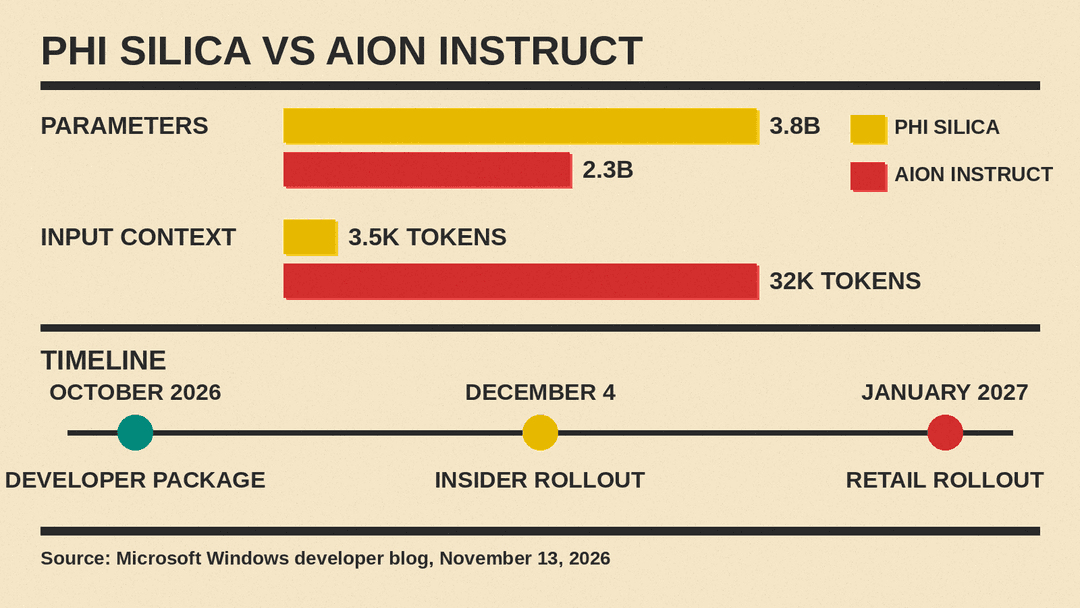
A Microsoft Windows developer blog post from November 13, 2026, by Connor Al-Joundi, lays out "the transition plan from Phi Silica to Aion Instruct." It compares the two: Phi Silica has 3.8B parameters and a 3.5K token input limit, and Aion Instruct has 2.3B parameters and a 32K limit. Its timeline says a standalone developer package arrived in October 2026, rollout to Windows Insider Preview devices is planned to begin on December 4, and retail rollout is planned for January 2027 ("targeted for late January"). The card and the blog both point to the end of January 2027.
The blog also says Microsoft is expanding Aion Instruct to supported GPUs, "including popular dGPUs like NVIDIA’s RTX-series and AMD’s RDNA4 generation." It says Microsoft added "invisible watermarking to Aion Instruct to fulfill Text Provenance requirements in specific regions." For app makers, it says "For most app developers, no action will be required," while apps with highly custom prompts, custom LoRAs or custom output parsing will need action.
How to try it
The model card Quickstart uses the Python transformers library. It says: "The model uses custom modeling code, so trust_remote_code=True is required. It was exported with transformers 5.x." You load the model and tokenizer with AutoModelForCausalLM and AutoTokenizer using the model id microsoft/Aion-1.0-Instruct-2.3B, then generate from a chat message. Keep in mind that trust_remote_code=True runs Python code from the repo on your machine.
The ONNX WebGPU card gives a separate path: download the repo with hf download microsoft/Aion-1.0-Instruct-2.3B-ONNX-WebGPU, install numpy and onnxruntime-webgpu, install onnxruntime-genai with --no-deps, then run its Python sample.
Windows developers can also look at the Aion Instruct Preview sample, a WinUI 3 chat app linked from the card. Its README warns: "This package is exclusively for developer validation of the new Aion Instruct model stack. It is not for end-user or customer use." It supports ARM64 Snapdragon, x64 Intel Lunar Lake and x64 AMD Ryzen AI Copilot+ PCs, and says "There is no CPU fallback when a supported NPU provider is unavailable."
For other ways to run small models on your own hardware, see our llama.cpp explainer.
Why it matters
Microsoft's blog says Aion Instruct is replacing Phi Silica as its on-device language model for Windows, while "continuing to work with familiar Windows AI capabilities and APIs." With this release, the base model behind that plan can be downloaded and tested under MIT terms before the optimized version reaches retail PCs. Microsoft frames the Hugging Face version as a way to "maximize transparency" and to collect feedback.
The Hugging Face weights are not the final Windows build. The card calls the shipping version "further optimized" and paired with a content moderation model, and the GitHub sample says its validation package "is not the final Windows delivery." Developers who build on the Windows AI APIs can still test the base model now, ahead of the Insider rollout.
Sources
- microsoft/Aion-1.0-Instruct-2.3B model card and Files tab, Hugging Face
- Aion-1.0-Instruct-2.3B LICENSE (MIT)
- microsoft/Aion-1.0-Instruct-2.3B-ONNX-WebGPU model card, Hugging Face
- microsoft/Aion-Instruct-Preview-Sample, GitHub (README and LICENSE)
- Microsoft Aion Instruct: Advancing local AI on Windows and expanding to GPU, Microsoft Windows developer blog, November 13, 2026
