
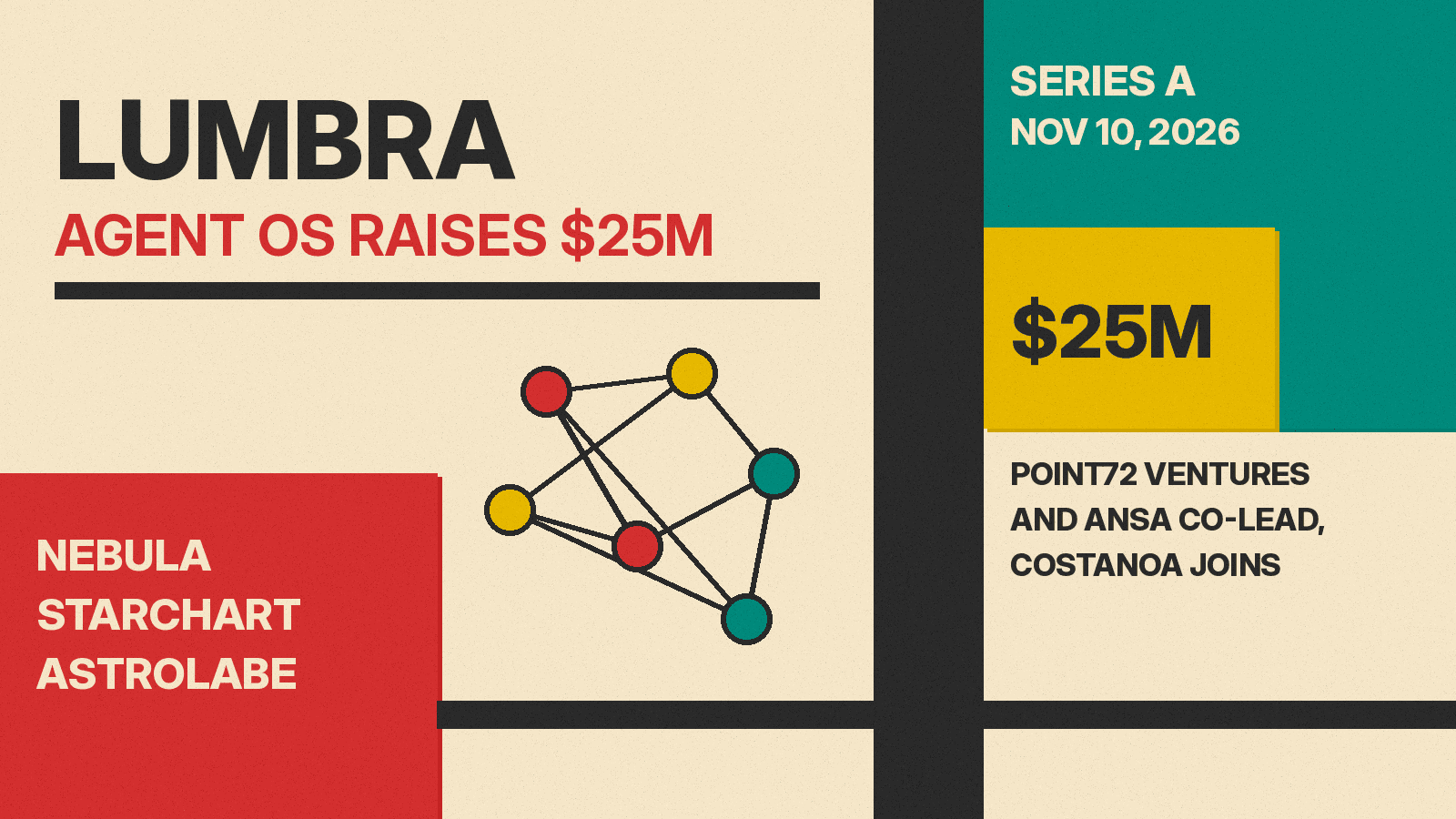
Lumbra, a Washington, D.C. and New York startup, has raised a $25 million Series A. The round was co-led by Point72 Ventures and Ansa, with continued participation from Costanoa, according to Lumbra's Business Wire release dated November 10, 2026.
Lumbra calls itself "the company building the operating system for AI agents in high-consequence environments." The release says its agents "are already in production on top-secret networks across the Pentagon and U.S. Intelligence Community." It also says "most of the new capital" will fund the engineers and deployment teams taking the platform into regulated commercial sectors. The headline names finance, healthcare and law.
What LumbraOS is
LumbraOS is the company's agent platform. The release describes it as "model-neutral": teams can mix frontier-lab models with open-source models. In Lumbra's words, "agents find, trace, and propose, and people set the standards and make the final decisions."
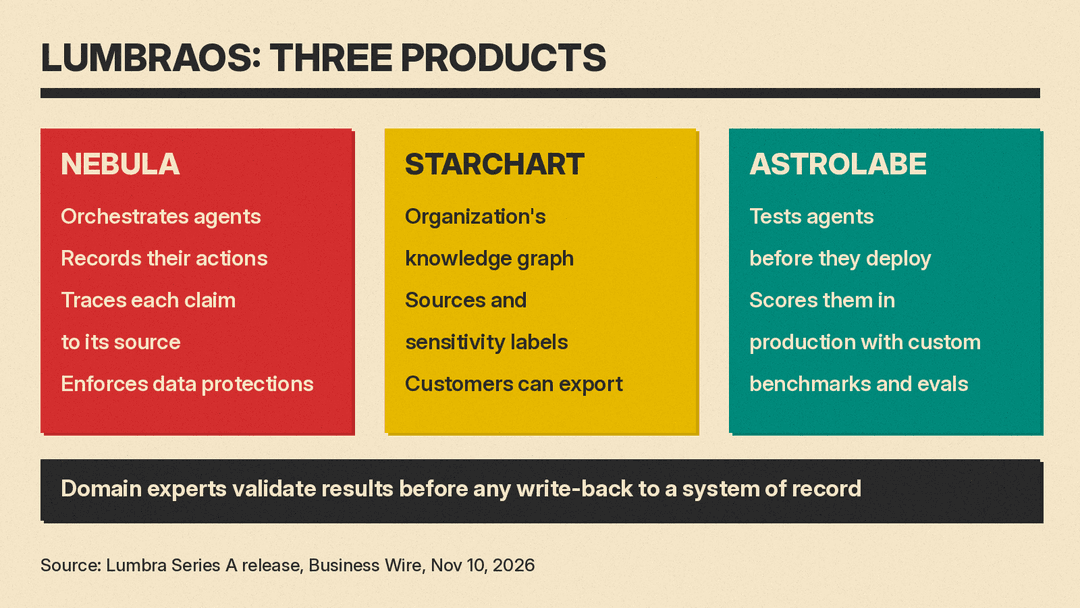
The release lists three products:
- Nebula "orchestrates agents, records their actions, traces each claim to its source, and enforces data protections." Before an agent writes anything back to a system of record, domain experts validate the results.
- StarChart is "an organization's knowledge graph where agents automatically compound knowledge over time." Insights are stored with sources and sensitivity labels. The release says customers own the data rights and can export their graphs.
- Astrolabe "tests agents before they deploy and scores them in production using custom benchmarks and evaluations."
The release adds that agents "read each data source in place, under that source's own permissions."
Lumbra's Technology page walks through an intelligence example in five steps, from Decompose to Synthesize. The orchestrator breaks one collection requirement into hundreds of tasks, and specialized agents search different source types. The page says "single-source findings are held back" and "contradictions go to the officer, not to a vote." It ends with: "The officer signs it. The system shows its work."
The same page states some design rules. It says "LLM-as-judge is a degraded fallback, not a strategy," and that the platform "validates against truth that humans defined, curated, and maintain." It says the orchestration around models "is fully deterministic," even though the models are not. For deployment, the page lists "Air-gapped, on-premise, sovereign cloud," and under Compliance it lists "FedRAMP, IL5, NIST 800-53." The page does not say which of these Lumbra holds as formal authorizations.
If you are new to how agent tools gate risky actions, our explainer on AI agent permissions and approvals covers the basic pattern.
The government track record Lumbra cites
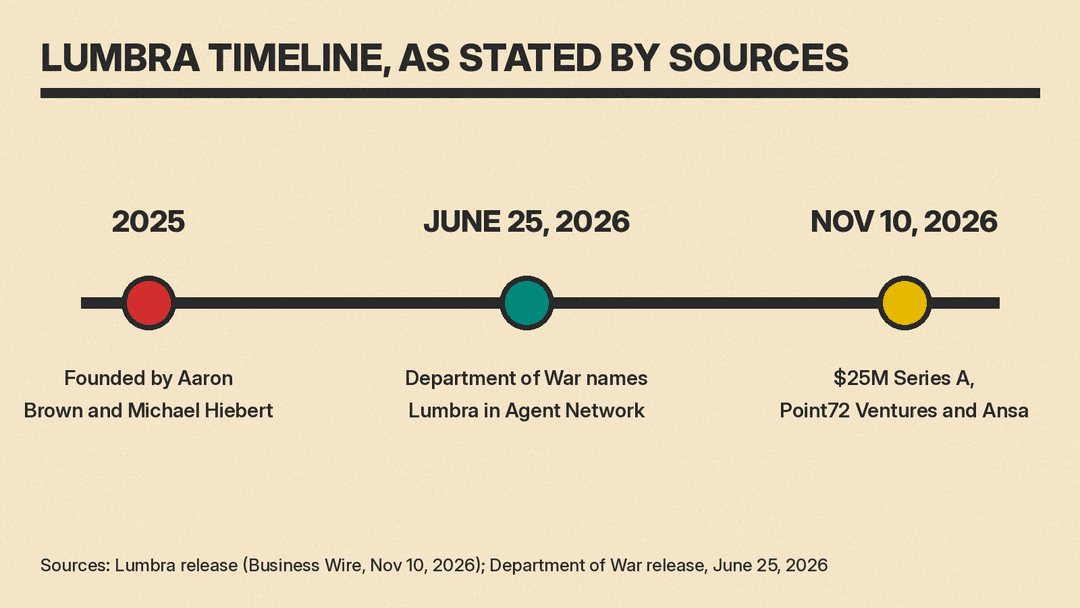
The release gives this timeline:
- Lumbra signed its first contract, with a U.S. intelligence agency, two months after product work began. SiliconANGLE calls it a "multimillion-dollar contract" with an unnamed agency.
- Under a later Department of War contract, the release says Lumbra "went from award to production on the Department's top-secret networks in just six months."
- The Pentagon named Lumbra as one of two companies, "at that time," whose work underpins its Agent Network project.
That last claim matches a Department of War release from June 25, 2026. It says Agent Network, the second of seven Pace-Setting Projects in the Department's AI Acceleration Strategy, "builds on foundational Command and Control innovation by Palantir Technologies" and on Lumbra. The Department says Agent Network uses AI agents to scan intelligence and operational systems and turn findings into options for commanders. It also says Agent Network "does not autonomously select or strike targets."
Lumbra's CEO took a similar line in an interview with Tectonic. "I say over and over again, these systems are nowhere near ready enough to do any type of automated targeting work," Aaron Brown told the outlet. "I wouldn't trust it; nobody should trust it."
Who is behind it
The release says Aaron Brown, a former CIA officer, and Michael Hiebert, an MIT-trained engineer and former special operations infantry officer, founded Lumbra in 2025. Tectonic lists Brown as CEO and Hiebert as CTO. The release says the company has more than 40 team members.
In the release, Brown said: "The organizations that get agents right will spend less time telling them what to do and more time deciding what they may touch and what their work must prove."
Marco DeMeireles of Ansa Capital said in the release: "Trust and verifiability remain one of the largest barriers to relying on AI agents in high-consequence environments." Ansa's investment note says the platform "records what each agent did, ties each claim back to its source, and tests how agents perform before and after deployment."
Chris Morales of Point72 Ventures said in the release that Lumbra tackled this challenge "first in the demanding national security setting."
The commercial push
The release says that today "most organizations use AI agents for single tasks that make one person faster." The release says control over agentic workflows means "knowing what every agent did and how it formed its conclusions, while trusting that sensitive data stayed where it belongs."
Brown told Tectonic that Lumbra is already "working with some private companies in a B2B relationship," which he described as "some very big ones." The article does not name them.
Lumbra's site does not list public prices. It sends buyers to a contact page.
For other recent agent news, see Plurai's $13M seed for agent testing and SemiAnalysis on persistent agents in its AI spend.
Sources
- Lumbra Raises $25M Series A to Scale Agentic AI for High-Consequence Environments (Business Wire, Nov 10, 2026)
- Lumbra Technology page
- Lumbra Newsroom
- Department of War: DOW Unleashes 'Agent Network' (June 25, 2026)
- SiliconANGLE: Lumbra gets $25M in backing (Nov 10, 2026)
- Tectonic: Exclusive: Agentic AI Startup Lumbra Raises $25M Series A (Nov 10, 2026)
- Ansa: Why We Invested in Lumbra
