
As of November 8, 2026, the European Commission had confirmed that 16 capitals had missed the deadline to appoint a national authority to enforce the EU's AI law, POLITICO reported on November 8, 2026. The report came days before the 27 EU leaders meet in Dublin on Friday, November 13, for what European Council President António Costa's invitation letter calls "a first dedicated discussion, at Leaders' level" on AI.
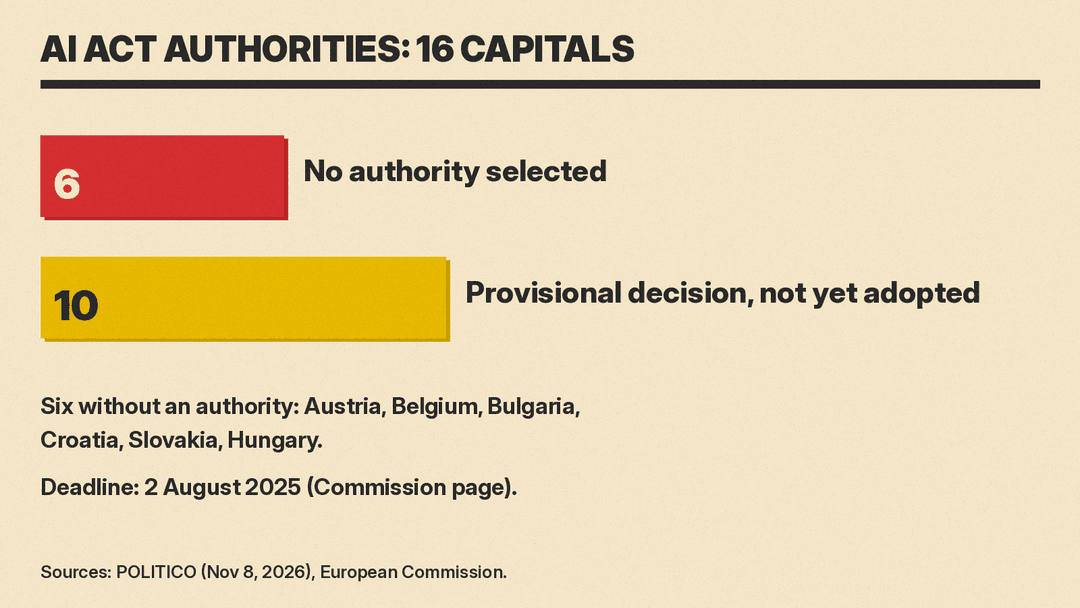
According to that November 8 report, six countries had not selected an authority and ten more had made only a provisional decision. This post explains what the national authority does under the AI Act, what the Commission says it may do about missed deadlines, and what is on the agenda for the Dublin meeting.
What POLITICO reported about the 16 capitals
As of November 8, according to POLITICO, six countries (Austria, Belgium, Bulgaria, Croatia, Slovakia and Hungary) "have not selected an authority". It says 10 other capitals "have only made a provisional decision that still needs to be adopted, the Commission confirmed."
The report, by Pieter Haeck, ties the deadline to August 2025. It also covers a separate delay to AI compute hub plans, described below.
What a national authority does under the AI Act
The AI Act is the EU's law on artificial intelligence. Article 70 of the AI Act says each Member State "shall establish or designate as national competent authorities at least one notifying authority and at least one market surveillance authority". The article says those authorities "shall exercise their powers independently, impartially and without bias". It also says Member States "shall ensure that their national competent authorities are provided with adequate technical, financial and human resources". Each Member State must designate one market surveillance authority to act as the single point of contact.
The Commission's page on market surveillance authorities under the AI Act describes the job in more detail. According to the page:
- Market surveillance authorities have the power to intervene when AI systems pose risks or do not comply with the requirements of the AI Act.
- They can conduct remote monitoring and access providers' documentation, data sets, and source code.
- They can request corrective measures and enforce the rules through the imposition of penalties.
- They accept complaints from any natural or legal person who has grounds to consider that there has been an infringement of the AI Act.
The same page says the AI Office supervises and enforces the rules for general-purpose AI models.
What the Commission says about missed deadlines
The Commission page says Member States are required to designate the responsible market surveillance authorities by 2 August 2025 and notify them to the Commission. It adds: "If the Member States fail to designate a market surveillance authority by that date, the Commission may launch a formal infringement procedure against the Member State."
The Commission also keeps a list of single points of contact. The page, last updated November 9, 2026, says the list "is updated continuously" and that for entries marked with an asterisk, "the national designation decision is still pending final adoption." The figure of 16, and the split of six and 10, come from POLITICO's November 8 report, which attributed that status to the Commission. On the November 9 list, Austria, Belgium, and Croatia still appear without a named authority. Bulgaria, which POLITICO listed among the six that had not selected an authority, appears with an asterisk. Slovakia and Hungary, also in that group of six on November 8, now appear on the list without an asterisk. The Commission page does not itself state a new official count.
The POLITICO report does not say that the Commission has opened any infringement procedure.
The letter from MEP Sergey Lagodinsky
POLITICO reports that Sergey Lagodinsky, a German member of the European Parliament from the Greens, said the delays undermine the credibility of capitals when they speak about Europe's AI ambitions. He is quoted as saying: "Stop blaming the EU for missing the race if you miss your own deadlines."
POLITICO also says that in a letter it saw, Lagodinsky asked the Commission to start a formal procedure against capitals for failing to meet their legal requirements under the AI law. POLITICO quotes him further: "Europe's AI ambitions cannot be delivered if national capitals cannot get their act together."
What leaders will discuss in Dublin
The invitation letter from European Council President António Costa says the discussions in Dublin "will focus on Artificial Intelligence". The morning session includes two external guests: Arthur Mensch, CEO of Mistral AI, and Professor Geoffrey Hinton. The letter says the lunch session is "an exchange of views at 27 on the way forward for Europe in the area of AI".
The steering note for the discussion has two topics: "Boosting Europe's competitiveness and AI sovereignty" and "Addressing societal impacts, safety and security". Under the second topic, it says "The EU has established a comprehensive regulatory framework." The note does not mention national authorities or the designation deadline. Its guiding questions ask about societal and security impacts, labour markets, and international governance of advanced AI.
The Council's media advisory lists a press conference at 16:15 local time with President Costa, Taoiseach Micheál Martin, and President von der Leyen. The advisory says all times are approximate and subject to change.
A second delay in a separate AI program
POLITICO adds a second item. It says Brussels pushed back plans to support seven AI compute hubs: the department running that €30 billion investment project announced at the end of October that it would extend the deadline for consortia to express their interest. The stated reason, quoted by POLITICO, was "to give member states the necessary time to complete their national budgetary process and submit financial commitments." POLITICO says it was the second delay in a row, after the initial November deadline moved to February.
This is a separate program from the AI Act authorities.
What to watch
- Whether the Commission opens a formal infringement procedure. The Commission page says it "may". The POLITICO report does not say it has.
- Whether leaders mention enforcement of the AI Act in Dublin. The steering note says only that the EU "has established a comprehensive regulatory framework".
- Whether more countries complete their designations. POLITICO's November 8 figures were six without an authority and ten with a provisional decision. The Commission says its list of single points of contact is updated continuously.
For earlier coverage of EU AI rules, see our posts on the EU AI Office's questions to OpenAI and Anthropic about agent incidents, the leaked Digital Fairness Act draft on AI companions, and Australia's plan for an AI safety regulator.
Sources
- POLITICO: EU countries still can't get it together on AI (Nov 8, 2026)
- AI Act Service Desk: Article 70
- European Commission: Market surveillance authorities under the AI Act
- Council of the EU: invitation letter by President Costa
- European Council: steering note on AI for Dublin
- Council of the EU: media advisory, Nov 11, 2026
