
Google DeepMind announced Genie 4 on October 27, 2026, its newest world model. A world model makes a scene you can move through, frame by frame, as you go. Genie 4 adds native audio, including spoken dialogue, more lifelike people and physics, and freeform text edits while the world runs. It is a research preview for trusted testers today. Google says it is coming to Google AI Ultra subscribers in Project Genie and to early access partners of the Gemini API and Google AI Studio.
For video creators, the interesting part is not the gaming pitch. DeepMind says creatives and technologists are testing Genie 4 as a rapid "draft mode" for pre-visualization and ideation.
What Genie 4 is
Clip models such as Google's Veo take a text, image or video prompt and return a finished clip. A world model works differently. It generates the next frames in real time from your inputs, so you can move through a scene with standard keyboard controls and steer the camera as it goes. DeepMind's Genie 4 model page describes it as "our most realistic and interactive world model yet."
Genie 4 builds on the Gemini family. According to DeepMind, Gemini Omni "anchors the simulations in real-world appearance and behavior," while other Gemini models supply the reasoning that keeps a simulation coherent. You can start from a text prompt or a reference image used as the first frame, and DeepMind's published examples range from a 16mm documentary scene on a floating platform to a stained-glass landscape and a first-person dragon race.
This is a crowded field. We have covered Runway GWM Worlds 2 and Tencent's open Hy-Nomas interactive video world model. TechCrunch places Genie 4 against that backdrop and notes the world model industry is starting to consolidate.
The four upgrades
DeepMind groups the changes into four capabilities.
1. Real-time edits by text
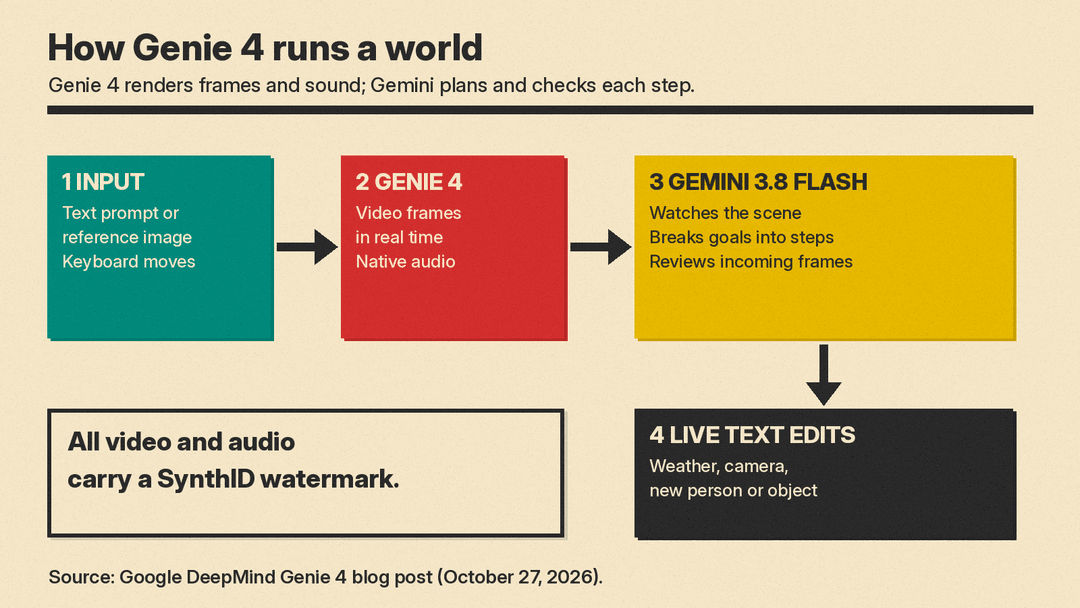
You can change a running simulation in plain language: change the weather, move the camera, or add a new person or object. DeepMind says Gemini "will contextually adapt your prompt to match the surrounding scene," and between your inputs Gemini also monitors and steers the scene so the world keeps progressing in a cohesive way.
2. Physics and people
DeepMind says Genie 4 simulates physics scenarios such as aerodynamics and collisions. Its model page shows objects that collide, water that flows and trees that sway. The company calls its handling of people "the most dramatic leap": characters that move naturally, respond to their surroundings and can be steered in real time.
3. Native audio and dialogue
This is DeepMind's first real-time world model to generate audio natively. Each world carries its own ambient sound, "from wind in the trees to waves crashing at the beach." DeepMind calls human speech "the true frontier": Genie 4 adds interactive dialogue, with characters that converse and react to your inputs or to events in the world. DeepMind says the sounds in the demo videos at the top of its launch post were produced directly by Genie 4.
4. Complex events with a Gemini agent in the loop
To keep multi-step events on track, Gemini 3.8 Flash acts as a guiding agent. As Genie 4 renders, Gemini watches the scene, breaks a goal into steps, and reviews incoming frames to check that each step succeeded. If the world shifts or you step in, it adapts the plan. DeepMind also shows Gemini 4 Argon planning a task for Apptronik's Apollo humanoid to play checkers, with each step passed to Genie 4 as a text caption while the simulation renders.
How it compares with Genie 3
Genie 3 powers the current Project Genie, which Google opened to US AI Ultra subscribers on January 29, 2026. Google's own post listed its limits: worlds that do not always look true to life or follow prompts, characters that can be less controllable, and generations limited to 60 seconds.
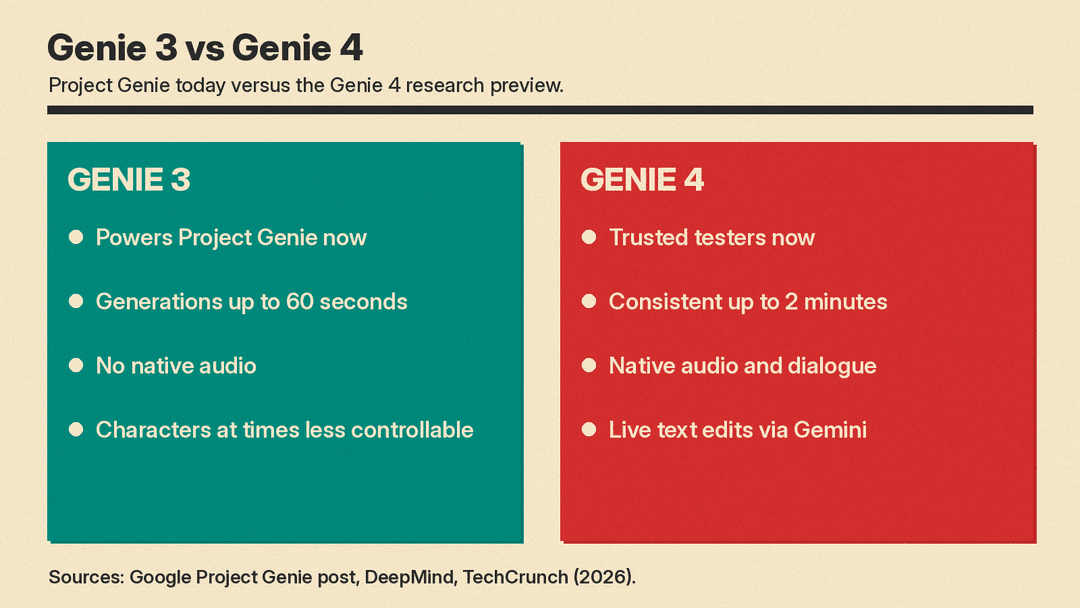
Per TechCrunch, Genie 4 can keep a scene consistent for up to two minutes, double its predecessor's limit. DeepMind's model page says the model "can support a few minutes of continuous interaction, rather than extended sessions." Ars Technica likewise reports that worlds stay consistent for "a couple of minutes" before they forget how things started.
Why it matters for AI filmmaking
DeepMind says trusted testers across creative industries, journalism, education, gaming and engineering have used the model. The creative use it describes is concrete: filmmakers "can step into a live simulation of a scene and run multiple 'takes' in real-time, adjusting camera angles, lighting, dialogue, and action on the fly."
That matches what Diego Rivas, who TechCrunch identifies as a Google DeepMind engineer, said in a press briefing. He said the real-time aspect "becomes most valuable in the areas where keeping a state of flow in the creativity space becomes incredibly useful," and named the ideation and storyboarding phases as examples. Per TechCrunch, Rivas added that users could eventually turn those prototypes into creative assets with Gemini Omni, though he said those capabilities are "still a ways off."
Our read: Genie 4 is a previs and blocking tool first, not a replacement for clip models. A director could find a camera path and a performance in Genie 4, then write a tight shot prompt for a finished render. If you are new to that second step, our guide to writing AI video prompts for Veo, Runway and Kling covers the basics.
Other tester uses DeepMind lists:
- Photojournalists turning a single archival photograph into a grounded simulation of that place.
- Game developers going from an idea to an explorable prototype before writing engine code.
- Enterprise partners evaluating it for fast "zero-to-one" scenario generation.
Limits DeepMind lists
DeepMind is direct about what does not work yet:
- Drift: visual details and object permanence can shift over time, more so in long runs, after many prompt edits, or while moving through a scene.
- Other agents: modeling complex interactions between users, multiple independent agents and shared spaces is still a research problem.
- Real places: it cannot simulate real-world locations with perfect accuracy.
- Text: clear text often appears only when it is in the input world description.
- Duration: a few minutes of continuous interaction, not extended sessions.
- Audio: real-time audio accuracy is still being improved.
On safety, DeepMind says it ran internal safety evaluations before the preview, and that all video and audio from Genie 4 will carry SynthID, its invisible watermark for AI-generated content.
Access and price
Today, only trusted testers have Genie 4. TechCrunch reports it will roll out "in the coming weeks" to Google AI Ultra subscribers in Project Genie and to early access partners of the Gemini API and Google AI Studio; Ars Technica says there is no specific timeline yet. There is a waitlist in Project Genie.
No price is public. Ars Technica reports that developer pricing "isn't yet available," that consumer access will start with Google's most expensive AI Ultra plans, and that Google may expand it to AI Pro and AI Plus plans later. We will update this post when Google publishes API pricing or opens Project Genie access.
Sources
- Google DeepMind: Genie 4, a new generation of world simulation
- Google DeepMind: Genie 4 model page
- Google: Project Genie launch post (January 29, 2026)
- TechCrunch: Google's Genie 4 world model adds audio, more realistic worlds, and real-time steering
- Ars Technica: DeepMind unveils Genie 4 world model promising more realistic physics and humans
