
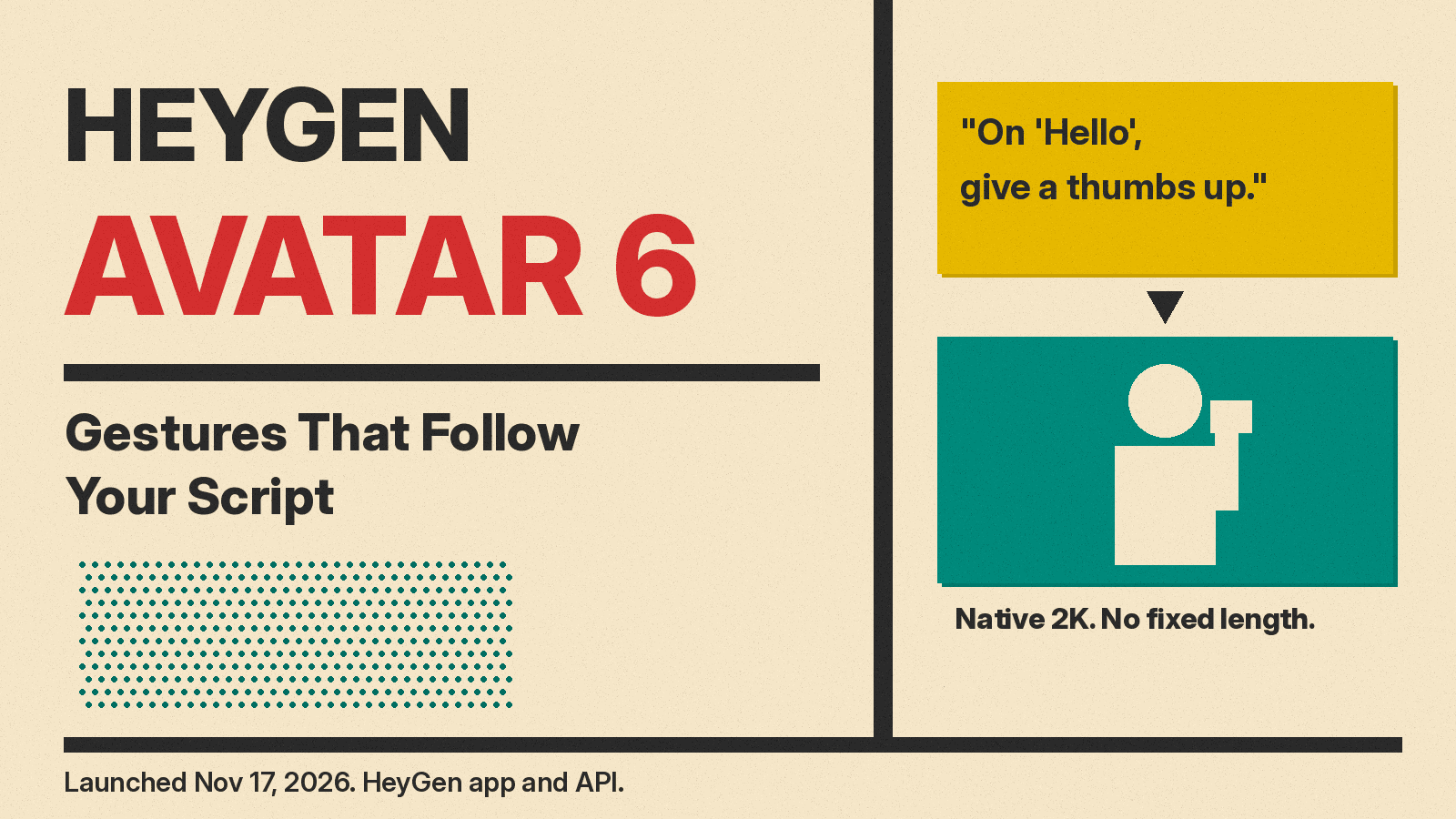
HeyGen launched Avatar 6 on November 17, 2026, and made it available through the HeyGen platform and its API. The company calls it "its smartest and most powerful AI avatar model yet." The pitch is narrow and practical: talking-head avatars that stop repeating the same few hand movements and instead gesture in step with what the script says.
That matters to the people who use these tools most, such as trainers, course makers, marketers and small business owners who want to post video without filming every take. This post covers what Avatar 6 does, what HeyGen's own tests and an outside arena found, where those tests stop, and what it costs as of November 2026.
What is HeyGen Avatar 6?
Avatar 6 is an audio-driven avatar model. According to HeyGen's launch release, it "interprets a user's script and generates corresponding gestures, addressing repetitive motion that has been a persistent limitation of AI avatar technology."
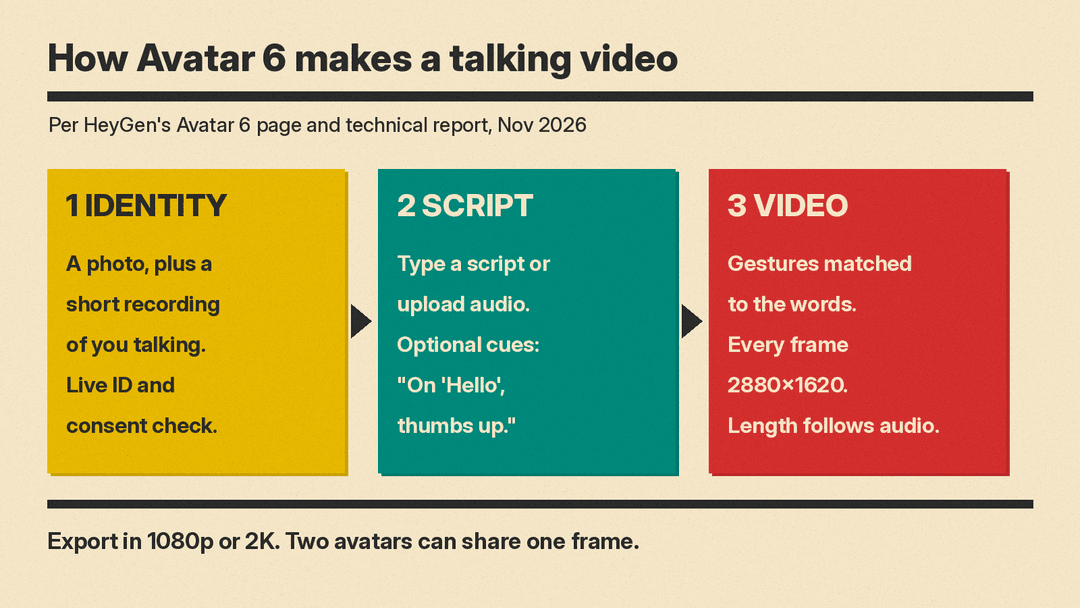
HeyGen's Avatar 6 page puts the change plainly: "Previous avatars looked like you but recycled the same gestures. Avatar 6 reads the script and performs it the way you would." It says the model gestures to match the words, "including pointing, counting, and directional motion," and that users can prompt the emotion, expressions and gestures themselves for finer control.
The technical report shows how that prompting works. You write the action next to the words. One example prompt reads: "On 'Hello', give a thumbs up. On 'the counter on the left', point to the side with your index finger."
What changed from Avatar V
HeyGen lists several upgrades over its earlier avatar engines:
- Longer memory for motion. The release cites "a 10x increase in the model's runtime context window, from approximately 3 to 30 seconds," which HeyGen says allows more varied movement based on each user's own footage, plus better lip sync.
- Native 2K. The report says every frame is generated at 2880x1620. The FAQ says you can export in 1080p or 2K.
- No fixed length. The report says length follows the audio, and shows demo videos of 25 to 28 minutes, each one continuous generation from one audio track.
- Two people in one shot. Two avatars can share a frame for a host and guest conversation generated in one go, which HeyGen points to its MCP for.
- Word edits. In an existing recording, only the edited words are regenerated, in the person's own voice, and the rest stays as filmed.
- Automatic upgrade. Existing Personal Avatars move to Avatar 6 without new footage, and users can connect YouTube, Instagram or TikTok accounts to build an avatar from footage they already posted.
One detail to check before you record: HeyGen's own pages give different footage figures. The release says you can create an avatar "with as little as 30 seconds of video," the model page's how-to says to "record at least 15 seconds of yourself talking," and the product update note says the model "learns from up to 30 seconds of video and a photo."
How good is it? What HeyGen's tests show
HeyGen ran a Turing-style test. Raters saw a real recording and an Avatar 6 clip side by side, with the same sentence and audio, and picked which one was real. They picked Avatar 6 as real 42.2% of the time across 270 answers. HeyGen explains that "50% would mean they cannot tell at all," so it doubles the figure and reports Avatar 6 as "84.4% indistinguishable," up from 44.4% for Avatar V. The press release rounds this to 84%.
Shown one at a time, 65.1% of Avatar 6 clips were judged real, compared with 78.9% for real recordings. So viewers still spotted real footage more often.
HeyGen also had external raters compare Avatar 6 with general video models. Working from a person's own footage, Avatar 6 was preferred in 72.4% of side-by-side answers that stated a preference against Seedance 2.5 reference-to-video, 74.1% against Wan 3.0 reference-to-video and 54.9% against Kling 4.0 reference-to-video. These are the company's own studies, published on its own site.
The outside check: New Measure's Avatar Arena
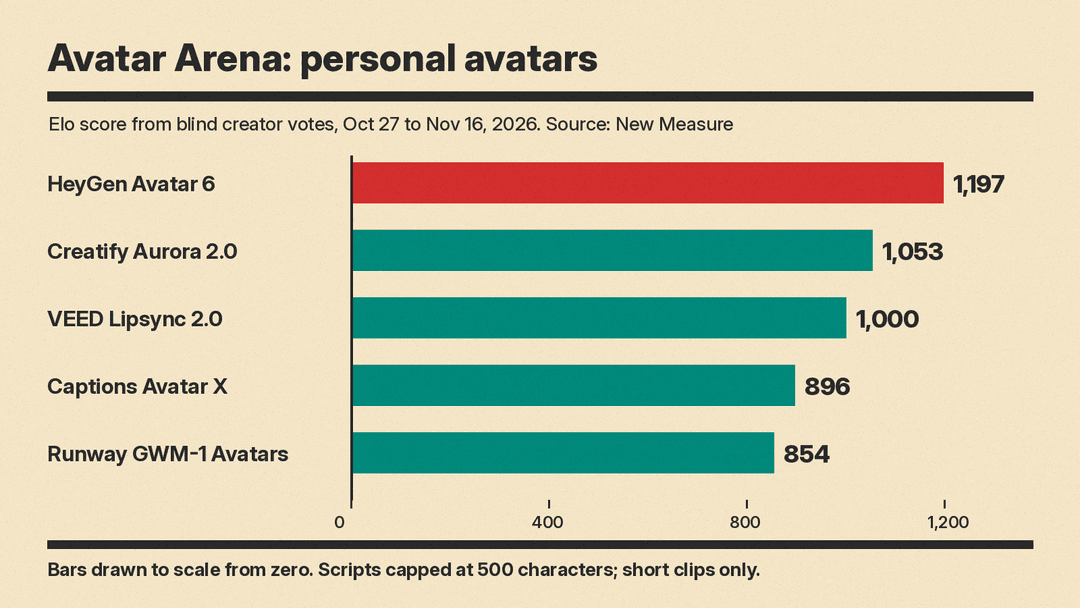
The one outside ranking comes from New Measure's Avatar Arena, published November 18. Creators wrote a short script, two providers each made a video, and the creator voted before seeing which provider made which.
On personal avatars, built from the creator's own upload, Avatar 6 scored 1,197 on an Elo scale based on 542 blind votes. Creatify Aurora 2.0 was second at 1,053, then VEED Lipsync 2.0 at 1,000, Captions Avatar X at 896 and Runway GWM-1 Avatars at 854. On stock presenters, Avatar 6 scored 1,237 and Creatify Aurora 2.0 1,088. New Measure says HeyGen leads both boards "by more than the uncertainty in the scores."
Where the tests stop
New Measure is upfront about the limits, and they matter for how you read the ranking:
- Short clips only. Scripts were capped at 500 characters, the typical script was 62 words, and in 97% of completed comparisons both videos were 35 seconds or shorter. New Measure says the results "don't tell us which provider would do best at a two-minute explanation or a ten-minute lesson." So the long-video claims rest on HeyGen's own demos.
- HeyGen in every match. The arena page notes that "every rival faces HeyGen; comparisons between rivals are indirect."
- Shared voice. VEED, Creatify and Captions used speech made with HeyGen's voice clone, so their voice ratings "partly reflect HeyGen's voice technology."
- Speed. Avatar 6 typically took about three minutes per personal-avatar video, against about one minute for Runway GWM-1 Avatars. One in ten HeyGen personal-avatar videos took more than nine and a half minutes. New Measure's summary: "Speed and preference didn't line up."
Price and how to try it
As of November 2026, HeyGen's pricing page lists:
- Free: $0, three watermarked videos a month, up to one minute each, with access to Avatar 6.
- Creator: $29 a month with 600 credits, which includes Avatar 6 Turbo.
- Pro: $49 a month with 1,000 credits, which adds Avatar 6 Pro.
The page also offers yearly billing with two months free. In the app, HeyGen's update note says you start a video from the home screen, Video Agent or Studio, pick an avatar or look, and select Avatar 6 as the engine. If you would rather run open weights, our look at Kandinsky S2V 1.0, a set of open talking-avatar video models, covers one option.
Consent rules
HeyGen says it requires live identity verification and explicit consent to create realistic avatars of real people. The technical report adds that the person must record a short on-camera consent statement that includes a one-time code for that session, so footage recorded in advance or taken from elsewhere cannot pass. According to the release, third-party platforms can generate photo-based and virtual avatars through Avatar 6, while realistic videos of real people stay inside HeyGen's platform.
Why it matters
Avatar 6 builds on HeyGen's recent move into its own models, after HeyGen Video 1 and HeyGen Voice. The release says HeyGen passed $200 million in ARR in June. Free options are spreading too: on the same day, Google said personal avatars in Google Vids are now free for anyone with a personal Google account.
For buyers, the useful signal is the gap between the two kinds of evidence. The blind arena backs HeyGen's lead on short clips. Long videos, word edits and two-person scenes are, for now, backed only by HeyGen's own demos and studies, so test them on your own footage before you commit. For other ways to make talking videos, see our list of the best AI lip sync tools.
Sources
- HeyGen launch release on PR Newswire (Nov 17, 2026)
- HeyGen Avatar 6 technical report
- HeyGen Avatar 6 model page and FAQ
- HeyGen product update: Introducing HeyGen Avatar 6
- HeyGen pricing
- New Measure: Which AI avatar do creators prefer? (Nov 18, 2026)
- New Measure Arena leaderboard
- Google: personal avatars in Google Vids at no cost (Nov 17, 2026)
