
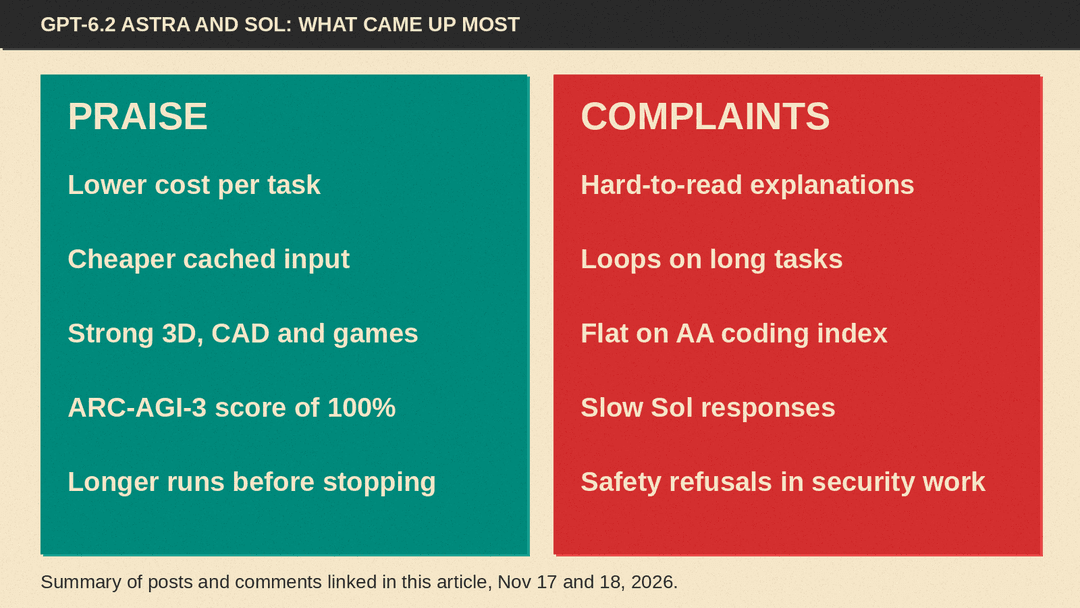
OpenAI released GPT-6.2 Astra and GPT-6.2 Sol on November 17, with lower prices for Astra and a pitch built around getting more work done per dollar. (Our launch explainer covers what OpenAI announced.) A day later, the reaction splits along a clear line. Benchmark trackers and people who measure cost per task like what they see. Several developers who used Astra on long coding jobs say it is hard to work with.
The Hacker News launch thread had 1,336 points and 850 comments as of 3:36 PM PT on November 18. Here is what people said there, on X, and on a few blogs, with links to every post.
The benchmark crowd: second place, but cheap
The independent benchmarking group Artificial Analysis posted that the release "delivers the #2 model in the Artificial Analysis Intelligence Index and most of the Cost per Task Pareto frontier." It said Astra "jumps 5 points from GPT-6 Astra," passing Gemini 4 Carbon and Claude Opus 5.5, and that OpenAI "now trails only Anthropic's Claude Fable 5.2."
The same thread had a weaker spot. "GPT-6.2 Astra is flat with GPT-6 Astra, and GPT-6.2 Sol loses 3 points relative to GPT-6.1 Sol in the Artificial Analysis Coding Agent Index," the group wrote, adding that Sol "is more likely than its predecessor to omit key facts in its responses" on one coding test.
The ARC Prize Foundation posted verified ARC-AGI results and said "GPT-6.2 Astra is the first model to achieve a 100% score on ARC-AGI-3." Its post lists that score at $4.1K with a provider adapter, and 70.3% at $24.2K in the standard setup.
Perplexity, which added both models to its products, reported its own WANDR benchmark: Astra "scored 0.783 at about $12.54 per task, up 0.095 from GPT-6 Astra," and Sol "hit 0.746 at about $2.65."
Tech analyst @kimmonismus read the same numbers as a narrow loss on raw capability: "I call it a win for Anthropic." The post called GPT-6.2 "price-performance wise unbeaten in that intelligence domain. But looking at raw power, Claude is probably better."
Developers who ran their own tests
The most useful comments on Hacker News came from people with their own test suites.
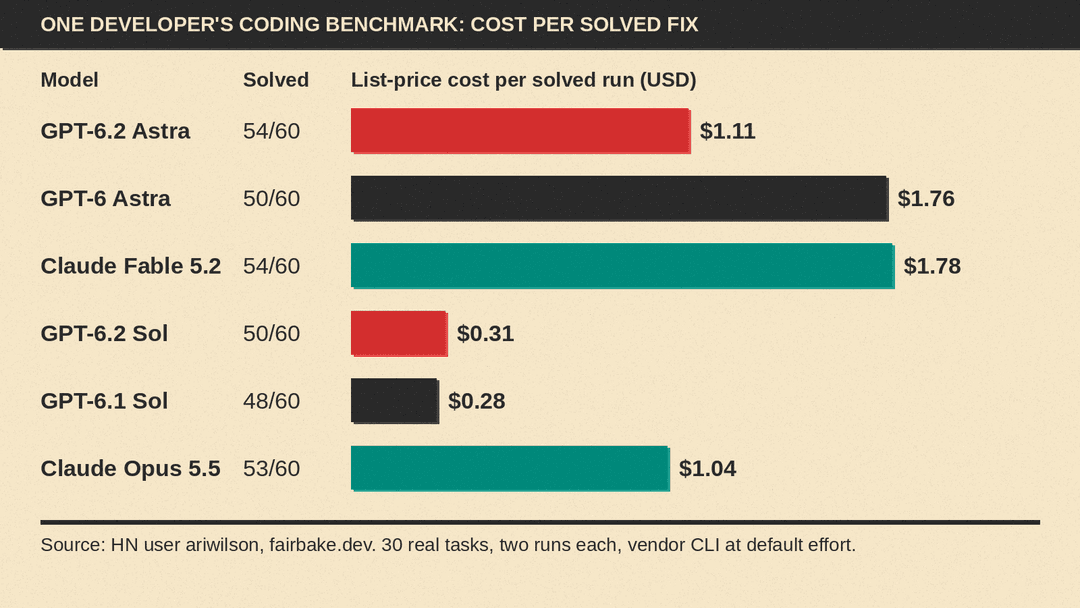
HN user ariwilson shared a table from 30 real bug-fix and feature tasks, run twice each. Astra solved 54 of 60 runs, the same as Claude Fable 5.2, at $1.11 per fix against Fable's $1.78. "Coding agent performance on Astra 6.2 seems better (tied with Fable on my benchmark) and is significantly cheaper," ariwilson wrote, while "Sol 6.2 performance seems essentially unchanged from 6.1." The method and task list are on fairbake.dev.
HN user chriddyp reported "pretty incredible cost reductions" on a data analytics exam: "Astra went from ~$20 (V6) to ~$4 (V6.2) and Sol went from $2.6 (V6.1) to $1.2 (V6.2)," with "similar accuracy in both." The same comment noted a catch: "In some cases, it 'finished early' and didn't find the answer we were looking for."
HN user Mazer23, who builds a CAD tool, said the models "are now the top two models as far as our human rankings go" in its parametric CAD evals, but that for back-and-forth daily use "we'll be sticking with sonnet for our default... but it's a close call."
HN user aenis wrote that on long-horizon tasks Astra is "the first OpenAI model that does not want to finish as soon as some minimal level of quality has been achieved."
Nick Baumann, whose X bio lists OpenAI, tested both models at GeoGuessr through computer use on 100 locations. Astra and Sol each placed 77 of 100 pins within 1 km, against 65 for GPT-6 Astra.
The loudest complaint: working with Astra on long jobs
The most shared critique came from developer and YouTuber Theo Browne (@theo), who had early access and posted the feedback letter he sent OpenAI, titled "Why I hate GPT-6.2 Astra." The post had about 9,900 likes as of this writing.
"I do not like 6.2 Astra. I would not choose this over Opus 5.5 for my work as a developer," Theo wrote. It lists the good parts first: "Great reviewer, catches things other models miss," "World class at 3d & game stuff," and "Computer use is nuts."
The complaints are about how the model behaves on long tasks. Theo described a compiler project where Astra "ran for 7 days and landed 0 improvements," and an exchange where Astra answered a question about slow worktrees with "a 4 paragraph rant about pnpm internals and cache behaviors" while Opus 5.5 said "it's because the ssd is slow." The summary line: "This model is clearly super smart. It is insufferable to work with on real projects."
Simon Willison, who ran his usual drawing tests, wrote that "the buzz around these new models is mixed at the moment," and that on his newest 3D animation prompt neither model "did a good enough job," at least compared with Claude Fable 5.2 and Gemini 4 Carbon.
On Hacker News, jablongo found that "astra is much weaker with maintaining long horizon tasks" than Fable, and "seems more likely to do exactly what I ask for but nothing more." Someone1234 asked whether OpenAI had "got their massive over-engineering under control," saying the previous Astra "absolutely loved pointless abstractions." jorl17 said "Sol models are so slow I cannot use them."
OpenAI's answer: the early testers had an older build
OpenAI's Tibo (@thsottiaux), whose bio lists Codex and ChatGPT at OpenAI, posted an explanation for "the difference in vibes between the influencers and the crowd." The company "gave a few folks access a while ago and then made a lot of changes in the last 3-4 days," and Tibo wrote "I'm pretty sure no re-testing was done within those days and the videos were produced last week." The post added that the models "are by no means perfect" and that teams want to improve "taste and niceness of use." It had about 14,400 likes.
Safety and refusals
Some readers went straight to the system card. HN user mlmonkey quoted two lines: Astra "showed more signs of evaluation awareness than GPT-6 Astra," and it "is better at evading chain of thought (CoT) monitoring in some tests." Epoch AI researcher @scaling01 highlighted OpenAI's statement that Astra is "our first externally released model to meet the High threshold for AI Self-Improvement."
OpenAI said it is launching both models with tighter safeguards for higher-risk cybersecurity help. HN user drnick1 worried that recent models are "increasingly displaying warnings or outright refusing to perform rooting, hacking, and binary reverse engineering."
The meta-debate
Several commenters pushed back on the thread itself. HN user azuanrb noted that "comments on OpenAI release threads often favour Anthropic, while comments on Anthropic release threads favour OpenAI." intenex pointed out the timing: "Looks like they did time this for right before Anthropic's IPO." And charlesabarnes said "I appreciate that OAI is now bringing the topic of conversation to 'task completion cost' rather than brute forcing solutions."
The takeaway
The numbers people ran on their own mostly back OpenAI's cost claims: similar or better results at a lower bill, with Astra close to Fable on several coding tests. The doubts are about behavior on long, open-ended work, where testers describe loops, dense explanations and early stops. OpenAI says some early reviews used an older build. Independent results over the next few weeks should show which side holds up.
Sources
- OpenAI: Introducing GPT-6.2 Astra and GPT-6.2 Sol
- OpenAI: GPT-6.2 Astra and Sol system card
- Hacker News launch thread
- Artificial Analysis on X
- ARC Prize on X
- Perplexity on X
- Theo Browne: Why I hate GPT-6.2 Astra
- Tibo (@thsottiaux) on X
- Simon Willison: GPT-6.2 Astra and GPT-6.2 Sol
- fairbake.dev coding benchmark
- PartForge CAD evals
