
Most AI video tools still work like a vending machine. You write a prompt, wait for a clip, watch it, and try again if the actor stood in the wrong spot. Pika wants to replace that loop with something closer to a film set. On November 18, 2026, the company published a research preview called Pika Enact, a system that lets you move actors, give them notes, and steer the camera while the video is still playing.
It is not a product you can open today. Pika says Enact is "unavailable for consumer use." But the blog post lays out how it works and how fast it runs, and it shows where creator tools are heading.
What is Pika Enact?
Pika describes Enact as "an experimental live-streaming environment" built on Pika H3 Flex, the video and audio model it released in October (we covered Pika H3 Flex and its open weights and audio stems at launch). Instead of rendering a finished clip, Enact generates video and sound in sub-second chunks. Each chunk carries the scene forward, and any new direction you give is folded into the next chunks.
Pika's stated goal is to make AI video feel like "directing on set" rather than typing into a prompt box. It splits that idea into three modes.
What can you do with Pika Enact?
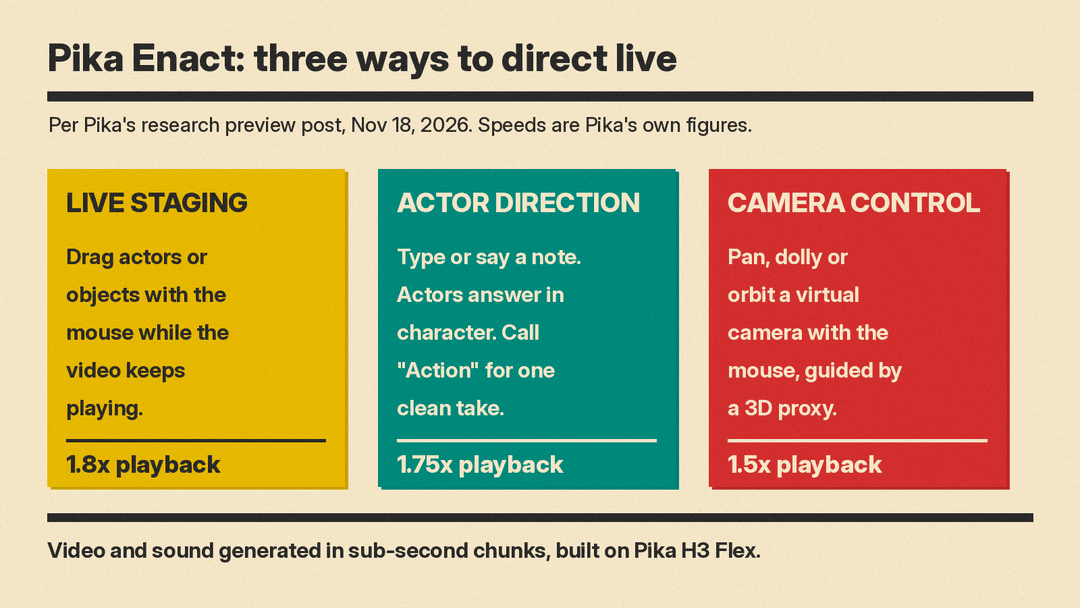
Live Staging. You drag a person or an object across a running video with your mouse, and the scene keeps playing while you move it. Pika says the model generates the moved subject together with the rest of the scene, so pose, lighting and shadows adapt to the new spot. It claims the result has "no cut-out edges, no hole where it stood, and no compositing pass to clean up afterwards." The subject also reacts to being moved, shifting its weight before it settles. Pika's training data for this mode also covered inserting new subjects from photos into live scenes.
The pitch is precision. A prompt can only ask for something "a bit to the left." A cursor puts it exactly where you want it.
Live Actor Direction. You type or say a note, such as "move closer to her" or "make it a kitchen at night," and the actors play it out while the video runs. They answer you in character, in their own voices. Pika says each actor is an AI agent with its own personality that remembers your notes and everything that has happened in the scene. The workflow mirrors a rehearsal: give notes, let the actors try again, then call "Action." Enact then shoots everything you rehearsed as one clean take, fresh from the first frame.
Live Camera Control. You steer a virtual camera with your mouse while the scene generates: panning, dollying in for a close-up, or orbiting around the subjects. This mode does not edit an existing clip. It generates audio and video from scratch, using an appearance image to anchor the cast and set and a lightweight 3D motion proxy, such as an untextured Blender viewport, to guide the camera path.
How fast is it?
Live control only works if the video is generated faster than it plays. Pika reports that all three modes clear that bar, on different hardware and with different measures:
- Live Staging: generates 1.8 times faster than playback on a single server. In a low-latency setting, the picture responds in under 0.4 seconds on an Nvidia H100, decoding included.
- Live Actor Direction: picture and sound generate 1.75 times faster than they play.
- Live Camera Control: on a node with eight Nvidia B300 chips, at 640x480 and 24 frames per second, the first frames arrive in 0.51 seconds and later chunks run at 1.50 times real time.
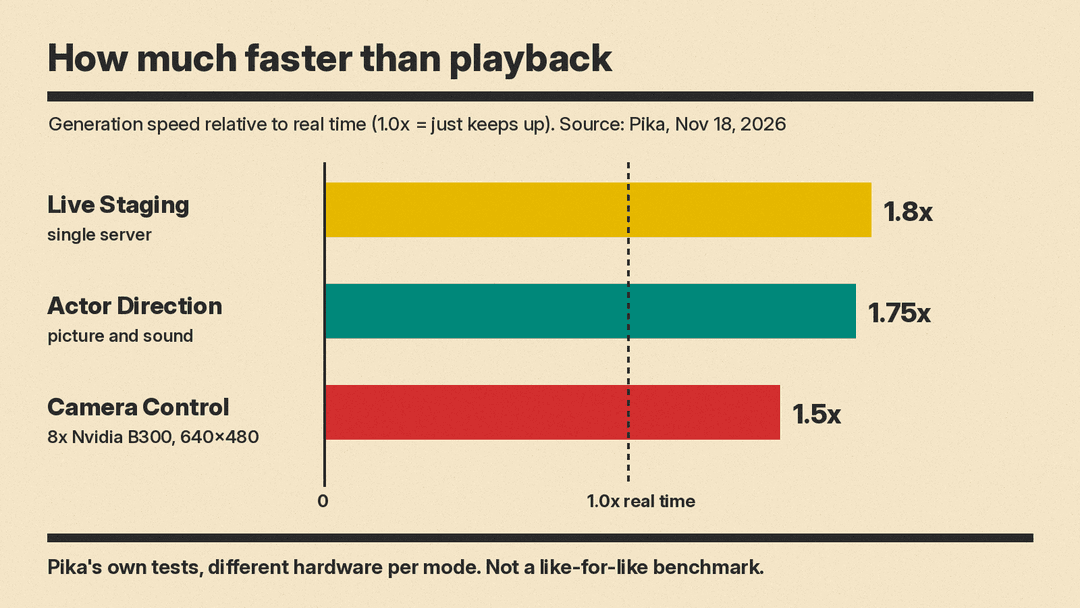
These are Pika's own numbers from its own tests. The camera figure comes from an eight-chip data center node at a modest 640x480 resolution, and Pika does not give a latency figure for actor direction. Treat them as lab results, not what a creator would see in a browser.
How does Pika Enact work?
The core trick is turning a model that makes whole clips into one that makes a stream. Pika says it distilled H3 Flex down to a few generation steps using a method called self-forcing distribution matching distillation (DMD), in which a fast "student" model learns to produce chunks from its own past output, guided by the full model. For staging, it cuts sampling from twenty steps to a few.
Staging streams short chunks of about 0.7 seconds, or 0.17 seconds in the low-latency setting. A sliding memory keeps the prompt, the source video, the first chunk and the four most recent chunks, so a session can run on without memory costs growing.
For actor direction, a separate script language model does the thinking. It reads your notes, the opening frame and the session memory, then turns your direction into structured beats: action, dialogue, emotion, gaze and lighting. The real-time video model does the acting. When there is no new note, the scene holds with subtle breathing and blinking.
Training data was built rather than collected. For staging, Pika says real footage cannot supply matched before-and-after clips tied to exact cursor paths, so it built a physics-driven synthetic data engine. For camera control, it built an automated Blender-to-video pipeline that records camera paths, 3D motion references, video frames and spatial audio together.
Can you use Pika Enact?
Not yet. Enact is a research preview and Pika lists no price or release date. Anyone interested in trying it or discussing integration is asked to contact enterprise@pika.art. Pika also notes that its rehearsal demo was edited for length, with subtitles and the director's webcam inset added afterwards.
Why it matters
Pika is not alone in chasing live direction. Adobe showed a similar idea at its Sneaks event with Project Live Set, which lets you direct AI video while it plays. The common thread is a move away from prompt, wait and retry toward tools that respond the way a set does.
For creators, the appeal is control. Blocking, performance and camera moves are the parts of a scene that prompts handle worst, and Enact puts each of them under a mouse or a spoken note. Actors that remember notes and stay consistent across a take also address one of the most common complaints about AI video, which is that every retry produces different people. Avatar tools are attacking a related problem from another side, as with HeyGen Avatar 6, which matches gestures to your script.
The open questions are practical ones. Pika has not said what resolution staging and actor direction run at, how many people one server can support, or what it would cost. The fastest figures come from data center chips. Until Enact ships in some form, it is a strong demo of a direction, and a signal that "directing" may become the main way people make AI video.
