
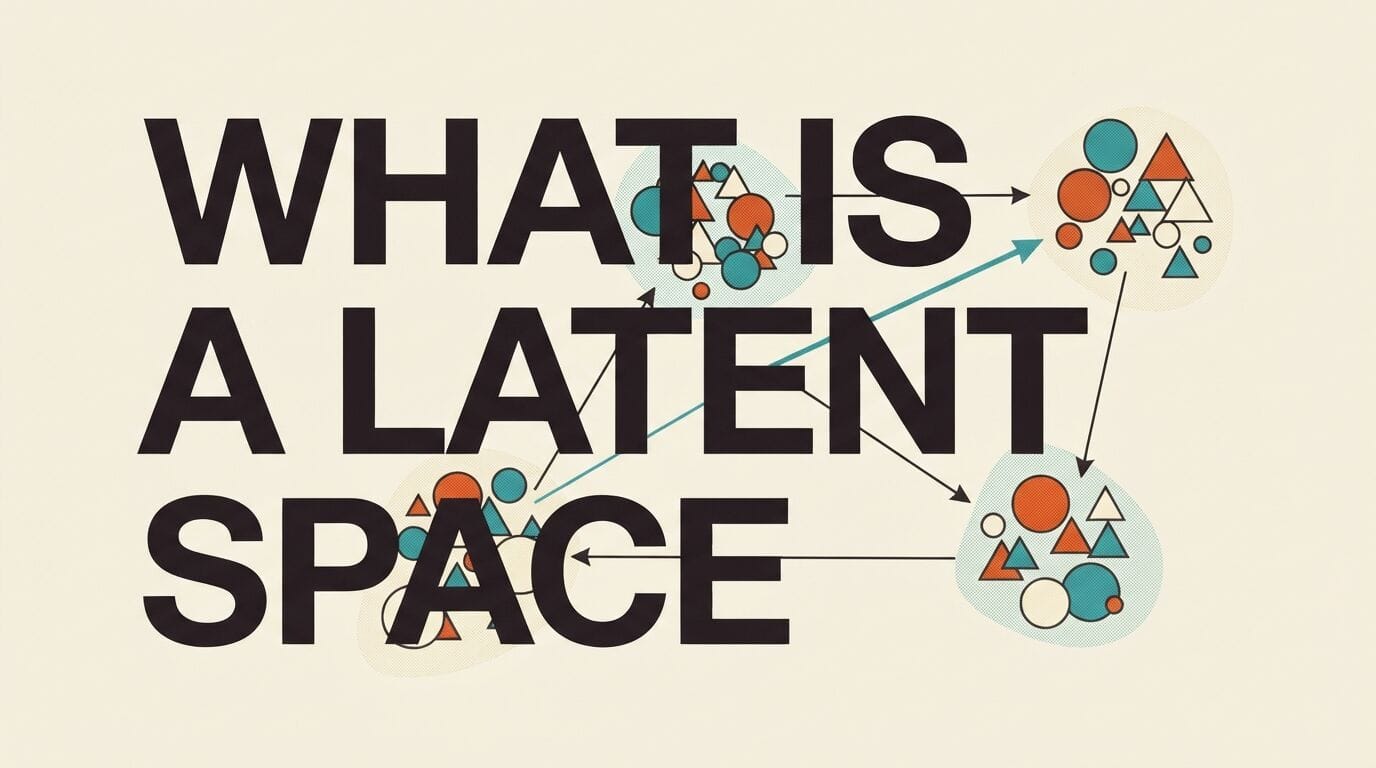
Every generative AI system, from an image model to a language model, does most of its thinking in a coordinate space it invented for itself. The space has a name, the latent space, and it explains a lot about how these models work, why they are fast enough to use, and why they sometimes produce nonsense.
The core idea
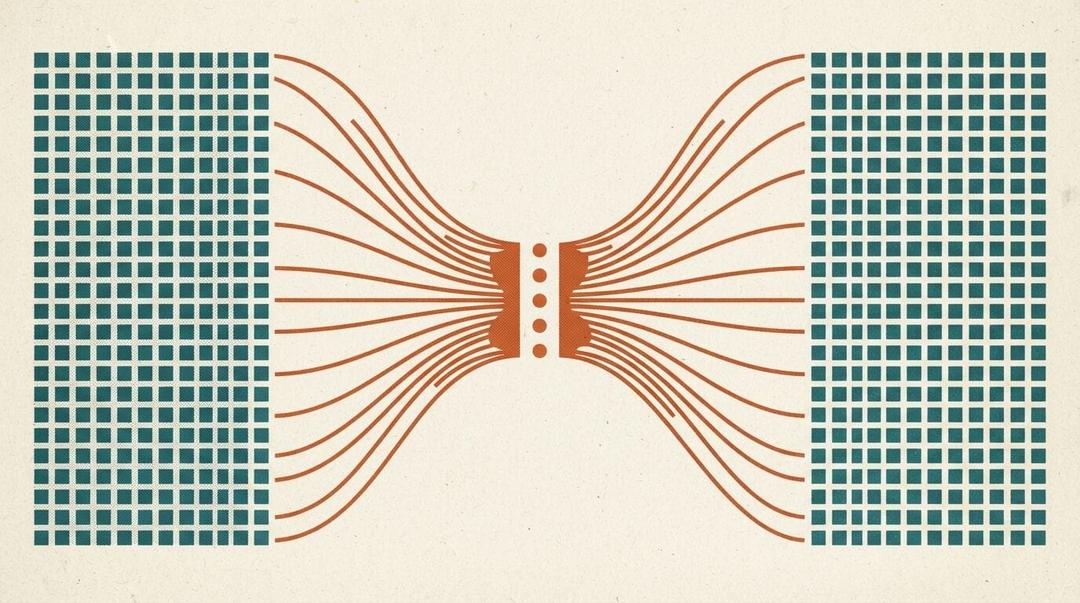
"Latent" simply means hidden. The claim behind the concept is that data has far fewer meaningful degrees of freedom than its raw form suggests. A photograph of a face might hold a million pixel values, but the things that make it that face, the pose, the expression, the lighting, the identity, can be described with far fewer numbers. A model trained to compress data and then reconstruct it will invent its own compact coordinate system for doing so. That system is the latent space. Each point in it is one possible output, and each direction through it is some pattern the model found in the training data.
The architecture that made this standard is the autoencoder: an encoder network that squashes an input down into a short vector, and a decoder network that expands the vector back into a full input. In December 2013, Diederik Kingma and Max Welling published "Auto-Encoding Variational Bayes," the paper that turned this into the variational autoencoder, or VAE (arXiv:1312.6114). The VAE twist is that the encoder outputs not a single point but a probability distribution, so training forces nearby points in the space to decode to similar, valid outputs. The space becomes continuous and navigable, not just a lookup table. In the paper's handwritten-digit experiments, each 784-pixel image is represented by a latent vector of roughly 20 numbers.
Why the geometry means something
A latent space is not just compression. The interesting property is that distance and direction carry meaning.
For text, the effect was first documented at scale in 2013 by Tomas Mikolov and colleagues. In word2vec, each word gets a vector of a few hundred numbers, and relational patterns show up as constant offsets between vectors: the vector for king minus the vector for man plus the vector for woman lands close to queen (Mikolov et al., NAACL 2013). This is the same phenomenon this site covered in its embeddings explainer.
For images, Alec Radford and colleagues showed the mirror result in 2015 with the DCGAN generator network. Averaging the latent vectors of a few smiling faces and subtracting the average of neutral ones produced a "smile vector" that could be added to other generated faces. A "turn" vector built from faces looking left versus right could rotate faces that had never been seen in training (Radford et al., arXiv:1511.06434). Arithmetic in the space corresponded to editing the world the space describes.
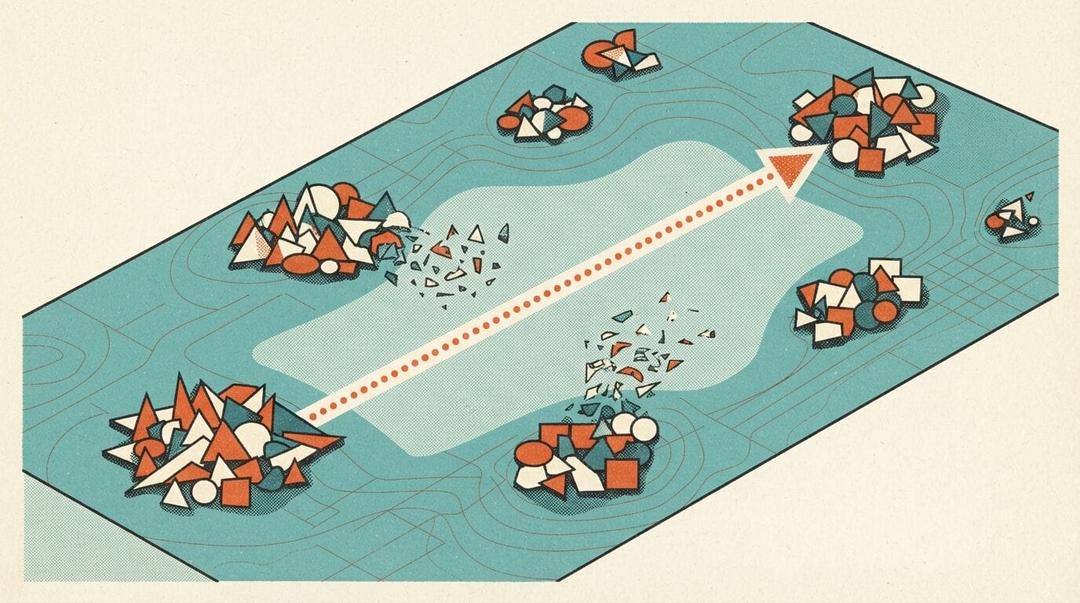
Two caveats belong here, and they matter for anyone touching these models in production. First, most directions in a latent space do not correspond to any human concept; the smile vector had to be constructed from examples, and there is no axis labeled "smile" waiting to be found. Second, a straight line between two good points can pass through territory the model never trained on, which is one reason interpolation between prompts sometimes yields garbage rather than a smooth morph.
Why image models do their heavy work in latent space
The most consequential use of latent spaces in current systems is computational. A diffusion model creates an image by repeatedly denoising it, and each denoising step is a full forward pass of a neural network. Run that process directly on pixels and the cost is brutal: a 512 by 512 color image is 786,432 numbers to update at every step.
Robin Rombach and colleagues solved this in 2021 by moving the diffusion into a learned latent space. Their latent diffusion model first trains an autoencoder with a perceptual loss so that images compress by a factor of 8 in each spatial dimension, then trains the diffusion model entirely on the compressed representation. The final latent is decoded back to pixels once, at the end (Rombach et al., arXiv:2112.10752). For the configuration behind Stable Diffusion, a 512 by 512 image becomes a 64 by 64 grid of 4 channels, about 48 times fewer numbers, so every denoising step costs a fraction as much. The authors' own framing is that most bits of a digital image correspond to details no human perceives, and modeling in latent space lets the system skip simulating them.
This single architectural decision is a large part of why text-to-image generation ran on consumer hardware in 2022 instead of remaining a datacenter-only capability.
One space, several senses
Latent spaces also explain how models connect different kinds of data. OpenAI's CLIP, published in 2021, trains an image encoder and a text encoder on 400 million image-caption pairs scraped from the internet, with the objective of placing matched image and caption close together in one shared space (Radford et al., arXiv:2103.00020). The result: a photo of a dog and the sentence "a photo of a dog" become neighbors, and the model can classify images into categories it was never explicitly trained on by comparing them against text descriptions, matching a supervised ResNet-50 on ImageNet zero-shot. Text and pixels are different data, but in the latent space they become points in the same geometry.
Language models work the same way with their internal activations. When a transformer processes a token, the token is represented at every layer as a vector, a point in a space the model learned during training. In 2024 OpenAI reported that, using sparse autoencoders, it could decompose those internal activations of GPT-4 into roughly 16 million patterns, many of which corresponded to human-legible concepts such as code bugs, legal language, or rhetorical questions (OpenAI, Extracting Concepts from GPT-4). Interpretability research is, in essence, the cartography of these latent spaces: finding out what the coordinates mean.
What to take away
A latent space is a model's private map of the data it was trained on: a compressed coordinate system where similar things sit close together and some directions correspond to real attributes. Three practical consequences follow. Generative models can afford their compute because they create in the compressed space and unpack at the end. Editing prompts, interpolating between outputs, and steering models are all literally movements through this space. And the spaces are only as trustworthy as the data that shaped them: gaps and biases in the training set become gaps and biases in the geometry, in exactly the places the model will later be asked to walk.
Sources
- Kingma and Welling, "Auto-Encoding Variational Bayes" (2013): https://arxiv.org/abs/1312.6114
- Mikolov, Yih and Zweig, "Linguistic Regularities in Continuous Space Word Representations" (NAACL 2013): https://aclanthology.org/N13-1090/
- Radford et al., "Unsupervised Representation Learning with Deep Convolutional Generative Adversarial Networks" (2015): https://arxiv.org/abs/1511.06434
- Rombach et al., "High-Resolution Image Synthesis with Latent Diffusion Models" (2021): https://arxiv.org/abs/2112.10752
- Radford et al., "Learning Transferable Visual Models From Natural Language Supervision" (2021): https://arxiv.org/abs/2103.00020
- OpenAI, "Extracting Concepts from GPT-4" (2024): https://openai.com/index/extracting-concepts-from-gpt-4/
