
Google has opened Genie 4, its newest world model, to paying subscribers for the first time. In a Nov 18, 2026 post on the Keyword, Diego Rivas (Group Product Manager, Google DeepMind) and Pavan Kumar (Group Product Manager, Google Labs) write that Google is "rolling out a new Project Genie experience to eligible Google AI Ultra subscribers, making these worlds far more responsive, creative, and social."
The update has four parts: first-time access to Genie 4, upgrades to the older Genie 3 model, a new Project Genie agent, and a community gallery. Here is what each one does, who can use it, and the limits Google lists.
What Project Genie is
Project Genie is a web app from Google Labs for generating and exploring interactive worlds. Google first opened it on Jan 29, 2026 to Google AI Ultra subscribers in the U.S. aged 18 and over, and described it as an experimental research prototype. At that launch it ran on Genie 3, Nano Banana Pro and Gemini, and generations were limited to 60 seconds.
A world model, in Google's January description, "simulates the dynamics of an environment, predicting how they evolve and how actions affect them." In practice you describe a place and a character, step inside, and the model generates the path ahead as you move.
DeepMind announced Genie 4 on Oct 27, 2026 as a research preview for trusted testers, and said then that it was coming soon to Google AI Ultra subscribers in Project Genie. We covered that launch in Genie 4 Explained: DeepMind's World Model With Native Audio. The Nov 18 update is the point where that access actually starts.
Genie 4: edit the world while you are in it
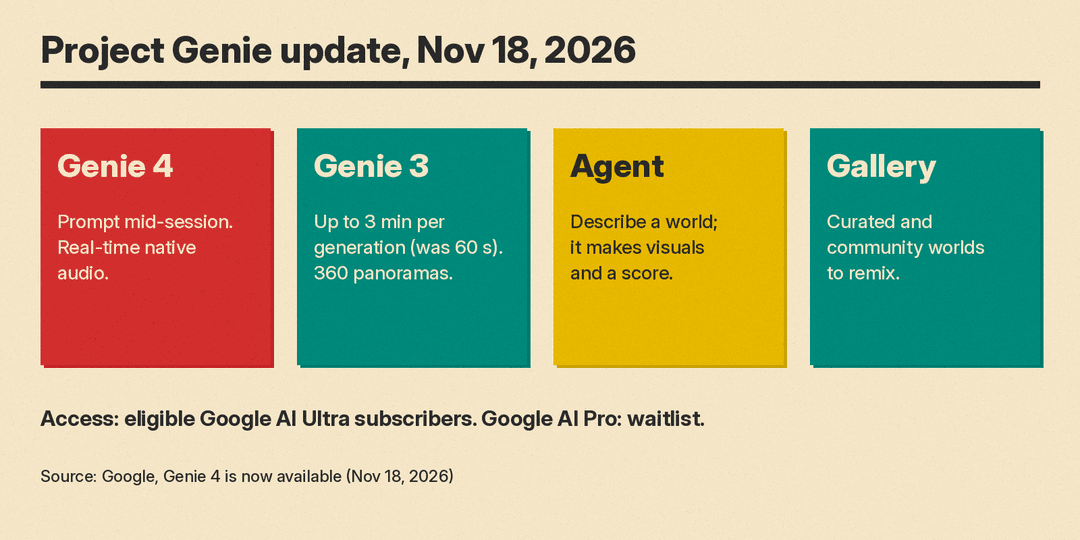
Google describes Genie 4 as its most realistic and interactive world model yet. The main new control is prompting mid-session. You type a new prompt while you navigate, and the environment changes in real time. Google's examples are shifting the weather, dropping in a character, or redirecting the action.
Genie 4 also generates sound. Per the post, "For the first time, Genie 4 pairs these visuals with real-time native audio that adapts as the scene unfolds, from ambient soundscapes to character dialogue."
Genie 3 stays, with longer runs
Genie 3 is not retired. It remains in Project Genie's model picker, and Google points to it "when you want longer runs or panorama-seeded spaces." The Genie 3 updates listed in the post are:
- Extended sessions and world chaining: up to 3 minutes per generation, up from 60 seconds, or several worlds linked together for longer journeys.
- 360-degree panorama image grounding: new worlds can be seeded from 360-degree panorama images.
- Real-time in-world events: natural-language prompts change the environment while you explore.
That last item closes a gap from January, when Google said promptable events "are not yet included in this prototype."
The Project Genie agent
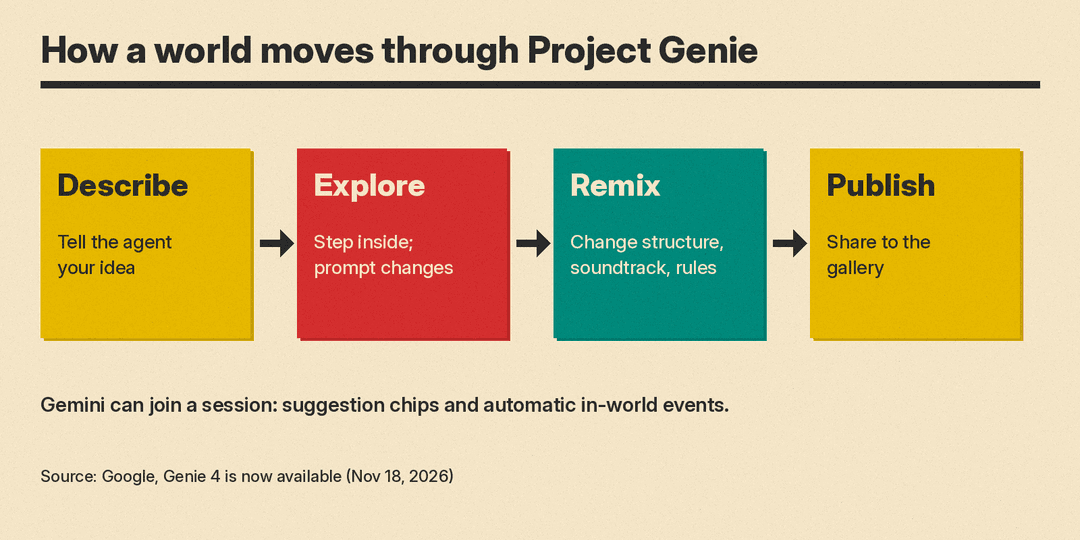
The new Project Genie agent turns world building into a conversation. You describe what you want in natural language, and Google says the agent "orchestrates Google’s suite of multimodal models" to create the first visuals for the world and a background score matched to its mood. The post does not name which models the agent calls.
Gemini can also join a session. According to Google, it watches what is happening on screen, offers suggestion chips for where to go next, or triggers in-world events automatically as the journey goes on.
The community gallery
The gallery mixes curated worlds with ones published by users. Examples Google names include "Living Memory," which turns personal photos into explorable spaces, "Dino Field Guide," built on 360-degree panoramas, and "Rock Paper Scissors," with Gemini acting as a real-time referee. Two showcase worlds were made with early-access creators: "Villa Giallo" with a creative technologist Google credits as Will, and "The Life of Ants" with filmmaker Anand Gandhi.
You can remix a gallery world with the agent, changing its world structure, soundtrack, or rules, and then publish your own version for others to explore and remix.
Who can use it
- Eligible Google AI Ultra subscribers can try the new experience starting Nov 18, 2026.
- Google AI Pro members can join a waitlist on the same page.
- The Nov 18 post does not list countries or an age limit. The original January rollout was for U.S. subscribers aged 18 and over, "expanding to more territories in due course." Check the Google AI plans page and Project Genie itself for your region (as read on Nov 18, 2026).
- The October Genie 4 post also named "early access partners in the Gemini API and Google AI Studio." The Nov 18 post does not mention API access, so treat Project Genie as the consumer route for now.
Limits Google lists
Google frames this as research. The post says: "Genie 3 and Genie 4 remain world models in the frontier research space." It names these open problems: camera latency, intricate physical interactions, real-time audio precision, and long-term scene permanence.
DeepMind's October research post adds detail. It says Genie 4 can keep environments coherent over short sessions, but visual details and object permanence can still drift over time, especially in longer runs, after multiple complex prompt edits, or while navigating a scene. It also lists legible text and spatial accuracy as active research areas.
On safety, Google says all video and audio generated in Project Genie carries SynthID watermarking, and all model inputs and outputs go through safety screenings.
Why it matters
In October, DeepMind released Genie 4 as a research preview to trusted testers. This update puts it in a paid consumer product with sound and live editing, and adds sharing and remixing through the gallery. It also shows how Google pairs its models: Genie for the world, Gemini for suggestions and refereeing, and an agent that coordinates the rest.
For now the audience is small. Access is limited to Google's top consumer plan, with Pro users on a waitlist. For early reaction to the model itself, see What People Are Saying About Genie 4.
Sources
- Genie 4 is now available, Google, Nov 18, 2026
- Project Genie: Experimenting with infinite, interactive worlds, Google, Jan 29, 2026
- Genie 4: A new generation of world simulation, Google DeepMind, Oct 27, 2026
- Project Genie, Google Labs
- Google AI plans, Google One
