
Four AI agents built on Gemini 4 Argon have finished Minecraft with no human help. In a paper posted to arXiv on October 15, Google DeepMind researchers Maxence Faldor, Satinder Singh and Roberta Raileanu report that the team defeated the Ender Dragon 27 hours and 14 minutes after writing its first program, starting from a random world. The authors call it, to their knowledge, the first end-to-end autonomous completion of Minecraft by AI agents that used only the standard open-source Mineflayer library, with no pre-scouted seeds and no game-specific tools written by humans.
The game is the stage, not the point. DeepMind frames the run as a test of the skills that long software and enterprise jobs need: holding a plan across thousands of dependent steps for more than a day, recovering from failure, and coordinating with other agents.
How the agents played
None of the agents saw the screen or pressed keys. Each one was an instance of DeepMind's general-purpose Gemini 4 Argon coding agent, running on its own cloud machine with the same tools it uses for software work: a code workspace with version control, a shell, file editing, web search, and a memory with a private part and a part shared by the team.
To act, an agent wrote a short JavaScript program, sent it to its Mineflayer bot on the game server, and read the text that came back: position, health, inventory, what it found, or the error it hit. Then it wrote the next program. The median program ran for 33.5 seconds, and each player had a program running about 40% of the time. The rest went to reading, thinking and writing.
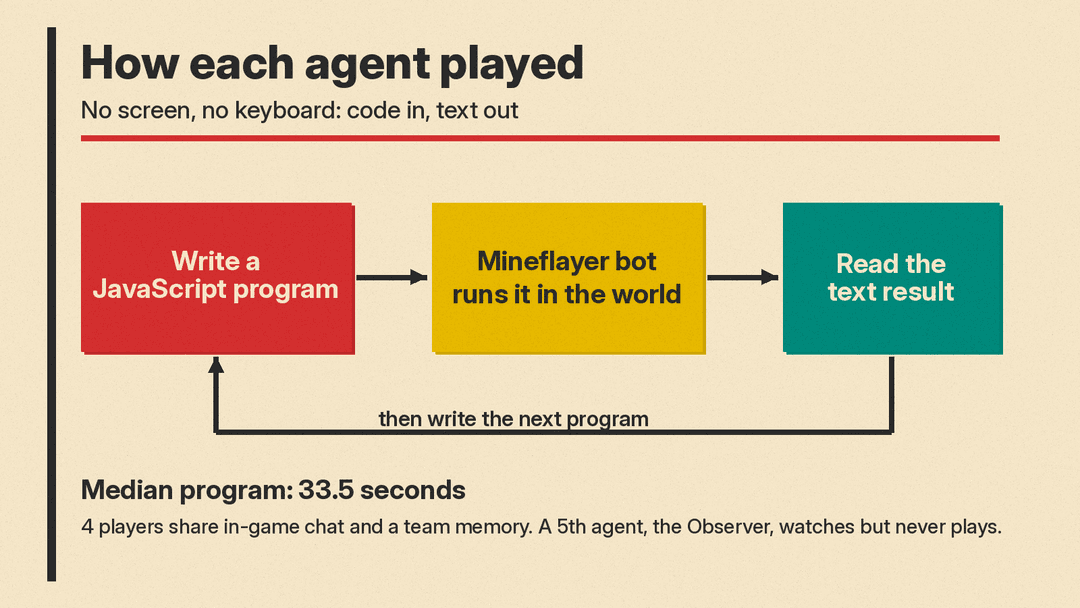
The setup was thin on purpose. The game was Minecraft Java Edition 1.20.4 in survival mode on Easy, with cheat commands off. The only game instruction was one paragraph: defeat the Ender Dragon, by any means allowed in survival mode, and decide among yourselves how to share the work. Nobody assigned roles or wrote game logic. A fifth agent, called the Observer, watched the session as an independent witness, checked the players' claims against the server log, and looked for cheating or specification gaming. The paper says it found none and never joined the game.
What happened in 27 hours
The paper gives a detailed timeline:
- Ten minutes in, one agent proposed a division of labor in chat. Another answered with a different plan within a minute, and roles settled: one scouted for food and supplies, one mined for diamonds, one made tools, one prepared the Nether portal.
- The portal was lit 1 hour 42 minutes into the run.
- In the Nether, three agents built two-block-high shelters so Endermen, which are nearly three blocks tall, could not reach them. The team had 15 ender pearls in a shared chest by hour five and a half.
- To find the stronghold, one agent threw two Eyes of Ender from different spots, sampled each eye's flight every 50 milliseconds, and computed where the two lines crossed. The estimate landed 43 m from the real portal room.
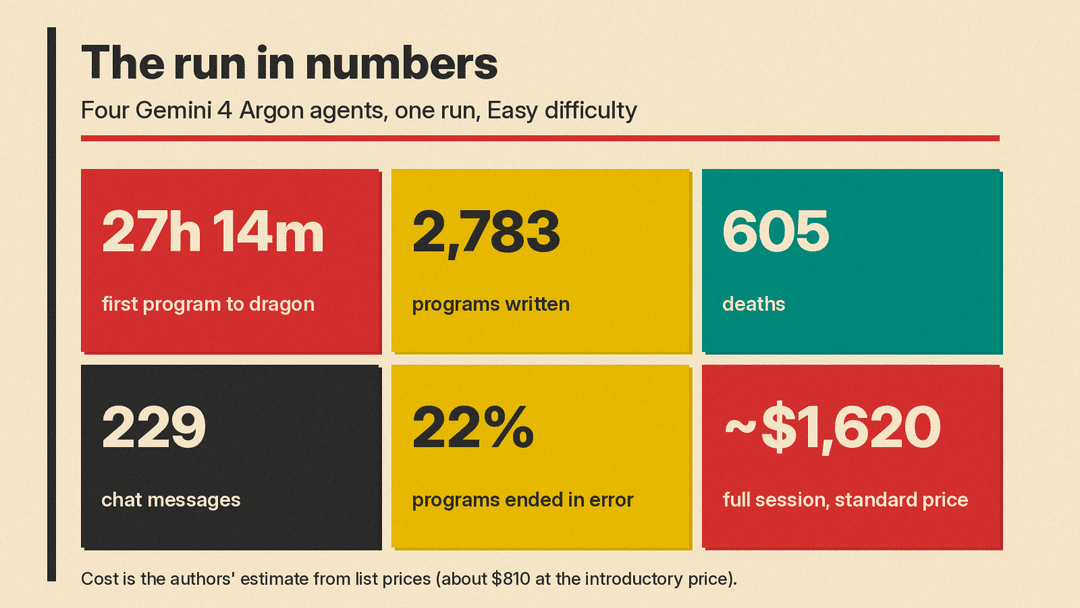
- The End portal was lit at 13 hours 17 minutes. The dragon then killed the team 69 times. The breakthrough came about 21 hours in, when an agent worked out that the ten crystals on the pillars kept healing the dragon, and that they could be reached by stacking dirt. The dragon died 39 minutes after the last crystal fell.
Over the run, the four agents wrote 2,783 programs, exchanged 229 chat messages and died 605 times, mostly to monsters. They also built their own tooling: 42 helper functions among 146 pieces of saved state and code, including one that stops leftover code from a timed-out program, which appeared in 1,519 programs.
The paper also records the agents catching their own errors. When one agent's script announced a success that had not happened, it retracted the claim two minutes later. When another reported coming back with twelve blaze powder one second after burning to death, a teammate flagged the contradiction within three minutes.
What it cost
Up to the win, the four players used about 1.35 billion input tokens, 91% served from the context cache, and about 16 million output tokens over roughly 24,000 model calls. The authors put that at about $520 at Gemini 4 Argon's introductory API list price, or $1,040 at the standard price. The full session, including the Observer and a day of activity after the win, came to about $810, or $1,620 at the standard price. These are estimates from list prices and token counters, not Google's cost to serve the model. Our Gemini 4 Argon explainer covers the price schedule.
What it does not show
The authors list the limits themselves, and they matter:
- Mineflayer does the seeing. It tells agents exactly which blocks and creatures are nearby, including blocks behind rock and the dragon's internal state, and its pathfinding plugin plans routes. A human has to see and judge all of that. Playing from pixels, as DeepMind's SIMA 2 does, is much harder.
- Easy difficulty. Monsters do less damage and hunger cannot kill a player.
- Prior knowledge. The model already knows a lot about Minecraft and Mineflayer from training. The test is whether it can turn that knowledge into working programs over a day, not whether it can learn an unseen game.
- One run. It was the first launch they tried, so it says nothing about how often the setup succeeds. 22% of programs ended in an error, the End fight took nearly 14 hours, and the server restarted 6 times.
The paper also notes two recent community dragon kills: a single Claude Opus 5 agent using 37 high-level Minecraft tools on Normal difficulty, and a planner on a fixed speedrun seed in Peaceful. DeepMind's claim to novelty rests on what the agents were not given: no human-written tools, curriculum, skill library or route.
Why it matters
For people building with agents, the useful part is the record of how a day-long run survives. The agents split work without being told to, wrote shared notes so that no one hit the same problem twice, and built reusable helpers that hundreds of later programs relied on. They also failed constantly, and a 22% program error rate did not stop them. The infrastructure lesson is plain: the server saved the world every five minutes and restarted from the latest save, and the run needed that six times.
It is also a product signal. Google is pitching Gemini 4 Argon on long-horizon coding, and this is a vivid, checkable demo of that claim, with a cost figure attached. For more on how the model is landing, see what people are saying about Gemini 4 Argon and our Gemini 4 Argon vs GPT-6 Astra vs Claude Opus 5.5 comparison. One run on Easy is a demonstration, not a reliability number. The next useful result would be many runs, on harder settings, with a success rate.
