
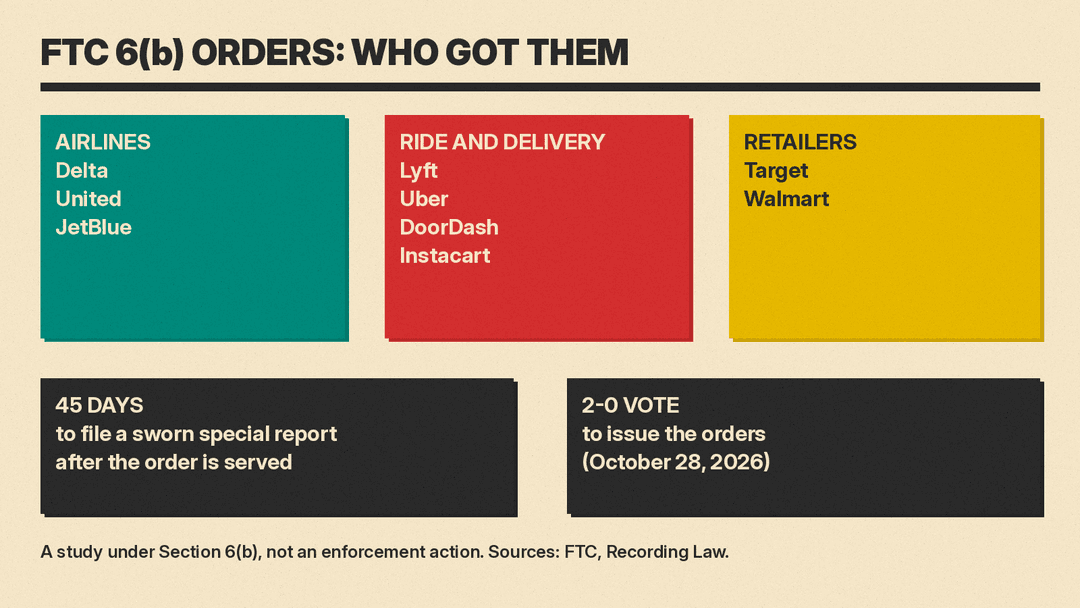
The Federal Trade Commission has ordered nine large companies to explain whether they use personal data to set the prices people pay and the pay gig workers get. The orders went to Delta, United, JetBlue, Lyft, Uber, DoorDash, Instacart, Target and Walmart on October 28, 2026. The Commission vote to issue them was 2-0, the FTC said in its announcement. The Commission's two sitting members are Chairman Andrew N. Ferguson and Commissioner Mark R. Meador, Recording Law reports.
This is a study, not an accusation. The orders are issued under Section 6(b) of the FTC Act, which the FTC says lets it conduct "wide-ranging studies that do not have a specific law enforcement purpose." A 6(b) order is a demand for information. It is not a complaint, and it does not say any of the nine companies broke the law. No complaint has been filed against any of them in this matter.
What the FTC said
In the FTC's announcement, Chairman Andrew N. Ferguson said: "We intend to scrutinize the opaque methodology that some companies in these industries may be using to determine how much consumers pay or how much gig workers are paid for the same product or service."
The same statement adds: "Consumers deserve to know whether companies use their web surfing habits or other personal data to estimate the highest price they can charge each consumer." It ends: "Workers also deserve to know if their compensation is affected by how companies use their personal data."
The announcement says each company must turn over information that will let the agency assess whether prices vary from one person to the next "based on factors such as participation in loyalty programs or analysis of personal data by superintelligence algorithms." It also says ride-sharing and food-delivery companies "may pay their workers shifting compensation offers based on opaque formulas," while airlines typically pay a transparent salary or fixed hourly wages.
The FTC is demanding information on whether and how the companies use consumers' personal data "such as location, browsing history and income to set individual prices, wages and job offers," a senior FTC official told Reuters, in a report published by CNBC. Reuters said the FTC will use the information to eventually publish a study to help inform regulators and lawmakers.
Why this is an AI policy story
Reuters wrote that "the advance of algorithmic pricing technology, including tools that incorporate AI, has fueled concern that companies are able to set prices for shoppers on an individual basis in order to extract the maximum price each shopper would be willing to pay."
The orders themselves reach these tools directly. According to Recording Law's review of the order:
- "Methodology" covers any formula, algorithm, code, model, or statistical or machine-learning technique. It expressly includes grouping or segmenting consumers in a way that produces different prices for the same product.
- The order defines "Super Intelligence," abbreviated SI, as a machine-based technology or system that, for a given set of human-defined objectives, makes predictions, recommendations or decisions influencing real or virtual environments.
- Specification 3 asks for employee headcount in the division working on Super Intelligence.
For background on the term, see our earlier post on President Trump's statement that the US would be "officially banning" the term AI.
What the companies must hand over
Recording Law, which read the order, reports that it has 23 numbered specifications across 15 pages. The main ones:
- Consumer prices (Specification 7): describe every methodology that uses personal information to adjust or set prices. For each product, name the pricing components, the tools or software, every input and whether it varies by individual consumer, the steps, how missing inputs are handled, and when a human modifies or overrides the machine's output.
- Which worker gets which job (Specification 11): how the company decides which workers are offered which jobs, including the order of offers and whether jobs are made visible to or hidden from a given worker.
- Worker pay (Specification 14): how pay is set, including how the price the consumer pays is split between the worker's pay and the company's revenue.
- Costs and benefits (Specification 21): whether each methodology lets more consumers buy, raises or lowers prices, expands worker supply, and raises or lowers worker pay.
- Disclosures (Specification 22): the exact wording, location (including the precise URL) and dates of each disclosure about these practices made to consumers or workers.
The order defines personal information across 24 categories, Recording Law reports. They run from name and address through geolocation, biometric data, health data, racial or ethnic origin, political beliefs or voting record, religion, sexual orientation, household and pregnancy status, devices, and transaction and browsing history. They expressly include a consumer's willingness to pay and a worker's willingness to accept a job, plus anything inferred from the listed data. Unless a specification says otherwise, the time period runs from January 1, 2023 until the company fully complies.
The order's definition of a worker excludes company employees paid a fixed salary or paid hourly on a fixed schedule, Recording Law reports. The FTC's own announcement notes that airlines typically pay employees a transparent salary or fixed hourly wages. Recording Law reads this to mean the pay questions have substantial scope at the rideshare and delivery companies and limited scope at the airlines.
Deadlines and what happens next
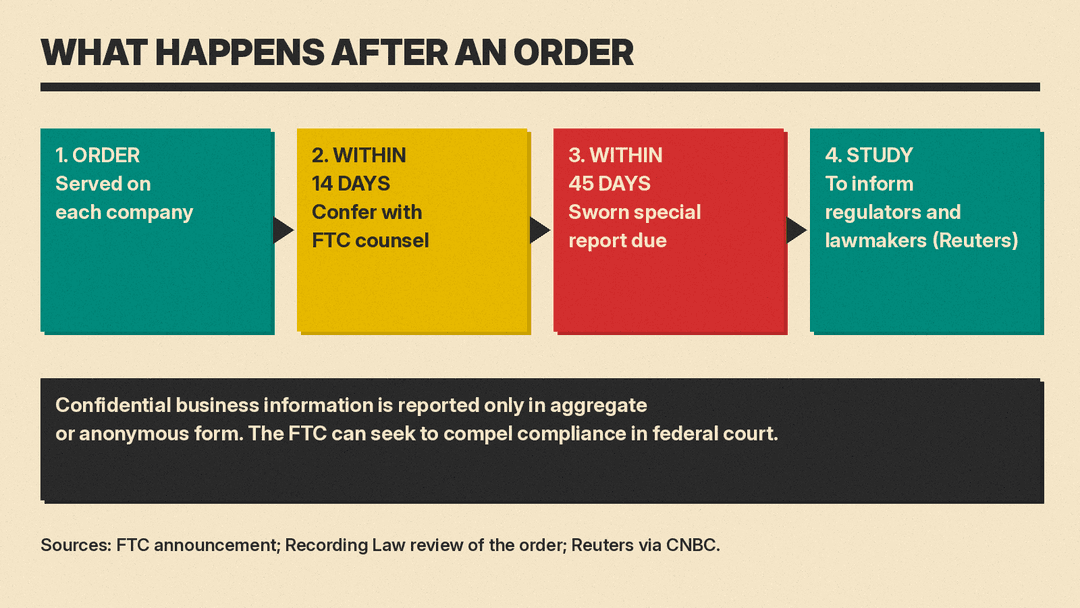
The FTC says the recipients have 45 days from the date they receive the orders to respond. Recording Law, which read the order, reports that the response is a sworn special report and that each company must contact FTC counsel within 14 days to confer. If a company does not respond, the FTC said it has the power to compel compliance in federal court.
Confidential business information will be reported only in aggregate or anonymous form, according to the order as summarized by Recording Law. Reuters reports that the FTC will use the information to eventually publish a study; the announcement gives no date.
Where the law stands
No federal rule bans personalized pricing outright. In an August 19, 2026 proposed enforcement policy statement, the FTC wrote that "Congress has not given the Commission the authority to prohibit personalized pricing in all circumstances." Reuters reported that after the FTC called for public comment, hundreds of commenters urged a ban, and that the FTC has said it lacks the authority for a blanket prohibition.
Instead, the proposed statement takes a disclosure approach. Where consumers reasonably expect prices not to vary based on their personal data, it says a business that personalizes prices should clearly and conspicuously disclose that the price is personalized, the basis for it, and the types of data used. It says failing to do so is likely an unfair or deceptive practice under Section 5 of the FTC Act. The statement is still a proposal, not a final rule.
Some states already have rules. New York's Algorithmic Pricing Disclosure Act (General Business Law 349-a) took effect November 10, 2025, according to the New York Attorney General. It applies when a business sets a price using "personalized algorithmic pricing," meaning dynamic pricing set by an algorithm that uses personal data, and shows that price to a New York consumer using data specific to that consumer. The price must carry a clear and conspicuous notice that reads: "THIS PRICE WAS SET BY AN ALGORITHM USING YOUR PERSONAL DATA." The law requires disclosure; it does not ban the practice. Insurers and certain financial institutions are exempt, and location data that ride-hail vehicles use only to calculate a fare from mileage and trip time does not count as personal data. The Attorney General enforces it, first by sending a cease and desist letter with time to fix the problem; the AG says violations can bring a $1,000 penalty each. Reuters reported that the National Retail Federation has criticized state laws on personalized pricing and defended retailers' use of data-driven discounts as a means of incentivizing loyalty.
Two other New York AI measures are dated the same day, October 28. Governor Kathy Hochul signed a law on AI companion apps for users under 18, and a new state Senate bill that its sponsor calls RAISE Act 2.0 would let a state office limit the compute used to train the largest models.
For readers, nothing changes today. The orders do not change what any company may charge or pay, and they give no one a new legal claim.
Sources
- FTC: FTC Launches Personalized Pricing and Compensation Inquiry (Oct. 28, 2026)
- Recording Law: FTC Orders Nine Companies to Report on Personalized Pricing (Oct. 29, 2026)
- CNBC (Reuters): FTC demands Walmart, Uber, Delta and others hand over data on personalized pricing (Oct. 28, 2026)
- New York General Business Law 349-a
- FTC: Proposed Enforcement Policy Statement Regarding Personalized Pricing (Aug. 19, 2026, PDF)
- New York Attorney General: consumer alert on the Algorithmic Pricing Disclosure Act (Nov. 2025)
