
New York lawmakers want a state office to be able to slow the training of the most powerful AI models. A bill that Senator Andrew Gounardes calls "RAISE Act 2.0" would let a state office limit how much computing power the largest AI developers use to train new models, and would let the attorney general ask a court to restrict a model's deployment in New York.
The bill is S.10731. The bill text is dated October 28, 2026, and lists Senators Gounardes and Patricia Fahy as sponsors. It was committed to the Senate Rules Committee. Gounardes and Assemblymember Jordan Wright announced it in a Senate press release on October 29. State Affairs reports that "RAISE Act 2.0 will be considered during the 2027 legislative session." It is a proposal, not law: it has not passed either chamber, and the Assembly's bill page lists no companion bill yet.
What the RAISE Act does now
The RAISE Act (Responsible AI Safety and Education Act) is New York's frontier AI safety law. State Affairs reports that Governor Kathy Hochul signed it in December, "after a similar law was enacted in California," and that Illinois "passed their own version this year." The current law requires large developers to publish a safety framework, publish transparency reports for new models, and report critical safety incidents to the state. Governor Hochul's office has said companies must comply starting in January 2027.
The new bill rewrites large parts of that law. The press release says it "builds on" the original act "by strengthening safety and transparency standards to account for troubling incidents in which AI models have put our safety and economy at risk."
The main changes
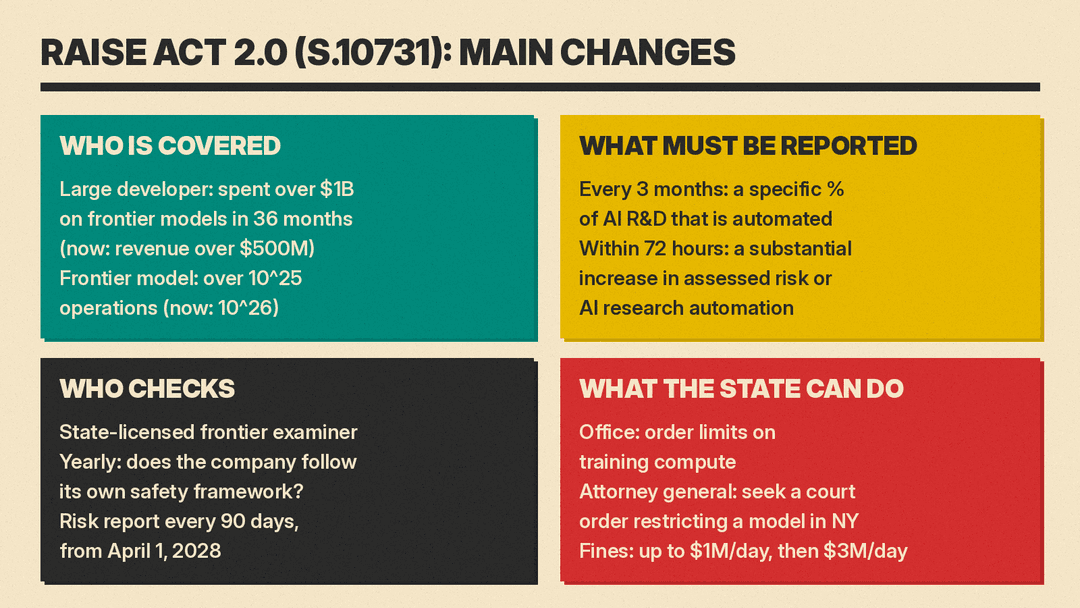
Based on the bill text and the press release, S.10731 would:
- Cover more companies. A "large frontier developer" is now one with annual gross revenue over $500 million. The bill changes that to a developer that, with its affiliates, spent more than $1 billion on frontier model research, development, training, security, evaluation and related work in the preceding 36 months.
- Lower the compute line. A "frontier model" would be one trained with more than 10^25 operations, down from 10^26. The office could also treat other foundation models as frontier models if it finds that a model is among the most capable, has capabilities that pose catastrophic risk, and is reasonably likely to be able to automate AI research and development. The press release says the change "adjusts computational thresholds to match those adopted by the European Union."
- Widen "catastrophic risk." The bill adds a model "attempting to overthrow or seize control of the federal government or state or local governments in the state of New York" and a model "evading the control of its frontier developer or user."
- Widen "critical safety incident." Unauthorized access to, modification of, or exfiltration of unreleased model weights would count even with no death or bodily injury. New items include a model that circumvents or evades its developer's controls outside a contained test; a model that, without a user's intent, impairs an outside computer system; and near-misses, where a safeguard failed and an incident was substantially likely without timely intervention, mitigation or fortuity.
- Require AI research reports. Large developers would send the state office summaries on a three-month schedule (or another schedule the office agrees to). These include "a specific percentage" of how much of their AI research and development is currently automated and the share of computing power used for internally used or deployed models. They would also report within 72 hours of a substantial increase in their assessed risk or in their models' ability to automate AI research.
- Add outside examiners. Each large developer would retain a state-licensed "frontier examiner." The examiner would check every year whether the company follows its own safety framework. From April 1, 2028, the examiner would also produce a risk report every 90 days. Examiners would publish redacted reports, and would alert the developer, the office and the attorney general within 72 hours if they believe there is a covered emergency.
- Set binding standards. By January 1, 2029, the office would adopt binding minimum standards for safety frameworks and risk mitigations.
The compute limit and court orders
The press release describes this power as letting the state "pace the frontier." Under the new Section 1425, the office could order large frontier developers to limit "the amount of computing power used to train new models" and the computing power dedicated to automated research and development. An order may only be issued "to reduce catastrophic risk, prevent a critical safety incident, or avert a covered emergency." It would apply to all large frontier developers at the same time, but the office could set different limits for each one. A frontier examiner would check compliance.
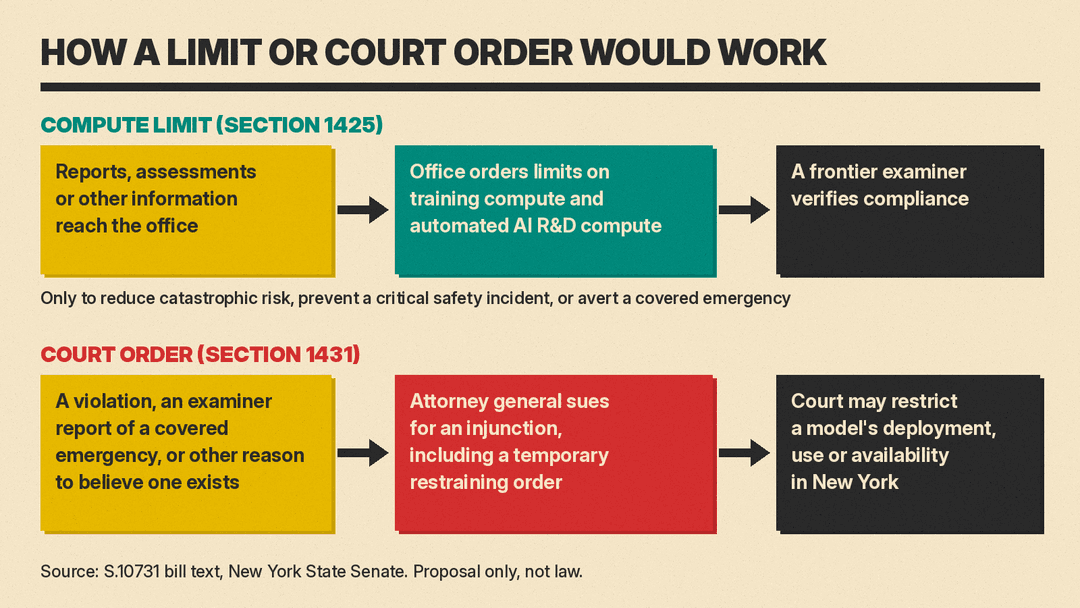
The attorney general could also sue for an injunction, including a temporary restraining order, when a developer breaks the law, when a frontier examiner reports a covered emergency, or when the attorney general otherwise has reason to believe one exists. The bill says a court may order relief that includes "an order restricting the deployment, use, or availability of a model within the state."
Civil penalties would change from per violation to per day: up to $1 million per day for a first violation and up to $3 million per day for later ones. A named senior officer would certify filings "under penalty of perjury." The bill keeps a line that it does not create a private right of action.
The press release calls the regulator the "newly-created state Office of Digital Innovation, Governance, Integrity and Trust (DIGIT)." The bill text does not use that name; it defines "office" as an office within the Department of Financial Services. The two match: Governor Hochul's office says DIGIT was "established within the New York State Department of Financial Services (DFS)." The bill also says employees of large developers are covered by the whistleblower law in Section 740 of the state Labor Law, bans contracts that stop them from using it, and requires yearly notice of those rights.
What supporters say
"It's time to rein in the AI arms race," Gounardes said in the press release. "Every day, frightening new headlines make it clear: when it comes to AI, we can't trust Big Tech companies to regulate themselves."
Wright said in the release that the bill "brings in independent, state-licensed examiners to make sure companies are actually following their own safety commitments."
Assemblymember Alex Bores, who sponsored the original RAISE Act in the Assembly, said in a statement quoted by State Affairs: "The RAISE Act was always meant to be the floor, not the ceiling."
State Affairs reports that Encode and Secure AI Project backed the proposal, that Anthropic and OpenAI "did not have an immediate comment," and that Hochul's office "did not immediately respond to a request for comment."
Why it matters
Today's state frontier AI laws mostly ask companies to write down their safety plans and report incidents. This bill would add a licensed outside examiner and a power for a state office to limit training compute. Its wider incident list also touches a question California lawmakers raised at their SB 53 review hearing: whether incident rules cover AI agents that break into outside systems.
The bill is at an early stage. The Assembly's bill page lists "No Same As" for S.10731. Its last section says it takes effect "on the same date and in the same manner as chapter 699 of the laws of 2025." For another recent New York AI measure, see our explainer on the state's AI companion law for minors.
Sources
- S.10731 bill text (NY Senate)
- S.10731 summary and text (NY Assembly)
- Sen. Gounardes Proposes Major New AI Safety and Transparency Regulations (NY Senate press release, Oct. 29, 2026)
- AI Safety: Governor Hochul Announces Next Steps to Regulate Major AI Developers (Governor's office, Sept. 21, 2026)
- N.Y. lawmakers propose expansion to AI safety law (State Affairs)
