
Fish Audio has launched Live 3, a full-duplex voice model for AI voice agents. In its launch post dated November 10, 2026, the company says the model "keeps listening while it speaks, so a pause, a quick acknowledgment, or a change of mind can shape what happens next." Fish Audio frames it as a fix for voice agents that speak at the wrong moment.
What is Fish Audio Live 3?
Live 3 is a speech model that handles conversational timing itself. Fish Audio says most voice agents coordinate speech recognition, reasoning, speech generation, and turn-taking across separate parts of a pipeline, and that getting those parts to work together naturally takes care. Live 3, in the company's words, "brings conversational timing into the speech model itself."
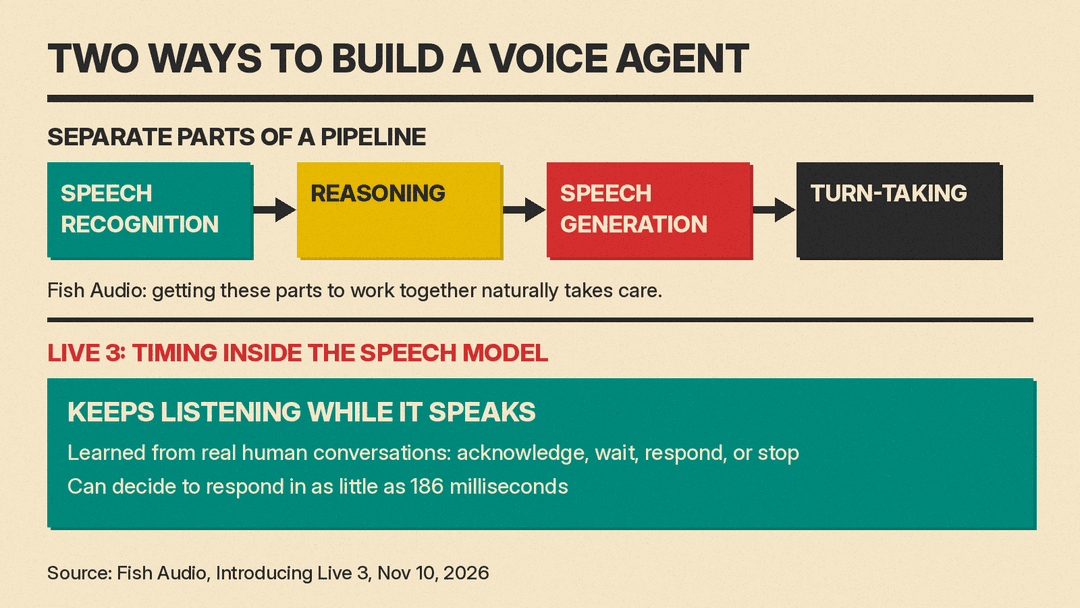
Fish Audio says it trained Live 3 on real human conversations, so the model learns when to acknowledge, wait, respond, or stop. "Those behaviors were learned from people, not written as a list of rules," the post says.
Rissa Cao, Fish Audio's co-founder and CEO, put the approach this way: "The fix so far has been more rules and more thresholds. We think a model should learn this from real conversations, the same way language models learn grammar."
The post also makes a point about speed. Fish Audio writes that speed and conversational timing are not the same problem: an agent can start a reply quickly and still speak at the wrong moment. A pause after "What time do you open?" might mean the caller is done. A pause halfway through a phone number means more is coming.
How Live 3 handles pauses and interruptions
Fish Audio describes three behaviors, each with an example.
Acknowledging without taking over. When a caller reads out a number in chunks, such as "415… 555… 0132," Live 3 might say "mm-hmm" or "okay, 415" between them and wait for the rest. Fish Audio says that small reply tells the caller the digits were heard and leaves the floor open.
Knowing when the caller wants to jump in. Not every sound is an interruption. If the agent is explaining services and opening hours and the caller says "yeah" or "mm-hmm," Live 3 keeps going. If the caller says, "Wait, actually, I just need Thursday," it stops and makes room for the new request.
Leaving room to change your mind. In the example "I'd like two pizzas… no, three. Three large. And… actually, make one of them a margherita," Fish Audio says Live 3 waits through each correction instead of jumping in with the wrong item.
On response time, Fish Audio says Live 3 "can decide to respond in as little as 186 milliseconds." Short reactions such as "mm-hmm," "okay," and quick confirmations keep the exchange moving while the full answer is being prepared. The launch post includes three audio excerpts from real test calls, with the original pauses and overlaps, so readers can judge the timing themselves.
Where you can use it
Live 3 speaks English today. Fish Audio says it is available on the Fish Agent Platform and through its API, and enterprises can deploy it on-premises. You can try it at fish.audio/agents.
The agent platform around it is broader than the model. The voice agents page lists 2,000,000+ Fish Audio voices in 30+ languages, including your own clone. That language count is for the voice library; the launch post says Live 3 itself speaks English. The page also lists:
- A knowledge base built from PDFs, Markdown and URLs, shared across agents
- Tools and webhooks that call your APIs mid-conversation
- Single-turn, multi-turn and tool-call tests, judged by an LLM against your success examples
- Phone numbers for inbound and outbound calls, with warm or cold transfer to your team
- Automatic call summaries, structured data fields and success criteria, delivered by webhook and API
- Settings for interruption handling, silence re-engagement and response eagerness
Fish Audio's example agents on the page cover support, bookings, reservations, orders, research and reminders.
How much does Live 3 cost?
As of November 12, 2026, the voice agents page lists one per-minute price that "includes Live 3, our full-duplex model":
- $0.035 per minute, down from an original price of $0.07 per minute (50% off)
- The offer is labeled limited-time and ends December 31, 2026
- "Full-duplex or cascaded, both supported"
- Start free with a $5 credit, no card needed
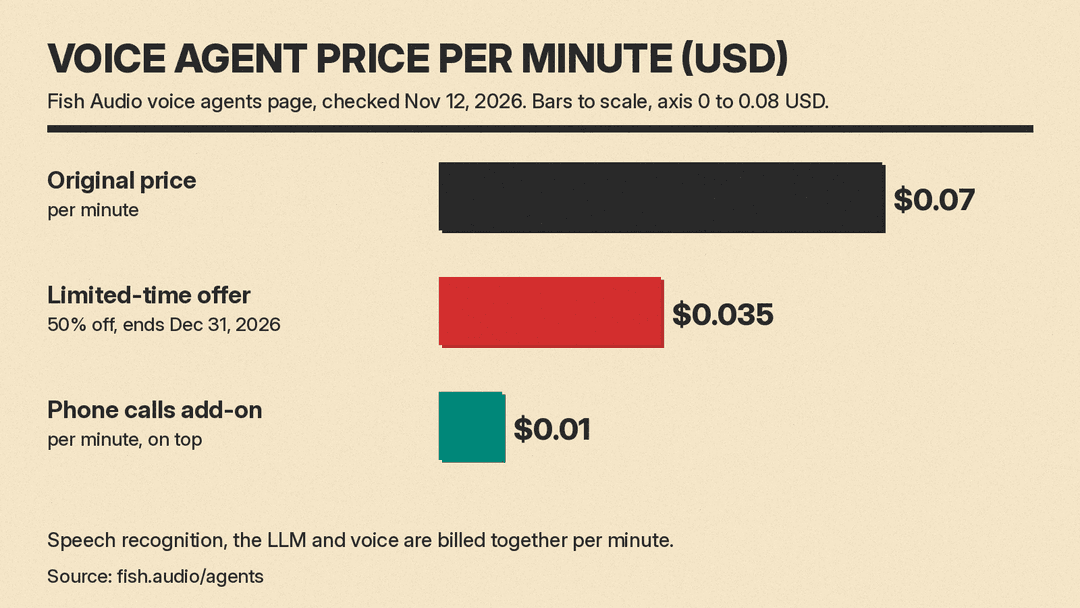
The page's FAQ says speech recognition, the LLM and voice are billed together per minute. Add-ons are listed separately: a premium LLM is billed at that model's own token rate, phone calls add $0.01 per minute, and a dedicated phone number costs $1.20 per month. The page says you can bring your own carrier at no extra cost. An Enterprise tier lists zero data retention, with pricing through sales.
Fish Audio's agent pricing docs list more charges. When the agent transfers a phone call to a person, the rest of the call is billed at $0.015 per minute for a cold transfer or $0.025 per minute for a warm transfer. Some outbound phone destinations carry a higher rate than the $0.01 per minute phone surcharge.
What we don't know yet
The launch post does not state benchmark scores, a model size, or whether Live 3 weights will be released. Fish Audio's earlier Drama 3 text-to-speech model was released with open weights, but the Live 3 post says nothing about that for this model. The post also does not say when languages other than English will arrive.
Why it matters
Fish Audio's argument is that timing should be learned from human conversations inside the speech model, instead of tuned with rules and thresholds in a pipeline. Other companies are also building speech-native agent models; we covered one recently in our look at Phonic 1 speech-to-speech voice agents, and ElevenLabs announced its own agent updates at its NYC summit.
For a small business or a support team, the practical test is simple: does the agent let a caller pause, say "yeah," or change an order without losing track? Fish Audio's published call excerpts let listeners judge that now; we have not seen independent tests yet. Until then, the clear facts are the English-only launch, the API and on-premises options, and a $0.035 per minute offer that runs to the end of 2026.
