
What is VOCALOID7?
Yamaha Corporation, based in Hamamatsu, Japan, released VOCALOID7 on November 11, 2026. It is the latest version of its VOCALOID singing voice synthesis software. The product is sold as a download from the official VOCALOID shop at vocaloid.com. Yamaha says VOCALOID7 is the first new version of the software in four years. VOCALOID was introduced in 2003. With the launch, Yamaha discontinued the VOCALOID6 series, including VOCALOID6 Editor Lite and the trial version.
Yamaha says VOCALOID7 was developed with the growing fan community around characters and songs in mind. It also says the release is meant to make the software easier for newcomers. The company's "enjoy" page describes a workflow: choose a voicebank, import a MIDI melody, type lyrics, and press play. Yamaha points to its Piano Sheet Converter, which can create a melody-only MIDI file from a song's audio. More than 100 voicebanks are listed on the VOCALOID shop.
What's new in the AI singing engine
Yamaha lists five key features in its press release.
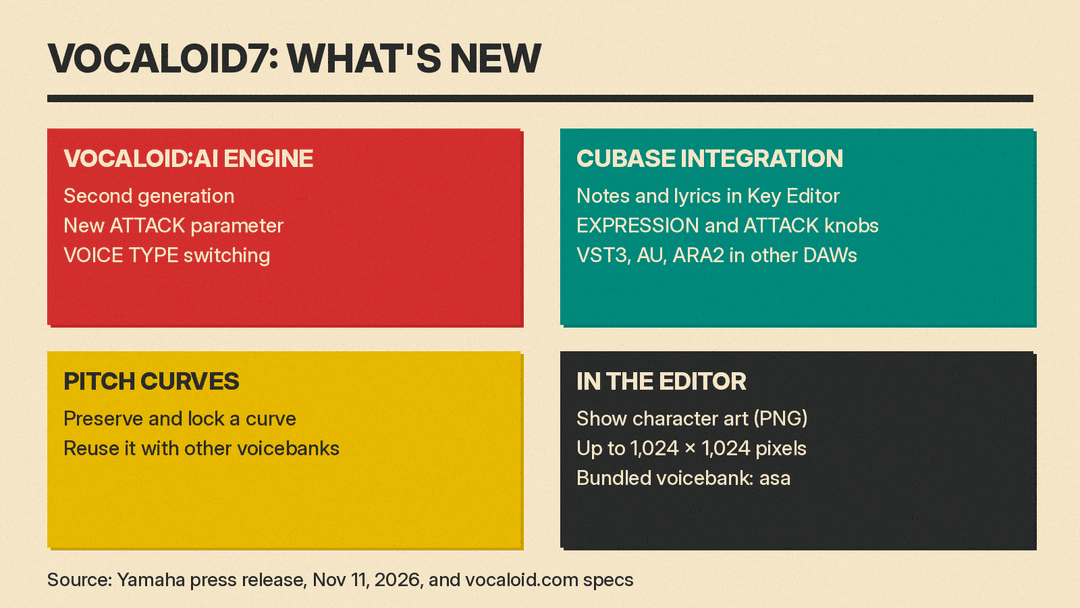
- VOCALOID7 uses a second-generation VOCALOID:AI synthesis engine. Yamaha says this can produce more natural and expressive vocals. Yamaha lists Japanese, English, and Chinese as supported.
- A new ATTACK parameter gives users control over pronunciation and articulation. VOICE TYPE lets users switch between vocal characteristics within the same voicebank. VOICE TYPE works only with VOCALOID7-exclusive voicebanks.
- The editor supports Cubase integration. Users can enter notes and lyrics directly in the Cubase Key Editor. New knobs in Cubase control EXPRESSION and ATTACK.
- Users can display favorite characters or illustrations in the editor. The editor supports only PNG images, up to 1,024 x 1,024 pixels.
- The editor can preserve synthesized pitch curves and lock them. This lets each engine's pitch curve be reproduced with different voicebanks.
The main editor also includes the standard voicebank "asa".
Price and upgrade deals
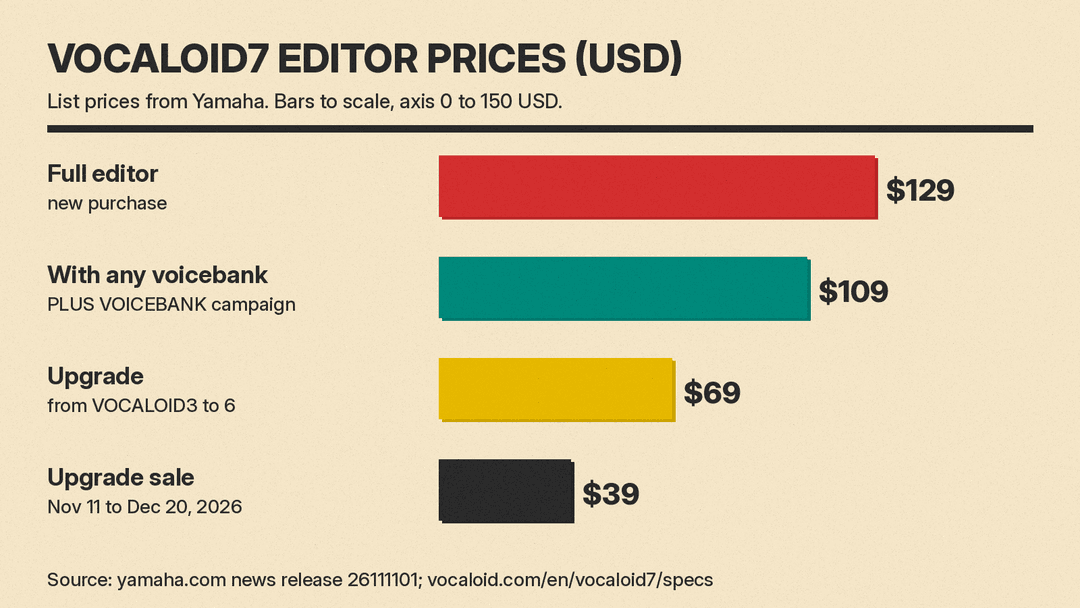
VOCALOID7 Editor is priced at USD 129.00. The shop lists all prices before tax. An upgrade is USD 69.00 for owners of VOCALOID3 through VOCALOID6 or any VOCALOID Editor for Cubase product. A valid serial number is required, and Tiny VOCALOID3 Editor, VOCALOID6 Editor Lite and VOCALO CHANGER PLUGIN do not qualify. In a limited-time sale from November 11 through December 20, 2026, the upgrade is USD 39.00. Yamaha says buyers of a product including VOCALOID6 Editor on or after October 9, 2026 receive a USD 39.00 coupon. During the promotion, that coupon can make the upgrade free.
The editor supports all voicebanks from VOCALOID3 to VOCALOID6. Yamaha also lists a PLUS VOICEBANK campaign. If the editor is bought with any voicebank, the editor price is USD 109.00 instead of USD 129.00. Upgrade versions are not eligible. The release gives one example: Editor plus NurseRobot_TypeT at USD 90.00 is USD 199.00.
The new voicebanks
Yamaha announced five VOCALOID7-exclusive voicebanks, sold as six products.
- AI Megpoid is USD 92.00. It is distributed by INTERNET Co., Ltd. It is based on the voice of singer and voice actress Megumi Nakajima. It includes eight Voice Types: Native, Whisper, Cute, Downer, Power, Soft, Vivid, and Ballade.
- GekiyakuV is USD 90.00. Yamaha describes it as a strong and artless girl's voice. Its shop page lists two Voice Types: Normal and Power.
- KazehikiV is USD 90.00. Yamaha describes it as androgynous and husky. Its shop page lists two Voice Types: Normal and Power.
- A GekiyakuV and KazehikiV set is USD 135.00.
- NurseRobot_TypeT is USD 90.00. Yamaha describes it as soft, airy, and whisper-like. Its shop page lists two Voice Types: Normal and Power.
- LUCI is USD 90.00. It comes from the voice of VSinger Akatsuki Ruki. Yamaha describes it as having a rich, full-bodied tone. Its shop page lists three Voice Types: Normal, Power, and Whisper.
Yamaha says more VOCALOID7-exclusive voicebanks will launch later. Each voicebank includes VOCALOID7 Editor Lite. Yamaha says Editor Lite is a limited standalone-only version with a maximum of two tracks: one VOCALOID:AI or VOCALOID track plus one audio track. The press release says it can be used without activation.
System requirements
The specification page lists a free trial of the full editor for 31 days. It also says Editor Lite is free, with no time limit, for anyone who owns a voicebank. VOCALOID7 runs on Windows and macOS. It can be used standalone, as VST3, or as AU. Editor Lite is standalone only.
In Cubase, the editor can use VST with native integration. In other DAWs, Yamaha lists VST3, AU, and ARA2. The full editor bundles Cubase AI, but the upgrade versions do not include it.
The editor offers over 100 style presets, 11 audio effects, up to 32 tracks, and 999 measures. It reads MIDI, MusicXML, UST, SVP, and other sequence formats. It reads and writes WAV and mp3.
Yamaha's listed requirements are Windows 11 22H2 or later, or macOS 15, 26, or 27. The computer needs at least 8 GB RAM, 2 GB of storage, and internet access for authentication.
Why it matters
VOCALOID7 is still a note-by-note vocal instrument. The user controls pitch, timing, lyrics, and expression, then the engine renders a singing track. That is different from prompt-based song generators such as Suno, which create a whole song from a text prompt. Readers interested in that broader shift can see how AI music generators work.
Yamaha's own changes point the same way. The second-generation engine, the ATTACK parameter and VOICE TYPE give more control over how a voicebank sings. Notes and lyrics can now be entered in the Cubase Key Editor. Users can still load voicebanks from VOCALOID3 onward, lock pitch curves, and export WAV or mp3 audio.
The pitch is also aimed at fans, not only producers. Yamaha's "enjoy" page shows a short path from a MIDI melody to a favorite character singing a favorite song, and each new voicebank ships with the free Lite editor. For other AI tools that work from notes and MIDI rather than prompts, see Vienna Performer and AI features in Pro Tools, Logic and Splice Create.
