

Federal prosecutors in Manhattan have charged three men over an alleged scheme that used AI to copy the voices and faces of company CEOs and big-firm lawyers, then talked employees into wiring away more than $129 million. The U.S. Attorney's Office for the Southern District of New York announced the unsealed indictment on Thursday, November 5, 2026. All three men were arrested in Europe this year, and U.S. extradition requests are pending.
The charges are allegations. None of the three has been convicted in this case, and the attorneys for one defendant say he had nothing to do with it (more on that below).
Who is charged
The indictment names Jacob Soall, Sharon Hazan and Guy Sheetrit. According to the SDNY release, Soall was arrested in Spain on June 17, 2026, Hazan was arrested in Spain on August 5, 2026, and Sheetrit was arrested in the United Kingdom on September 7, 2026. Extradition requests for all three are pending.
According to the SDNY release, the three each face conspiracy to commit wire fraud, wire fraud, two counts of aggravated identity theft, money laundering conspiracy and two counts of money laundering. The listed maximums for those seven counts add up to 104 years. The release says those figures are for information only, and that any sentence would be up to the judge.
How the scheme worked, according to prosecutors
Prosecutors describe a two-step con built around trust in familiar voices.
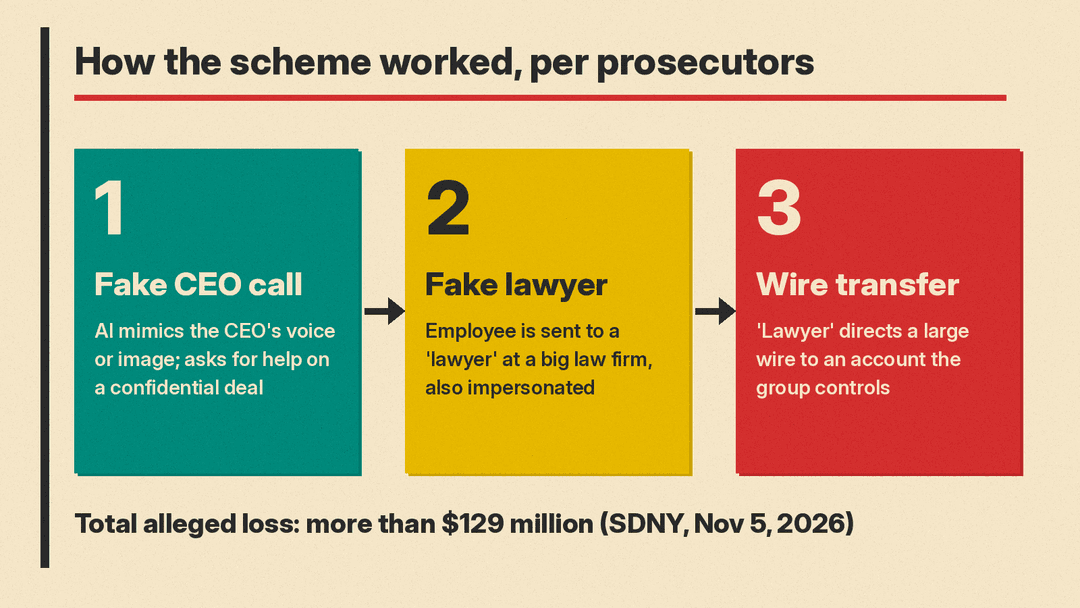
First, the group targeted employees at the victim companies and posed as each company's chief executive. In the words of the SDNY release, they "would use SI to mimic the CEO's voice and/or image in calls with the employee." The fake CEO said the employee was needed on a confidential financial transaction. NBC News reports that the targets were typically in accounting departments, and CyberScoop says prosecutors allege the group picked employees with enough authority to approve large wire transfers.
Second, the fake CEO told the employee to contact lawyers at large international law firms who were supposedly working on the deal. The group then impersonated those lawyers too. CyberScoop reports that the lawyers they posed as were at some of the 50 largest law firms in the world, and that the scheme typically began with an email from an e-signature company asking the employee to sign a non-disclosure agreement before talking to the "attorney."
Finally, a conspirator posing as one of the lawyers told the employee to wire a large sum to a bank account. That account, prosecutors say, was controlled by the group. According to the SDNY release, money went to accounts in the United States, Spain, Portugal, Greece, the United Arab Emirates, Singapore, Austria, Slovakia and China. CyberScoop reports that the group then allegedly converted the funds to cryptocurrency and split the proceeds.
NBC News says prosecutors allege the scheme ran from July 2024 to February 2026. CyberScoop reports that court records say the three targeted thousands of victims in that period.
The named losses
The SDNY release lists six of the losses. Prosecutors say the scheme took:
- $4,829,580 from a hospital system headquartered in Missouri
- $2,684,580 from a bank headquartered in Rhode Island
- $2,968,497 from a hospital system headquartered in California
- $11,578,474 from a financial technology company headquartered in the United Kingdom
- $4,639,918 from a mutual fund company headquartered in Massachusetts
- $5,242,747 from a pet food company headquartered in Florida
CyberScoop also lists a New York-based investment company that it says lost $2.8 million. The release does not name any of the victim companies.
What each defendant is accused of
According to the SDNY release, Soall, 41, of Marbella, Spain, and the United Kingdom, allegedly mostly impersonated attorneys from the United Kingdom and kept a handwritten script titled "Lawyer Call." The release says Hazan, 54, of Israel, among other things allegedly laundered funds from the scheme, and that he boasted he had been laundering money since 1994, including more than $400 million in the past three years, and was "number one all over the world" among professional money launderers. The release also says Hazan was previously convicted in the Southern District of New York of conspiracy to commit bank fraud in 2008. Sheetrit, 42, of Israel and the United Arab Emirates, also allegedly laundered funds from the scheme, the release says.
Sheetrit's lawyers deny the charges
Sheetrit's attorneys, Sharon Nahari and Shay Shorer, sent CyberScoop a statement after its first story ran. They wrote that their client "has no connection to this matter and has had no involvement in it whatsoever." They added: "Our client maintains his complete innocence and, like everyone else, is entitled to the presumption of innocence." The attorneys also said they are confident that, once the evidence is fully examined, "it will become clear that there is no basis for holding him criminally responsible." CyberScoop did not report a response from Soall or Hazan.
What officials said
U.S. Attorney Jamie McDonald said in the release: "SI technology offers tremendous potential. But the public should recognize that there are some who seek to use this emerging technology to pursue criminal goals." McDonald also said: "I encourage individuals and the business community to consider how to best protect themselves from the emerging threat of SI-enabled crime."
James C. Barnacle Jr., assistant director in charge of the FBI's New York field office, said in the SDNY release that the alleged scheme "demonstrates how the use of advanced technology can be exploited to commit large scale fraud." Barnacle added that the FBI "remains committed to rapidly adapting our capabilities to identify, investigate, and disrupt those who seek to harm New Yorkers and businesses operating in our communities."
The release uses the phrase "super intelligence" ("SI") throughout, where CyberScoop and NBC News write AI. NBC News describes super intelligence as the White House's preferred term for artificial intelligence. For background on that wording, see our earlier post on the administration and the term AI.
The SDNY charges were announced the same day the Justice Department launched its Super Intelligence Task Force. Neither release links the case to the task force; see our report on the DOJ Super Intelligence Task Force.
Why it matters for companies
In the scheme prosecutors describe, the request looked like a message from "the boss" about a confidential deal that ended in a wire transfer. Prosecutors say the employee heard or saw what appeared to be the real CEO on a call, and then a second impersonated person, a lawyer at a large international law firm, backed up the story.
That makes a single phone or video call weak proof of who is asking for money. Finance teams that verify large transfers with a call-back to a known number, or a second approver, do not rely on recognizing a voice. For how voice cloning works, read our explainer on AI voice cloning. For one approach to proving a real human is on a call, see our post on World ID and deepfakes.
The SDNY release states that the charges "are merely accusations, and the defendants are presumed innocent unless and until proven guilty."
Sources
- U.S. Attorney's Office, SDNY: Three Foreign Nationals Arrested And Charged With Scheme To Use Super Intelligence To Defraud Companies Of $129 Million (Nov 5, 2026)
- CyberScoop: Authorities accuse trio of using AI deepfakes to defraud $129M from businesses (Nov 6, 2026)
- NBC News: 3 foreign nationals allegedly used AI to mimic CEOs in $129M scheme, DOJ says
