
Baidu used its annual Baidu World conference in Beijing on Nov 12, 2026 to launch a marketplace for buying AI model access, not only another model. The platform is called 词元所 (Ciyuansuo). 词元 is the Chinese word for a token, and Baidu founder Robin Li compared the service to a stock exchange for large language models.
The launch came with a long list of other items: ERNIE 5.5 Flash Preview, two new application models, agent upgrades, a 1,024-card computing system and a chip roadmap. But the exchange is the piece that says the most about where China's model market is now.
What Ciyuansuo is
According to Xinhua's report on the event, Ciyuansuo lets companies and individuals find, buy and use model tokens that Baidu has checked. Li framed it against a problem he described on stage: in the first nine months of 2026 a new model came out almost every day, and the same model is sold at very different prices by sellers of mixed origin and quality.
Yicai Global quoted Li in English: "Ciyuansuo is an exchange for LLMs, enabling enterprises and even individuals to easily find, purchase, and use trustworthy model tokens." It also quoted his view of the current market: "After all the picking and choosing, people still don't feel confident or dare to use them."
Sina Tech reported that Li aimed his criticism at third-party 词元中转站, literally "token relay stations": resellers that pool many models for developers to call. Xinhua reported Li saying these sellers take no responsibility for model results or service stability. Sina added that some pass off a lower version of a model as the Pro version. Sina also reported that Ciyuansuo runs on Baidu's Qianfan cloud platform.
How Baidu says it checks models
Baidu describes two functions, which Xinhua calls verification and credit rating:
- Verification. Before a supplier gets in, Baidu says it runs model fingerprint comparison, capability tests, and performance and availability tests. The goal, per Li's remarks reported by DoNews, is to keep out swapped models and inflated parameter claims.
- Credit rating. After entry, Baidu says it runs regular spot checks and dial tests and monitors calls across the full chain in real time, per Xinhua. DoNews reported that providers get scores on service quality, fulfillment, safety compliance and commercial contract performance, that users get an alert when a provider's rating drops, and that the records become public credit files.
Baidu has not published how the fingerprinting works or how the ratings are calculated. No outside group has tested these checks yet, so the quality claims are Baidu's own.
The early numbers
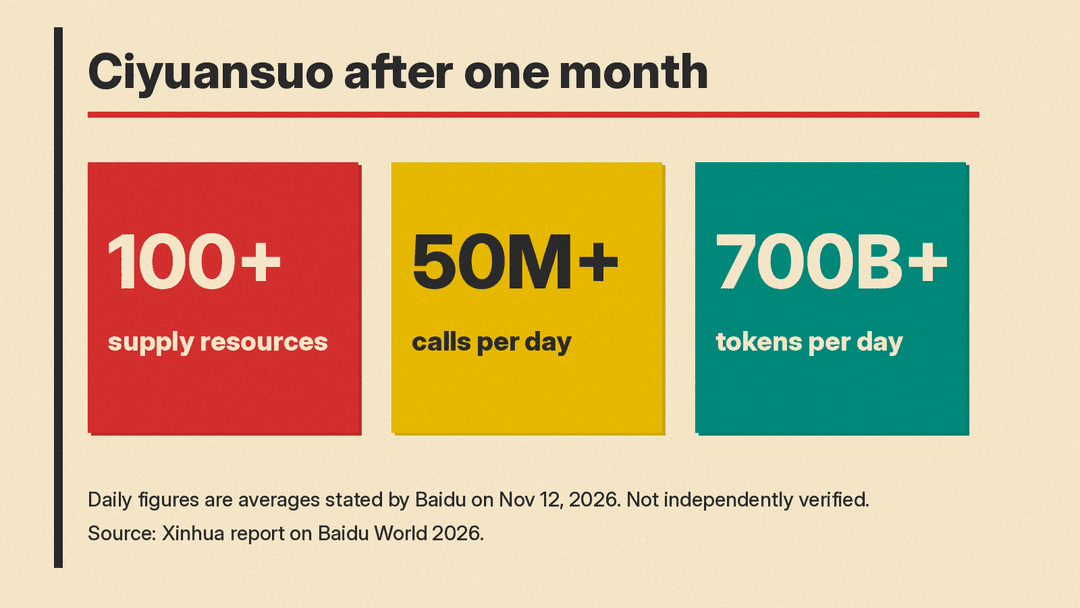
Li said Ciyuansuo has run for one month. Per Xinhua, in that time it has signed up more than 100 supply resources and reached more than 50 million calls and more than 700 billion tokens per day on average. These are Baidu's figures as of Nov 12, 2026, and no independent source has confirmed them.
Sina also reported Li's statement that revenue tied to open-source models on Qianfan grew more than tenfold, while compute stays scarce and compute prices rise. That context matters: if model makers cannot serve all API demand themselves, resellers fill the gap, and buyers have less certainty about what they actually get.
Why it matters
Chinese labs now sell access in many ways at once. Just this week, several of them sold discounted token plans on Tmall for Double 11, which we covered here. Baidu is betting that, with so many models and sellers, a trusted middleman can earn a place. Yicai Global's own analysis put it this way: an exchange's value "has never depended on the traded assets."
There is an open question for buyers. Baidu builds and sells its own ERNIE models and now also rates other providers on the same platform. Baidu calls the exchange neutral, but it has not said how it separates those roles.
Models and agents
- ERNIE 5.5 Flash Preview. Xinhua lists 280 billion total parameters, 14 billion active per token and up to a 1 million token context. We covered its API launch and the promised open weights in our ERNIE 5.5 Flash Preview report.
- Two application models. A deep-thinking model that Yicai Global calls Ernie Lightning, and a micro-expression model for Baidu's digital-human product Yijing. Both are on Qianfan with API access for enterprise customers and partners, per National Business Daily.
- Agents. Per Xinhua, Baidu's general agent Dazi becomes one entry point to Baidu's specialist agents and opens its Harness engine and an Agent API. Baidu says its Dazi team generated 90% of its code with Dazi. Famu, an agent for industrial and operations tasks, moved to version 3.0. Yijing added a short comic drama studio, which Baidu prices at 0.2 yuan per second of video.
For background on the ERNIE family, see our ERNIE explainer.
Robin Li's "intelligent organization"
Li's keynote theme was organization, not models. Per Xinhua, he said the next stage of AI is the intelligent organization, and he gave three principles: break down job boundaries, consolidate tacit knowledge, and design closed feedback loops. He said jobs will converge into two types, Builders and Sellers.
Baidu gave internal figures to support this. Per Xinhua, daily active agents inside Baidu went from an average of 5,000 to 37,000 over the past year, and valid tasks completed by agents went from 84,000 per week to more than 1 million per week. Nikkei Asia reported that Li said commercial AI adoption is "only starting."
Chips and cars
Baidu AI Cloud released its Tianchi 1,024-card supernode. Per Xinhua, Kunlunxin said on Nov 12 that its M100 chip was on the market and that the M300 would launch next year. Baidu also said its Apollo Go autonomous driving service covers 28 cities worldwide.
Sources
- Xinhua: Robin Li's three principles and Baidu World 2026 launches (Nov 12, 2026)
- Yicai Global: Baidu's LLM trading platform passes 50 million daily calls (Nov 12, 2026)
- Sina Tech: Robin Li launches Ciyuansuo (Nov 12, 2026)
- DoNews: Ciyuansuo launch details (Nov 12, 2026)
- National Business Daily: two ERNIE application models (Nov 12, 2026)
- Nikkei Asia: Robin Li says commercial AI adoption is only starting (Nov 12, 2026)
