
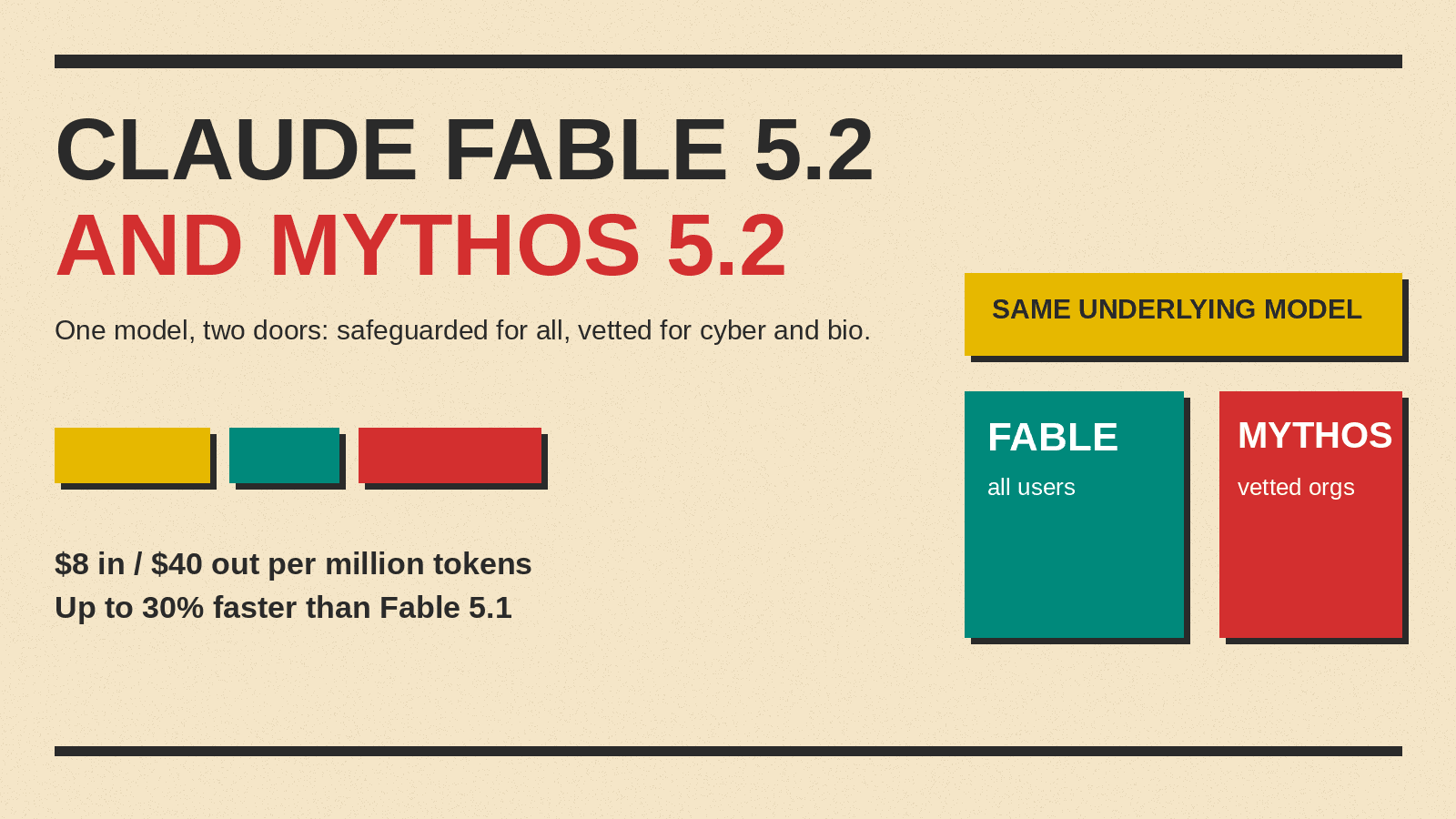
Anthropic released Claude Fable 5.2 and Claude Mythos 5.2 on November 9, 2026. The two names refer to the same underlying model. Fable 5.2 has strong cybersecurity and biology safeguards, so it is available to all users. Mythos 5.2 is for organizations in cybersecurity or biomedical research that apply through the Cyber Verification Program or the Life Sciences Verification Program.
What is Claude Fable 5.2?
Anthropic says both models improve coding, reasoning and vision, and generate output up to 30% faster than Fable 5.1 and Mythos 5.1.
According to the Fable 5.2 model page, the model ID is claude-fable-5-2, with a 1 million token context window and 128K maximum output. It is available on the Claude Platform, Amazon Web Services, Google Cloud and Microsoft Azure (Foundry). Anthropic's documentation says the model requires 30-day data retention and is not available under zero data retention unless Anthropic expressly authorizes it.
Anthropic recommends that most users start with Claude Opus 5.5 for most coding and knowledge tasks, and move up to Fable or Mythos for the most ambitious, open-ended technical work. Fable 5.2 can act as an Advisor that smaller models consult, or an Orchestrator that delegates simpler tasks.
Anthropic gave these examples of the model's work:
- A team of 1,000 Fable 5.2 agents formalized the proof of Fermat's Last Theorem in 30 hours with minimal human intervention. Anthropic's first formalization, done by an unreleased research version of Claude with a purpose-built harness and a human researcher's guidance, took 11 days.
- With circuit board maker Diode, Fable 5.2 designed three working electronic devices: a home voice-assistant hub, a USB speakerphone and a handheld virtual pet.
- Anthropic says it solved two open problems in black hole physics.
- One engineer had it coordinate over 1,000 subagents for eight days to build a prototype operating system that boots on a laptop.
How much does Fable 5.2 cost?
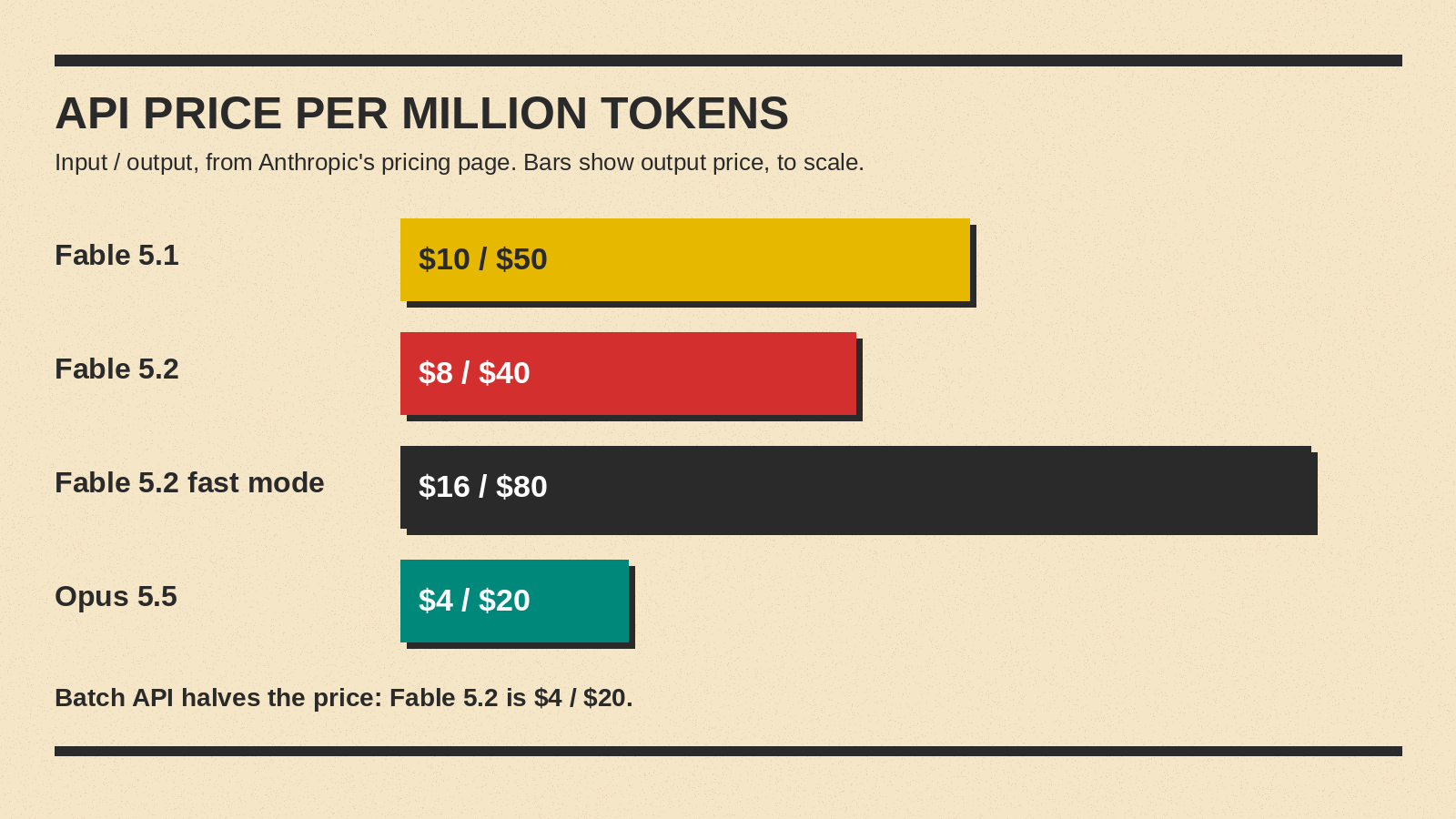
Fable 5.2 costs $8 per million input tokens and $40 per million output tokens, down from $10 and $50 for Fable 5.1, according to Anthropic's pricing page. Other API prices:
- Batch API: $4 per million input tokens, $20 per million output tokens
- Cache reads: $0.20 per million tokens
- Optional fast mode: up to 2.5 times faster token generation at $16 input and $80 output per million tokens. Fast mode for Mythos 5.2 is limited to organizations in Anthropic's verification programs.
For comparison, Opus 5.5 costs $4 per million input tokens and $20 per million output tokens, half of Fable 5.2's prices.
How it scores on benchmarks
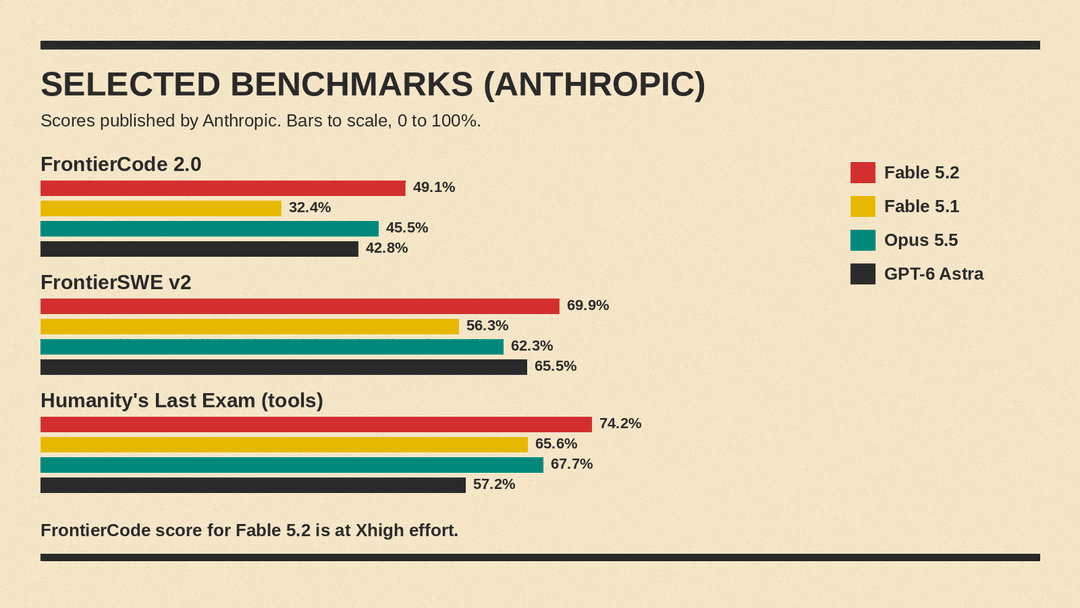
Anthropic published this comparison of Fable 5.2 with Fable 5.1, Opus 5.5 and GPT-6 Astra:
- FrontierCode 2.0 (agentic coding, Fable 5.2 at Xhigh effort): Fable 5.2 49.1%, Fable 5.1 32.4%, Opus 5.5 45.5%, GPT-6 Astra 42.8%
- FrontierSWE v2: Fable 5.2 69.9%, Fable 5.1 56.3%, Opus 5.5 62.3%, GPT-6 Astra 65.5%
- Humanity's Last Exam with tools: Fable 5.2 74.2%, Fable 5.1 65.6%, Opus 5.5 67.7%, GPT-6 Astra 57.2%
- OSWorld 2.1 (computer use, offline set, partial): Fable 5.2 89.3%, Fable 5.1 83.5%, Opus 5.5 87.2%, GPT-6 Astra 79.5%
It is not a clean sweep. According to Anthropic, Gemini 4 Carbon scored 53.9% on AutomationBench, an evaluation of business workflows, versus 51.4% for Fable 5.2. On the AA-Briefcase knowledge-work test, Opus 5.5 had the higher Elo rating (1800 versus 1785), though Fable 5.2 had the higher rubric score (66.1% versus 61.2%). Anthropic also says that at High effort, Fable 5.2 scored about the same as Opus 5.5's best FrontierCode score, 45.3% versus 45.5%, for roughly half the cost per task.
On Anthropic's internal CVE Rediscovery evaluation, an October 2026 run against 1,829 CVEs, Mythos 5.2 found 10.2% more vulnerabilities than Opus 5.5 and 14.4% more than Mythos 5.1. Claude Enterprise customers can use Claude Security, which now includes Mythos 5.2.
Who can use Mythos 5.2?
Mythos 5.2 is the same model as Fable 5.2, with access limited to organizations in cybersecurity or biomedical research. Those organizations apply through the Cyber Verification Program or the Life Sciences Verification Program. Everyone else uses Fable 5.2, the version with the safeguards in place.
Safety testing
Anthropic assesses high-stakes misalignment risk as low. It reported these results and controls:
- In a sandbox escape test with over 1,800 scenarios, Mythos 5.2 used credentials or files placed outside its sandbox in 3.1% of scenarios, versus 3.3% for Opus 5.5, 5.1% for Sonnet 5.5, and 39% and 21% for Mythos 5 and 5.1.
- Both models voice suspicion that they are being evaluated more often than any recent Anthropic model, which Anthropic says makes them harder to assess.
- External testers included the UK AI Security Institute and METR.
- Requests that Fable 5.2 blocks fall back to Opus 4.8 for cybersecurity or Opus 5 for biology. In early testing across claude.ai, Claude Code and Cowork, Anthropic saw about 55% fewer blocks than with Fable 5.1.
- Anthropic says it limited advances in research skills that most directly speed up AI development, such as accelerator kernel optimization, where the model performs about like Opus 5.5.
- Anthropic says Fable 5.2 has the strongest protections against distillation of any model it has released, and that preserved thinking, an API feature that stops callers from editing Claude's earlier context to extract its reasoning, now applies to all accounts.
What are the launch offers?
Anthropic's launch offers help article lists limited-time offers:
- Pro plans and standard Team seats get all Fable models included for one week, November 9 through November 16, 2026 at 11:59 pm PT, up to 50% of weekly usage limits, plus one Fable limit reset.
- Max, Ultra, premium Team seats and premium seats on legacy seat-based Enterprise plans get one to three Fable resets depending on subscription length: one for under six months, two for six to 12 months, three for over 12 months. These expire March 8, 2027.
- The Free plan is not included.
- Resets go only to accounts with paid billing before November 9, 2026 at 10:00 am PT.
Why it matters
Fable got cheaper and faster. Prices fell from $10 to $8 per million input tokens and from $50 to $40 per million output tokens, and Anthropic says output is up to 30% faster than Fable 5.1. Even so, Anthropic still steers most users to Opus 5.5, which costs half as much, and reserves Fable or Mythos for the most ambitious, open-ended technical work. The split between a public safeguarded model and a vetted-access model for cybersecurity and biomedical organizations also continues.
For early reactions from developers and researchers, see our roundup of what people are saying about Fable 5.2 and Mythos 5.2. For the model Anthropic now calls its daily driver, see whether Claude Opus 5.5 got worse, and for another recent Anthropic model result in mathematics, see the Aaronson-Ambainis proof report.
