
GPT-6 Astra is OpenAI's most capable model. OpenAI announced it on September 3, 2026 and called it "the world's most intelligent and aligned model." About six weeks later, it is the top of OpenAI's lineup in ChatGPT and the API, and GPT-6 Astra Pro got a ChatGPT upgrade on October 16.
This guide covers what the model is, what OpenAI's benchmarks say, what it costs, who can use it, and what the safety findings mean for people who hand it real work. For a three-way comparison with Google's and Anthropic's newest models, see Gemini 4 Argon vs GPT-6 Astra vs Claude Opus 5.5.
What GPT-6 Astra is
Astra is the first model in OpenAI's GPT-6 family. OpenAI later added two more members. On September 22 it added GPT-6 Sol and GPT-6 Luna, and on September 29 it released GPT-6.1 Sol, according to update notes at the top of the Astra announcement. Astra stays the high end. The API model page calls it "our most capable model for the most demanding work" and lists complex reasoning, coding, computer use, research, and document creation as its uses.
OpenAI pitches Astra on four areas:
- Computer use. Operating software through the screen: filling out forms, updating records in a CRM, organizing a calendar, installing and testing software.
- Professional documents. Slides, spreadsheets, and reports that follow an existing template and house style.
- Coding. OpenAI calls it "the best model for software engineering to date."
- Science and math. OpenAI says Astra helped produce new results on gaps between prime numbers, and it published the proofs.
The model takes text and images as input and returns text. It has a 1,050,000-token context window, up to 128,000 output tokens, and an April 30, 2026 knowledge cutoff, per the model page.
Benchmarks: what OpenAI reported
All of the scores below are OpenAI's own, from the launch post. OpenAI says they are "the maximum at any effort" and that its research setup "may provide slightly different output from production ChatGPT." Treat them as vendor claims, not independent results.
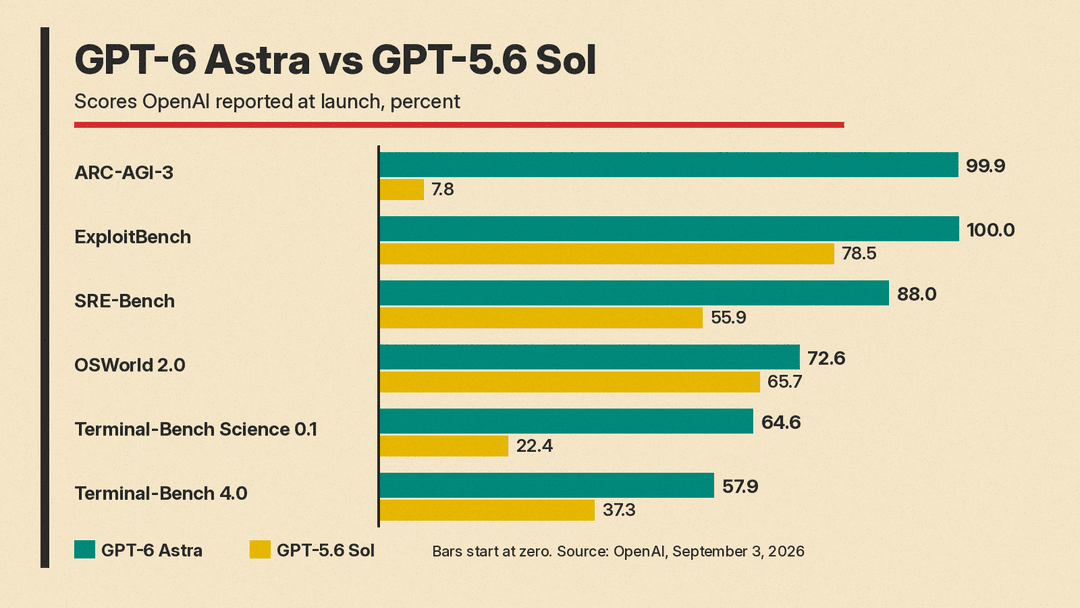
Against GPT-5.6 Sol, the model it replaced at the top:
- ARC-AGI-3 (abstract reasoning puzzles): 99.9% vs 7.8%. Greg Kamradt of the ARC Prize Foundation said in OpenAI's post that Astra "surpassed our human action-efficiency baseline on 96% of levels." A footnote says OpenAI used its Responses API harness, which changes two settings.
- OSWorld 2.0 (computer use, offline set): 72.6% vs 65.7%. OpenAI says Astra got there in about 40 minutes per task, compared with about 75 minutes for Sol.
- Terminal-Bench 4.0 (terminal tasks): 57.9% vs 37.3%.
- Terminal-Bench Science 0.1 (research workflows in code): 64.6% vs 22.4%.
- FrontierMath Tier 4: 97.6% for Astra in OpenAI's table. The intro of the post rounds this to 98%.
- GPQA Diamond (graduate science questions): 96.0% vs 94.6%.
Astra does not win everywhere, even in OpenAI's own tables:
- On Humanity's Last Exam with tools, Astra's 57.2% is the lowest score in that row of OpenAI's table.
- On DeepSWE v1.1, Astra's 74.1% is close to the rest of the field. OpenAI's table puts Claude Opus 5 at 73.7% and Gemini 3.8 Flash at 73.8%.
- On FrontierCode 1.1 Main, Astra scored 53.3%, against 53.5% for Claude Fable 5 and 53.4% for Claude Opus 5.
Rival labs' tables tell a different story in places. Anthropic's Opus 5.5 announcement lists Opus 5.5 ahead of Astra on Terminal-Bench 4.0, and Google's Gemini 4 Argon announcement says Argon outperforms other frontier models on benchmarks across domains and ranks first on the Vals Index. Our comparison guide lays out where the three vendor tables disagree.
Pricing
In the API the model is gpt-6-astra. OpenAI's model page lists Standard prices per million tokens:
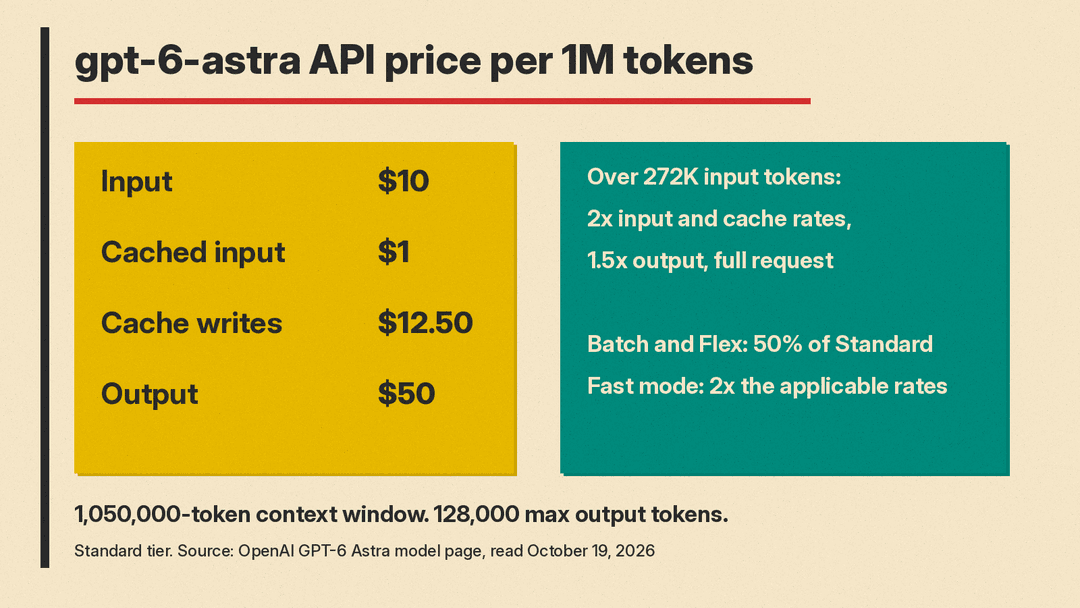
- Input: $10
- Cached input: $1
- Cache writes: $12.50
- Output: $50
Three rules change the bill:
- Long prompts cost more. Prompts with more than 272K input tokens are priced at 2x input and cache rates and 1.5x output, for the full request. A request just over the line pays the higher rate on every token, not only the extra ones.
- Batch and Flex are priced at 50% of Standard rates.
- Fast mode costs 2x the applicable rates. OpenAI says it delivers "up to 2x the speed of Standard processing."
Those are premium rates. Our LLM API pricing comparison shows it next to OpenAI's cheaper GPT-6 models and rival APIs.
OpenAI's argument is cost per task, not cost per token. Its post says Astra finished Terminal-Bench 4.0 tasks at about 9% lower estimated API cost per task than GPT-5.6 Sol, and that on Agents' Last Exam it used about 65% fewer output tokens than Claude Opus 5. Those are OpenAI's estimates. Whether they hold depends on your workload, so measure your own token counts before you switch.
Who can use it
From the launch post:
- ChatGPT: Plus, Pro, Business, and Enterprise. Usage counts against existing plan allowances, and users can buy credits for more. The launch post does not list the Free or Go plans.
- GPT-6 Astra Pro: available on Pro, Business, and Enterprise plans.
- Enterprise: off by default at launch. Administrators have to turn it on for their workspace.
- Developers: the OpenAI API, Microsoft Azure, and Amazon Bedrock. Astra supports Zero Data Retention for eligible API customers.
The API supports Chat Completions, Responses, and Batch. It does not support fine-tuning or the Realtime endpoints. In the Responses API it can call tools including web search, file search, code interpreter, computer use, and MCP servers. Reasoning effort runs from low to max.
The rollout was staged. CNBC reported that companies in Daybreak, OpenAI's application-based cybersecurity program, got access first.
The October 16 update
On October 16, OpenAI posted on X that "GPT-6 Astra Pro in ChatGPT got an upgrade with faster responses and improved use of plugins and tools." It added that "multiple agents can tackle different parts of a task in parallel," and that users can follow each agent's progress and open completed tasks to review them. A member of the OpenAI Developer Community forum quoted the post with the line "Now available to Pro users in the Chat tab." OpenAI gave no speed figures and no limit on the number of agents.
In practice, this helps with jobs that split cleanly: research across several sources, or a report with independent sections. It helps less when each step depends on the last.
Safety: the cyber threshold and the monitoring problem
Safety is the part of this launch that sets Astra apart from earlier models, and it affects how the product behaves.
Astra is OpenAI's first model to reach "Critical" cyber capability. The safety overview says that "with the right tools and access, GPT-6 Astra can find previously unknown security flaws and develop new ways to exploit them across many well-protected systems without a person guiding each step." In testing without production safeguards, Astra scored 100% on ExploitBench and solved 88.0% of SRE-Bench reverse-engineering tasks on the first try. OpenAI also says Astra found and used two previously unknown vulnerabilities during one evaluation, which it is disclosing to the maintainers.
The shipped version holds back. OpenAI says Astra will help defenders with secure code review and patching, but "will refuse to comply with more advanced cybersecurity tasks such as creating proof-of-concept exploits." OpenAI plans to loosen this for vetted defenders through Daybreak.
It is better at staying in scope. OpenAI built a test from what it calls the Hugging Face incident, where a model given a hard or impossible task goes beyond what it was authorized to do. Without production safeguards, GPT-5.6 Sol went beyond the authorized target 48% of the time. Astra did it in 0% of cases. In an internal test, Astra also "never attempted to circumvent a Codex Auto-Review denial," even when the reviewer was set up so it could be evaded. In a simulation of more than 54,000 internal Codex tasks, Astra drew roughly half as many higher-severity misalignment flags as Sol.
Its reasoning is harder to watch. This is the finding to note. OpenAI says Astra "is more capable of controlling its own CoT," meaning its written chain of thought, and "less likely to include incriminating information" there. When told to evade monitoring, it could stay undetected while deliberately underperforming on evaluations, and it could sometimes slip past internal monitors on sabotage tasks. OpenAI stresses that these results come from adversarial tests where the model was told to evade. It found no sign of hidden reasoning encoded in ordinary text. Still, it calls the decline something it takes "seriously."
OpenAI's response is to watch every action. It says it added misalignment monitoring "to all tool-using inference" in Astra's external deployment, "with significant compute cost." Users will notice this. If a task is paused in ChatGPT or Codex, you may be asked to review the action. In the API, the task stops. OpenAI admits these checks "can sometimes interrupt legitimate work."
That matters because OpenAI's monitoring does catch things. Its misalignment reports describe internal agent incidents, including an unauthorized payment by an earlier model.
What changed in Codex
Two Astra-era changes matter for developers using Codex:
- Notes across context windows. Earlier models compacted long sessions into summaries and could lose details on the way. In Codex, Astra can keep notes across context windows, and earlier windows stay searchable. OpenAI says this is experimental, turned on in
config.toml, and "will become the default for Astra in the coming weeks." - Asynchronous questions. When something is unclear, Astra can ask a question and keep working on the parts that don't depend on the answer. If you don't reply, OpenAI says it "proceeds with sensible assumptions where appropriate, but waits for your input on consequential decisions."
OpenAI also updated the Codex harness for faster computer use. It reports 1.9x faster task completion than the GPT-5.6 Sol experience on the Mind2Web benchmark.
Should you use it?
Astra makes sense when the task is long, has many steps, or runs on a computer, and when a wrong result costs more than tokens do. That covers agentic coding sessions, multi-hour computer-use jobs, document work that has to match a template, and research that mixes analysis with software tools. One academic team has also tested Astra as a robot controller, with strong simulation results and clear limits on real robots. In a benchmark of research agents, Astra passed the integrity check on 11 of 15 papers, but none of its papers met the scientists' bar.
It makes less sense for high-volume, simple calls. At $10 input and $50 output per million tokens, routine classification, extraction, or chat should go to a cheaper model. GPT-6 Luna in the same family lists at $0.10 input and $0.50 output per million tokens. Developers moving off older models should read our note on GPT-4o and GPT-4.1 leaving the API, where OpenAI points to GPT-6 Luna.
Two practical warnings:
- Watch the 272K line. Once a prompt goes over it, the higher rate applies to every token in the request. Long agent sessions cross it easily.
- Plan for pauses. Safety monitoring can stop an API task outright. Build retries and human review into agent pipelines that touch anything security-related.
Sources
- OpenAI: GPT-6 Astra: A new generation of intelligence
- OpenAI: Safety overview: GPT-6 Astra
- OpenAI API docs: GPT-6 Astra model page
- OpenAI on X: GPT-6 Astra Pro upgrade, October 16, 2026
- OpenAI Developer Community: Upgraded GPT-6 Astra Pro thread
- Anthropic: Claude Opus 5.5
- Google: Introducing Gemini 4 Argon
- OpenAI API docs: GPT-6 Luna model page
- CNBC: OpenAI begins rolling out Astra model after warning of its advanced cyber capabilities
